Thank you for visiting SNEWPapers!
Sign up free
Rhode Island American, Statesman And Providence Gazette
Providence, Providence County, Rhode Island
What is this article about?
Historical article details experiments and observations on bird flight speeds, including carrier pigeons covering 270 miles in over six hours (45 mph), eider ducks at 90 mph, wild swans at 100 mph, and geese at 25 mph, with evidence from undigested berries in crops suggesting rapid long-distance travel.
Clipping
OCR Quality
Full Text
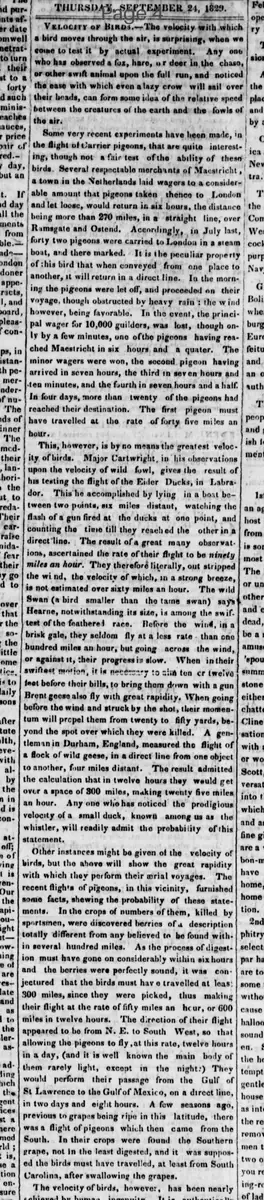
Some very recent experiments have been made, in the flight of Carrier pigeons, that are quite interesting, though not a fair test of the ability of these birds. Several respectable merchants of Maestricht, a town in the Netherlands laid wagers to a considerable amount that pigeons taken thence to London and let loose, would return in six hours, the distance being more than 270 miles, in a straight line, over Ramsgate and Ostend. Accordingly, in July last, forty two pigeons were carried to London in a steam boat, and there marked. It is the peculiar property of this bird that when conveyed from one place to another, it will return in a direct line. In the morning the pigeons were let off, and proceeded on their voyage, though obstructed by heavy rain: the wind however, being favorable. In the event, the principal wager for 10,000 guilders, was lost, though only by a few minutes, one of the pigeons having reached Maestricht in six hours and a quarter. The minor wagers were won, the second pigeon having arrived in seven hours, the third in seven hours and ten minutes, and the fourth in seven hours and a half. In our days, more than twenty of the pigeons had reached their destination. The first pigeon must have travelled at the rate of forty five miles an hour.
This, however, is by no means the greatest velocity of birds. Major Cartwright, in his observations upon the velocity of wild fowl, gives the result of his testing the flight of the Eider Ducks, in Labrador. This he accomplished by lying in a boat between two points, six miles distant, watching the flash of a gun fired at the ducks at one point, and counting the time till they reached the other in a direct line. The result of a great many observations, ascertained the rate of their flight to be ninety miles an hour. They therefore literally, outstripped the wind, the velocity of which, in a strong breeze, is not estimated over sixty miles an hour. The wild Swan (a bird smaller than the tame swan) says Hearne, notwithstanding its size, is among the swiftest of the feathered race. Before the wind, in a brisk gale, they seldom fly at a less rate than one hundred miles an hour, but going across the wind, or against it, their progress is slow. When in their swiftest motion, it is necessary to aim ten or twelve feet before their bills, to bring them down with a gun. Brent geese also fly with great rapidity. When going before the wind and struck by the shot, their momentum will propel them from twenty to fifty yards, beyond the spot over which they were killed. A gentleman in Durham, England, measured the flight of a flock of wild geese, in a direct line from one object to another, four miles distant. The result admitted the calculation that in twelve hours they would get over a space of 300 miles, making twenty five miles an hour. Any one who has noticed the prodigious velocity of a small duck, known among us as the whistler, will readily admit the probability of this statement.
Other instances might be given of the velocity of birds, but the above will show the great rapidity with which they perform their aerial voyages. The recent flights of pigeons, in this vicinity, furnished some facts, showing the probability of these statements. In the crops of numbers of them, killed by sportsmen, were discovered berries of a description totally different from any believed to be found within several hundred miles. As the process of digestion must have gone on considerably within six hours and the berries were perfectly sound, it was conjectured that the birds must have travelled at least 300 miles, since they were picked, thus making their flight at the rate of fifty miles an hour, or 600 miles in twelve hours. The direction of their flight appeared to be from N. E. to South West, so that allowing the pigeons to fly, at this rate, twelve hours in a day, (and it is well known the main body of them rarely light, except in the night:) They would perform their passage from the Gulf of St Lawrence to the Gulf of Mexico, on a direct line, in two days and eight hours. A few seasons ago previous to grapes being ripe in this latitude, there was a flight of pigeons which then came from the South. In their crops were found the Southern grape, not in the least digested, and it was supposed the birds must have travelled, at least from South Carolina, after swallowing the grapes.
The velocity of birds, however, has been nearly achieved by human ingenuity. It is authentically related of Lunardi, the celebrated aeronaut, that on one occasion, he was conveyed in a balloon at the rate of seventy miles an hour, though it was quite calm at Edinburgh, when he descended, and continued so during the voyage. What became of his hair, in the meantime, is not mentioned by the historian.
What sub-type of article is it?
What themes does it cover?
What keywords are associated?
What entities or persons were involved?
Where did it happen?
Story Details
Key Persons
Location
Maestricht, Netherlands; London, England; Labrador; Durham, England; Gulf Of St Lawrence; Gulf Of Mexico; South Carolina; Edinburgh
Event Date
July Last
Story Details
Experiments with carrier pigeons from London to Maestricht show speeds up to 45 mph over 270 miles; observations of eider ducks at 90 mph, wild swans at 100 mph, brent geese with high momentum, and wild geese at 25 mph; undigested berries in pigeons' crops indicate 50 mph flights over 300 miles; comparison to Lunardi's 70 mph balloon flight.