Thank you for visiting SNEWPapers!
Sign up free
The New Hampshire Gazette
Portsmouth, Rockingham County, New Hampshire
What is this article about?
In 1758, amid the Seven Years' War, the Prince Bishop of Breslau wrote to King Frederick of Prussia explaining his departure to Rome due to royal displeasure and Imperial orders. Frederick responded, accusing the bishop of treason for fleeing his post in Silesia during military operations.
Clipping
OCR Quality
Full Text
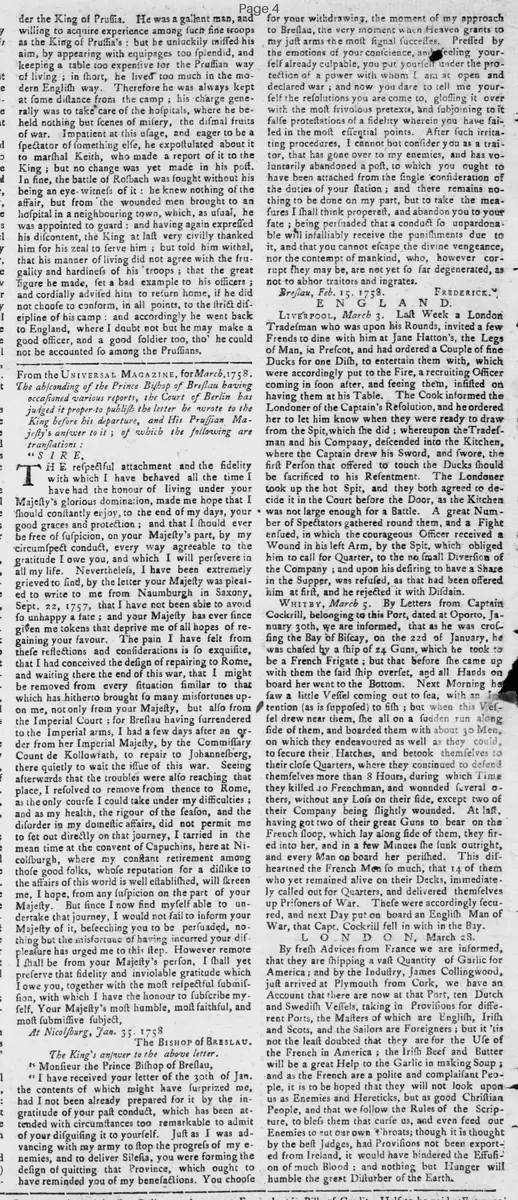
The absconding of the Prince Bishop of Breslau having occasioned various reports, the Court of Berlin has judged it proper to publish the letter he wrote to the King before his departure, and His Prussian Majesty's answer to it; of which the following are translations:
"SIRE,
The respectful attachment and the fidelity with which I have behaved all the time I have had the honour of living under your Majesty's glorious domination, made me hope that I should constantly enjoy, to the end of my days, your good graces and protection; and that I should ever be free of suspicion, on your Majesty's part, by my circumspect conduct, every way agreeable to the gratitude I owe you, and which I will persevere in all my life. Nevertheless, I have been extremely grieved to find, by the letter your Majesty was pleased to write to me from Naumburgh in Saxony, Sept. 22, 1757, that I have not been able to avoid so unhappy a fate; and your Majesty has ever since given me tokens that deprive me of all hopes of regaining your favour. The pain I have felt from these reflections and considerations is so exquisite, that I had conceived the design of repairing to Rome, and waiting there the end of this war, that I might be removed from every situation similar to that which has hitherto brought so many misfortunes upon me, not only from your Majesty, but also from the Imperial Court; for Breslau having surrendered to the Imperial arms, I had a few days after an order from her Imperial Majesty, by the Commissary Count de Kollowrath, to repair to Johanneberg, there quietly to wait the issue of this war. Seeing afterwards that the troubles were also reaching that place, I resolved to remove from thence to Rome, as the only course I could take under my difficulties; and as my health, the rigour of the season, and the disorder in my domestic affairs, did not permit me to set out directly on that journey, I tarried in the mean time at the convent of Capuchins, here at Nicolsburg, where my constant retirement among those good folks, whose reputation for a dislike to the affairs of this world is well established, will screen me, I hope, from any suspicion on the part of your Majesty. But since I now find myself able to undertake that journey, I would not fail to inform your Majesty of it, beseeching you to be persuaded, nothing but the misfortune of having incurred your displeasure has urged me to this step. However remote I shall be from your Majesty's person, I shall yet preserve that fidelity and inviolable gratitude which I owe you, together with the most respectful submission, with which I have the honour to subscribe myself, Your Majesty's most humble, most faithful, and most submissive subject,
At Nicolsburg, Jan. 25, 1758.
The Bishop of Breslau."
The King's answer to the above letter.
To Monsieur the Prince Bishop of Breslau,
"I have received your letter of the 30th of Jan. the contents of which might have surprised me, had I not been already prepared for it by the ingratitude of your past conduct, which has been attended with circumstances too remarkable to admit of your disguising it to yourself. Just as I was advancing with my army to stop the progress of my enemies, and to deliver Silesia, you were forming the design of quitting that Province, which ought to have reminded you of my benefactions. You chose for your withdrawing, the moment of my approach to Breslau, the very moment when Heaven grants to my just arms the most signal success. Pressed by the emotions of your conscience, and feeling yourself already culpable, you put yourself under the protection of a power with whom I am at open and declared war; and now you dare to tell me yourself the resolutions you are come to, glossing it over with the most frivolous pretexts, and subjoining to it false protestations of a fidelity wherein you have failed in the most essential points. After such irritating procedures, I cannot but consider you as a traitor, that has gone over to my enemies, and has voluntarily abandoned a post, to which you ought to have been attached from the single consideration of the duties of your station; and there remains nothing to be done on my part, but to take the measures I shall think properest, and abandon you to your fate; being persuaded that a conduct so unpardonable will infallibly receive the punishments due to it, and that you cannot escape the divine vengeance, nor the contempt of mankind, who, however corrupt they may be, are not yet so far degenerated, as not to abhor traitors and ingrates."
Breslau, Feb. 15, 1758.
FREDERICK.
What sub-type of article is it?
What keywords are associated?
What entities or persons were involved?
Where did it happen?
Foreign News Details
Primary Location
Breslau
Event Date
January 25 To February 15, 1758
Key Persons
Outcome
king frederick accuses the bishop of treason and abandons him to his fate.
Event Details
The Prince Bishop of Breslau, facing Prussian royal displeasure and Imperial orders after Breslau's surrender, explains in a letter from Nicolsburg his plan to flee to Rome to avoid war troubles. King Frederick responds from Breslau, denouncing the Bishop's actions as ingratitude and treason for abandoning his post during Prussian military advances in Silesia.