Thank you for visiting SNEWPapers!
Sign up free
The Daily Phoenix
Columbia, Richland County, South Carolina
What is this article about?
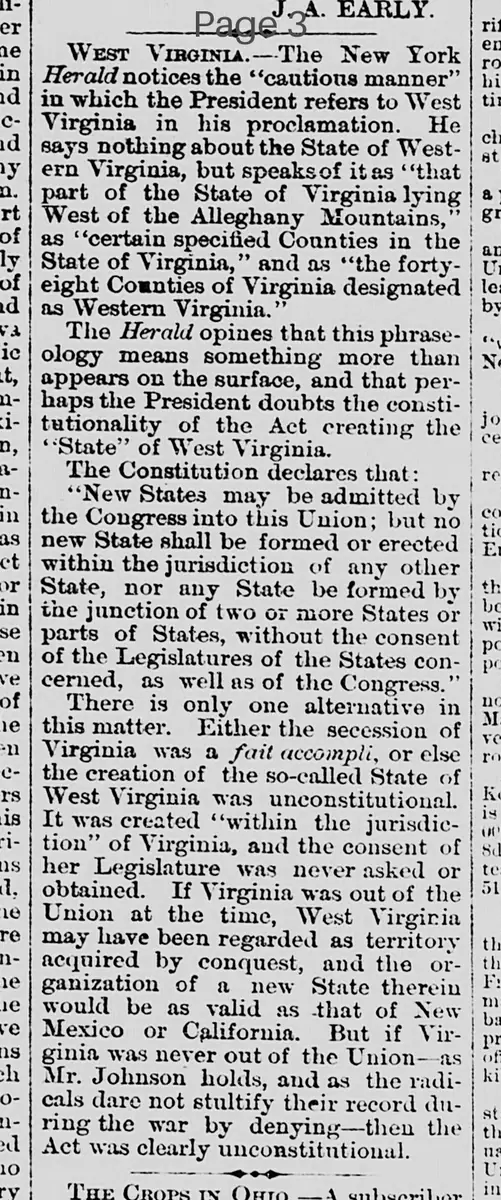
The New York Herald analyzes the President's cautious phrasing in his proclamation about West Virginia, suggesting doubts on its constitutionality. It argues that West Virginia's creation violated the U.S. Constitution without Virginia's consent, unless Virginia's secession is accepted, contrasting views of Mr. Johnson and radicals.
Clipping
OCR Quality
Full Text
The Herald opines that this phraseology means something more than appears on the surface, and that perhaps the President doubts the constitutionality of the Act creating the "State" of West Virginia.
The Constitution declares that: "New States may be admitted by the Congress into this Union; but no new State shall be formed or erected within the jurisdiction of any other State, nor any State be formed by the junction of two or more States or parts of States, without the consent of the Legislatures of the States concerned, as well as of the Congress."
There is only one alternative in this matter. Either the secession of Virginia was a fait accompli, or else the creation of the so-called State of West Virginia was unconstitutional. It was created "within the jurisdiction" of Virginia, and the consent of her Legislature was never asked or obtained. If Virginia was out of the Union at the time, West Virginia may have been regarded as territory acquired by conquest, and the organization of a new State therein would be as valid as that of New Mexico or California. But if Virginia was never out of the Union--as Mr. Johnson holds, and as the radicals dare not stultify their record during the war by denying--then the Act was clearly unconstitutional.
What sub-type of article is it?
What themes does it cover?
What keywords are associated?
What entities or persons were involved?
Where did it happen?
Story Details
Key Persons
Location
West Virginia, Virginia
Story Details
The New York Herald interprets the President's proclamation language as indicating doubts about West Virginia's constitutionality, citing the U.S. Constitution's requirements for new states and arguing that its creation without Virginia's consent was invalid unless Virginia's secession is recognized, contrasting Mr. Johnson's view.