Thank you for visiting SNEWPapers!
Sign up free
Gazette Of The United States & Evening Advertiser
Philadelphia, Philadelphia County, Pennsylvania
What is this article about?
London report on the trial, condemnation, and execution of Jacques-Pierre Brissot and other Girondist deputies in revolutionary France, detailing charges of treason, counter-revolutionary plots, protection of the monarchy, and collaboration with foreign powers during 1792-1793 events.
Clipping
OCR Quality
Full Text
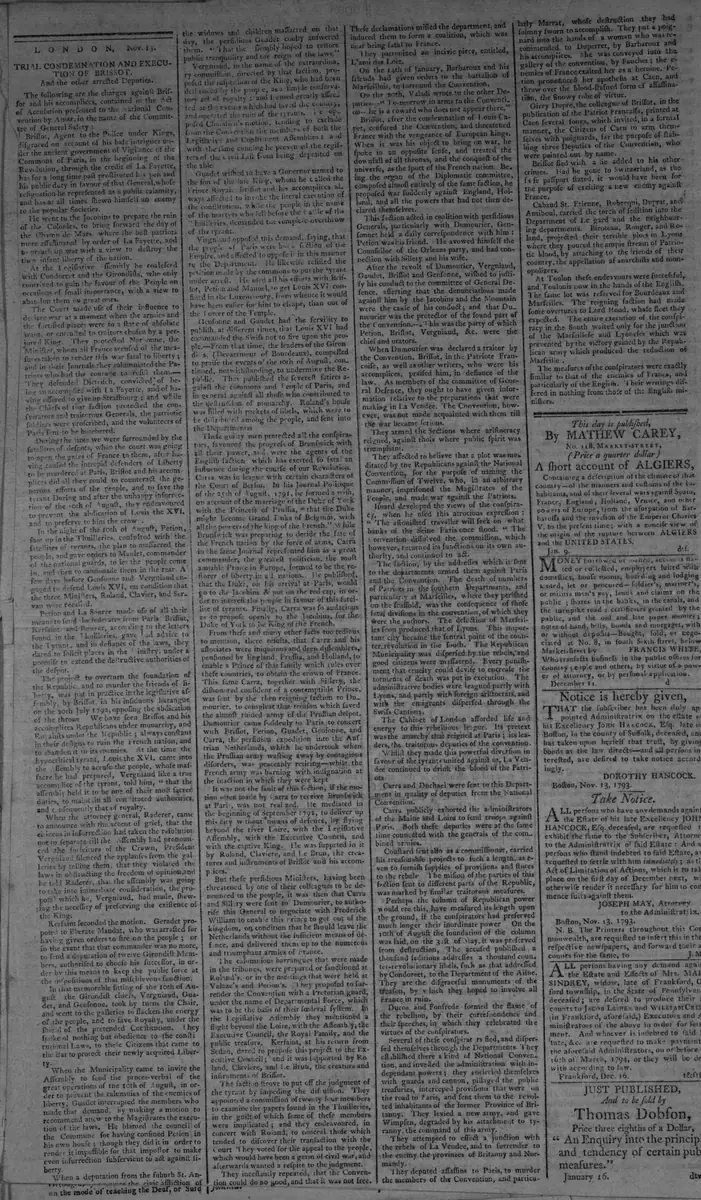
TRIAL, CONDEMNATION AND EXECUTION OF BRISSOT.
And the other arrested Deputies.
The following are the charges against Brissot and his accomplices, contained in the Act of Accusation presented to the national Convention by Amar, in the name of the Committee of General Safety:
Brissot, Agent to the Police under Kings, under the ancient government of Vigilance of the Commons of Paris, in the beginning of the Revolution, through the credit of La Fayette, has for a long time past prostituted his pen and his public duty in favour of that General, whose resignation he represented as a public calamity, and has at all times shewn himself an enemy to the popular Societies.
He went to the Jacobins to prepare the ruin of the Colonies, to bring forward the day of the Champ de Mars, where the best patriots were assassinated by order of La Fayette, and to preach up war with a view to destroy the then infant liberty of the nation.
At the Legislative Assembly he coalesced with Condorcet and the Girondists, who only contrived to gain the favour of the People on occasions of small importance, with a view to abandon them on great ones.
The Court made use of their influence to declare war at a moment when the armies and the fortified places were in a state of absolute want, or entrusted to traitors chosen by a perjured King. They protected Narbonne, the Minister, whom all France accused of the measures taken to render this war fatal to liberty; and in their Journals they calumniated the Patriots who had the courage to resist them.
They defended Dietrich, convicted of being an accomplice with La Fayette, and of having offered to give up Strasbourg; and while the Chiefs of that faction protected the conspirators and traitorous Generals, the patriotic soldiers were proscribed, and the volunteers of Paris sent to be butchered.
During the time we were surrounded by the satellites of despots, when the court was going to open the gates of France to them, after having caused the intrepid defenders of Liberty to be murdered at Paris, Brissot and his accomplices did all they could to counteract the generous efforts of the people, and to save the tyrant. During and after the unhappy insurrection of the 10th of August, they endeavoured to prevent the abdication of Louis the XVI., and to preserve to him the crown.
In the night of the 10th of August, Pétion, shut up in the Thuilleries, consulted with the satellites of tyrants, the plan to massacre the people, and gave orders to Mandat, commander of the national guards, to let the people come in, and then to cannonade them in the rear. A few days before, Gensonné and Vergniaud engaged to defend Louis XVI. on condition that the three Ministers, Roland, Clavière, and Servan were recalled.
Pétion and La Source made use of all their means to send the federates from Paris. Brissot, Kéraint and Reubell, according to the letters found in the Thuilleries, gave bad advice to the Tyrant, and in defiance of the laws, they dared to solicit places in the ministry, under a promise to extend the destructive authorities of the usurper.
The project to overturn the foundation of the Republic, and to murder the friends of liberty, was put in practice in the legislative assembly, by Brissot, in his insidious harangue on the 20th July 1792, opposing the abdication of the throne. We have seen Brissot and his accomplices Republicans under monarchy, and Royalists under the Republic; always constant in their designs to ruin the French nation, and to abandon it to its enemies. At the time the hypocritical tyrant, Louis the XVI. came into the assembly to accuse the people, whose massacre he had prepared, Vergniaud like a true accomplice of the tyrant, told him, "that the assembly held it to be one of their most sacred duties, to maintain all constituted authorities, and consequently that of royalty."
When the attorney general, Roederer, came to announce with the accent of grief, that the citizens in insurrection had taken the resolution not to separate till the Assembly had pronounced the forfeiture of the Crown, President Vergniaud silenced the applauses from the galleries by telling them, that they violated the laws in obstructing the freedom of opinion, and he told Roederer, that the assembly was going to take into immediate consideration, the proposition which he, Vergniaud, had made, shewing the necessity of preserving the existence of the King.
Kéraint seconded the motion. Gérard proposed to liberate Mandat, who was arrested for having given orders to fire on the people; or in the event that that commander was no more, to send a deputation of twelve Girondist Members, authorised to choose his successor, in order by this means to keep the public force at the dispositions of that mischievous faction.
In that memorable sitting of the 10th of August the Girondist chiefs, Vergniaud, Guadet, and Gensonné, took by turns the Chair, and went to the galleries to slacken the energy of the people, and to save Royalty, under the shield of the pretended Constitution. They spoke of nothing but obedience to the constitutional Laws, to these Citizens that came to the Bar to protect their newly acquired Liberty.
When the Municipality came to invite the Assembly to send the proces-verbal of the great operations of the 10th of August, in order to prevent the calumnies of the enemies of liberty, Guadet interrupted the members who made that demand, by making a motion to recommend anew to the Magistrates the execution of the laws. He blamed the council of the Commune for having confined Pétion in his own house; though they did it in order to render it impossible for that impostor to make even insurrection subservient to act against liberty.
When a deputation from the suburb St. Antoine came to present the civic oath, Guadet interrupted them. [Note: garbled lines omitted]
the widows and children massacred on that day, the perfidious Guadet coolly answered, "that this assembly hoped to restore public tranquillity and the reign of the laws."
Vergniaud, in the name of the extraordinary committee, directed by that faction, proposed the suspension of the King, who had been dethroned by the people, as a simple conservatory act of royalty: and seemed greatly affected at the events which had saved the country, and operated the ruin of the tyrants. He opposed Choderlos's motion, tending to exclude from the Convention the members of both the Legislative and Constituent Assemblies: and with the same cunning he prevented the registers of the Civil List from being deposited on the table.
Guadet wished to have a Governor named to the son of the late King, whom he called the Prince Royal. Brissot and his accomplices always affected to invoke the literal execution of the constitution, while the people in the name of the martyrs who fell before the castle of the Thuilleries, demanded the complete overthrow of the tyrant.
Vergniaud opposed this demand, saying, that the people of Paris were but a section of the Empire, and affected to oppose it in this manner to the Department. He likewise resisted the petition made by the commons to put the tyrant under arrest. He used all his efforts with Brissot, Pétion and Manuel, to get Louis XVI. confined in the Luxembourg, from whence it would have been easier for him to escape, than out of the Tower of the Temple.
Gensonné and Guadet had the servility to publish, at different times, that Louis XVI had commanded the Swiss not to fire upon the people.--From that time, the leaders of the Girondists, (Department of Bordeaux), compelled to praise the events of the 10th of August, continued, notwithstanding, to undermine the Republic. They published the severest satires against the commons and People of Paris, and in general against all those who contributed to the destruction of monarchy. Roland's house was filled with packets of libels, which were to be distributed among the people, and sent into the Departments.
These guilty men protected all the conspirators, favoured the progress of Brunswick with all their power, and were the agents of the English faction which has exerted so fatal an influence during the course of our Revolution.
Carra was in league with certain characters of the Court of Berlin. In his Journal Politique of the 25th of August, 1791, he formed a wish, on account of the marriage of the Duke of York with the Princess of Prussia, "that the Duke might become Grand Duke of Belgium, with all the powers of the king of the French." while Brunswick was preparing to decide the fate of the French nation by the force of arms, Carra in the same Journal represented him as a great commander, the greatest politician, the most amiable Prince in Europe, formed to be the restorer of liberty in all nations. He published, that the Duke, on his arrival at Paris, would go to the Jacobins & put on the red cap, in order to interest the people in favour of this satellite of tyrants. Finally, Carra was so audacious as to propose openly to the Jacobins, for the Duke of York to be King of the French.
From these and many other facts too tedious to mention, there results, that Carra and his associates were iniquitous and deep dissemblers, pensioned by England, Prussia, and Holland, to enable a Prince of that family which rules over these countries, to obtain the crown of France.
This same Carra, together with Sillery, the dishonored confident of a contemptible Prince, was sent by the then reigning faction to Dumouriez, to complete that treason which saved the almost ruined army of the Prussian despot.
Dumourier came suddenly to Paris to concert with Brissot, Pétion, Guadet, Gensonné, and Carra, the perfidious expedition into the Austrian Netherlands, which he undertook when the Prussian army wasting away by contagious disorders, was peaceably retiring-while the French army was burning with indignation at the inaction in which they were kept.
It was not the fault of this faction, if the motion often made by Carra to receive Brunswick at Paris, was not realized. He meditated in the beginning of September 1792, to deliver up this city without means of defence, by flying beyond the river Loire, with the Legislative Assembly, with the Executive Council, and with the captive King. He was supported in it by Roland, Clavière, and Le Brun, the creatures and instruments of Brissot and his accomplices.
But these perfidious Ministers, having been threatened by one of their colleagues to be denounced to the people, it was then that Carra and Sillery were sent to Dumourier, to authorize this General to negotiate with Frederick William to enable this Prince to get out of the kingdom, on condition that he should leave the Netherlands without the sufficient means of defence, and delivered them up to the numerous and triumphant armies of France.
The calumnious harangues that were made in the tribunes, were prepared or sanctioned at Roland's, or in the meetings that were held at Valazé's and Pétion's. They proposed to surround the Convention with a Pretorian guard, under the name of Departmental Force, which was to be the basis of their federal system. In the Legislative Assembly they mentioned a flight beyond the Loire, with the Assembly, the Executive Council, the Royal Family, and the public treasure. Kéraint, at his return from Sedan, dared to propose this project to the Executive Council; and it was supported by Roland, Clavière, and Le Brun, the creatures and instruments of Brissot.
The faction strove to put off the judgment of the tyrant by impeding the diffusion. They appointed a commission of twenty four members to examine the papers found in the Thuilleries, in the guilt of which some of these members were implicated; and they endeavoured, in concert with Roland, to conceal those which tended to discover their transaction with the Court. They voted for the appeal to the people, which would have been a germ of civil war, and afterwards wanted a respite to the judgment. They incessantly repeated, that the Convention could do no good, and that it was not free.
These declamations misled the department, and induced them to form a coalition, which was near being fatal to France.
They patronized an incivic piece, entitled L'ami des Loix.
On the 14th of January, Barbaroux and his friends had given orders to the battalion of Marseillois to surround the Convention.
On the 20th, Valazé wrote to the other Deputies- "To-morrow in arms to the Convention- he is a coward who does not appear there."
Brissot, after the condemnation of Louis Capet, censured the Convention, and threatened France with the vengeance of European kings.
When it was his object to bring on war, he spoke in an opposite sense, and treated the downfall of all thrones, and the conquest of the universe, as the sport of the French nation. Being the organ of the Diplomatic committee, composed almost entirely of the same faction, he proposed war suddenly against England, Holland, and all the powers that had not then declared themselves.
This faction acted in coalition with perfidious Generals, particularly with Dumourier. Gensonné held a daily correspondence with him: Pétion was his friend. He avowed himself the Counsellor of the Orleans party, and had connection with Sillery and his wife.
After the revolt of Dumourier, Vergniaud, Guadet, Brissot and Gensonné, wished to justify his conduct to the committee of General Defence, asserting that the denunciations made against him by the Jacobins and the Mountain were the cause of his conduct; and that Dumourier was the protector of the sound part of the Convention.--This was the party of which Pétion, Brissot, Vergniaud, &c. were the chiefs and orators.
When Dumourier was declared a traitor by the Convention, Brissot, in the Patriote François, as well as other writers, who were his accomplices, praised him, in defiance of the law. As members of the committee of General Defence, they ought to have given information relative to the preparations that were making in La Vendée. The Convention, however, was not made acquainted with them till the war became serious.
They armed the Sections where aristocracy reigned, against those where public spirit was triumphant.
They affected to believe that a plot was meditated by the Republicans against the National Convention, for the purpose of naming the Commission of Twelve, who, in an arbitrary manner, imprisoned the Magistrates of the People, and made war against the Patriots.
Barrère developed the views of the conspiracy, when he used this atrocious expression: "The astonished traveller will seek on what banks of the Seine Paris once stood." The Convention dissolved the commission, which however, resumed its functions on its own authority, and continued to act.
The action, by the address which it sent to the departments armed them against Paris and the Convention. The death of numbers of Patriots in the southern Departments, and particularly at Marseilles, where they perished on the scaffold, was the consequence of those fatal divisions in the convention, of which they were the authors. The defection of Marseilles soon produced that of Lyons. This important city became the central point of the counter-revolution in the south. The Republican Municipality was dispersed by the rebels, and good citizens were massacred. Every punishment that cruelty could devise to increase the torments of death was put in execution. The administrative bodies were leagued partly with Lyons, and partly with foreign aristocrats, and with the emigrants dispersed through the Swiss Cantons.
The Cabinet of London afforded life and energy to this rebellious league. Its pretext was the anarchy that reigned at Paris; its leaders, the traitorous deputies of the convention.
Whilst they made this powerful diversion in favour of the tyrants united against us, La Vendée continued to drink the blood of the Patriots.
Carra and Duchatel were sent to this Department in quality of deputies from the National Convention. Carra publicly exhorted the administrators of the Maine and Loire to send troops against Paris. Both these deputies were at the same time connected with the generals of the combined armies.
Coustard sent also as a commissioner, carried his treasonable projects to such a length, as even to furnish supplies of provisions and stores to the rebels. The mission of the parties of this faction sent to different parts of the Republic, was marked by similar traitorous measures.
Perhaps the column of Republican power would ere this, have measured its length upon the ground, if the conspirators had preserved much longer their inordinate power. On the 10th of August the foundation of the column was laid, on the 31st of May, it was preserved from destruction. The accused published, a thousand seditious addresses a thousand counter-revolutionary libels, such as that addressed by Condorcet, to the Department of the Aisne.
They are the disgraceful monuments of the treason, by which they hoped to involve all France in ruin.
Ducos and Fonfrède formed the flame of the rebellion, by their correspondence and their speeches, in which they celebrated the virtues of the conspirators.
Several of these conspirators fled, and dispersed themselves through the Departments. They established there a kind of National Convention, and invested the administration with independent powers; they encircled themselves with guards and cannon, pillaged the public treasuries, intercepted provisions that were on the road to Paris, and sent them to the revolted inhabitants of the former Province of Brittany. They levied a new army, and gave Wimpfen, degraded by his attachment to tyranny, the command of this army.
They attempted to effect a junction with the rebels of La Vendée, and to surrender to the enemy, the provinces of Brittany and Normandy.
They deputed again to Paris, to murder the members of the Convention, and particularly Marat, whose destruction they had solemnly sworn to accomplish. They put a poniard into the hands of a woman who was recommended to Duperré, by Barbaroux and his accomplices. she was conveyed into the gallery of the convention, by Fauchet; the enemies of France exalted her as a heroine. Pétion pronounced her apotheosis at Caen, and threw over the blood-stained form of assassination, the snowy robe of virtue.
publication of the Patriot François, printed at Caen by Girey Dupré, the colleague of Brissot, in the Caen several songs, which invited, in a formal manner, the Citizens of Caen to arm themselves with poniards, for the purpose of stabbing three Deputies of the Convention, who were pointed out by name.
Brissot fled with a lie added to his other crimes. Had he gone to Switzerland, as the false passport stated, it would have been for the purpose of exciting a new enemy against France.
Cabaud St. Etienne, Robespierre, Durrat, and Antiboul, carried the torch of sedition into the Department of Le Gard and the neighbouring departments. Brissotins, Rouget, and Roland, projected their terrible plots in Lyons where they poured the ample stream of Patriotic blood, by attaching to the friends of their country, the appellation of anarchists and monopolizers.
At Toulon these endeavours were successful, and Toulon is now in the hands of the English. The same lot was reserved for Bordeaux and Marseilles. The reigning faction had made some overtures to Lord Hood, whose fleet they expected. The entire execution of the conspiracy in the South waited only for the junction of the Marseillese and Lyonese which was prevented by the victory gained by the Republican army which produced the reduction of Marseilles.
The measures of the conspirators were exactly similar to that of the enemies of France, and particularly of the English. Their writings differed in nothing from those of the English ministers.
What sub-type of article is it?
What keywords are associated?
What entities or persons were involved?
Where did it happen?
Foreign News Details
Primary Location
Paris
Event Date
As Reported Nov. 13
Key Persons
Outcome
trial, condemnation, and execution of brissot and other arrested deputies for treason; mentions massacres, rebellions in lyons, marseilles, la vendée, and toulon falling to english.
Event Details
Detailed charges from the Act of Accusation by Amar against Brissot and Girondist accomplices for counter-revolutionary activities, including protecting the monarchy, plotting against the Republic, collaborating with foreign powers, inciting rebellions in departments, and undermining the Revolution from 1791-1793.