Thank you for visiting SNEWPapers!
Sign up free
Editorial
March 8, 1887
Alexandria Gazette
Alexandria, Alexandria County, District Of Columbia
What is this article about?
Editorial praises New York railroad commissioners for three years of defending Erie Canal against discriminatory rail practices that penalize canal shippers with higher winter rates, urging Legislature to pass a bill fining such discrimination to prevent monopoly and ensure fair competition for merchants.
Clipping
OCR Quality
95%
Excellent
Full Text
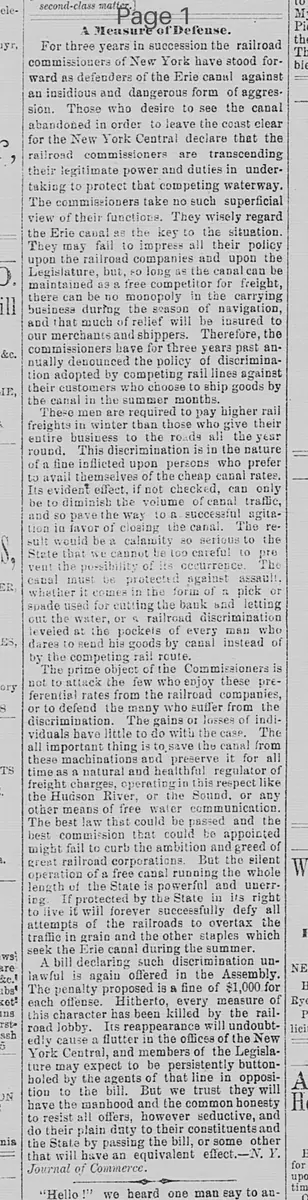
A Measure of Defense.
For three years in succession the railroad commissioners of New York have stood forward as defenders of the Erie canal against an insidious and dangerous form of aggression. Those who desire to see the canal abandoned in order to leave the coast clear for the New York Central declare that the railroad commissioners are transcending their legitimate power and duties in undertaking to protect that competing waterway. The commissioners take no such superficial view of their functions. They wisely regard the Erie canal as the key to the situation. They may fail to impress all their policy upon the railroad companies and upon the Legislature. but, so long as the canal can be maintained as a free competitor for freight, there can be no monopoly in the carrying business during the season of navigation, and that much of relief will be insured to our merchants and shippers. Therefore, the commissioners have for three years past annually denounced the policy of discrimination adopted by competing rail lines against their customers who choose to ship goods by the canal in the summer months.
These men are required to pay higher rail freights in winter than those who give their entire business to the roads all the year round. This discrimination is in the nature of a fine inflicted upon persons who prefer to avail themselves of the cheap canal rates. Its evident effect. if not checked, can only be to diminish the volume of canal traffic, and so pave the way to a successful agitation in favor of closing the canal. The result would be a calamity so serious to the State that we cannot be too careful to prevent the possibility of its occurrence. The canal must be protected against assault. whether it comes in the form of a pick or spade used for cutting the bank and letting out the water, or a railroad discrimination leveled at the pockets of every man who dares to send his goods by canal instead of by the competing rail route.
The prime object of the Commissioners is not to attack the few who enjoy these preferential rates from the railroad companies, or to defend the many who suffer from the discrimination. The gains or losses of individuals have little to do with the case. The all important thing is to save the canal from these machinations and preserve it for all time as a natural and healthful regulator of freight charges. operating in this respect like the Hudson River, or the Sound. or any other means of free water communication.
The best law that could be passed and the best commission that could be appointed might fail to curb the ambition and greed of great railroad corporations. But the silent operation of a free canal running the whole length of the State is powerful and unerring. If protected by the State in its right to live it will forever successfully defy all attempts of the railroads to overtax the traffic in grain and the other staples which seek the Erie canal during the summer.
A bill declaring such discrimination unlawful is again offered in the Assembly. The penalty proposed is a fine of $1,000 for each offense. Hitherto, every measure of this character has been killed by the railroad lobby. Its reappearance will undoubtedly cause a flutter in the offices of the New York Central, and members of the Legislature may expect to be persistently button-holed by the agents of that line in opposition to the bill. But we trust they will have the manhood and the common honesty to resist all offers, however seductive, and do their plain duty to their constituents and the State by passing the bill, or some other that will have an equivalent effect.--N. Y. Journal of Commerce.
For three years in succession the railroad commissioners of New York have stood forward as defenders of the Erie canal against an insidious and dangerous form of aggression. Those who desire to see the canal abandoned in order to leave the coast clear for the New York Central declare that the railroad commissioners are transcending their legitimate power and duties in undertaking to protect that competing waterway. The commissioners take no such superficial view of their functions. They wisely regard the Erie canal as the key to the situation. They may fail to impress all their policy upon the railroad companies and upon the Legislature. but, so long as the canal can be maintained as a free competitor for freight, there can be no monopoly in the carrying business during the season of navigation, and that much of relief will be insured to our merchants and shippers. Therefore, the commissioners have for three years past annually denounced the policy of discrimination adopted by competing rail lines against their customers who choose to ship goods by the canal in the summer months.
These men are required to pay higher rail freights in winter than those who give their entire business to the roads all the year round. This discrimination is in the nature of a fine inflicted upon persons who prefer to avail themselves of the cheap canal rates. Its evident effect. if not checked, can only be to diminish the volume of canal traffic, and so pave the way to a successful agitation in favor of closing the canal. The result would be a calamity so serious to the State that we cannot be too careful to prevent the possibility of its occurrence. The canal must be protected against assault. whether it comes in the form of a pick or spade used for cutting the bank and letting out the water, or a railroad discrimination leveled at the pockets of every man who dares to send his goods by canal instead of by the competing rail route.
The prime object of the Commissioners is not to attack the few who enjoy these preferential rates from the railroad companies, or to defend the many who suffer from the discrimination. The gains or losses of individuals have little to do with the case. The all important thing is to save the canal from these machinations and preserve it for all time as a natural and healthful regulator of freight charges. operating in this respect like the Hudson River, or the Sound. or any other means of free water communication.
The best law that could be passed and the best commission that could be appointed might fail to curb the ambition and greed of great railroad corporations. But the silent operation of a free canal running the whole length of the State is powerful and unerring. If protected by the State in its right to live it will forever successfully defy all attempts of the railroads to overtax the traffic in grain and the other staples which seek the Erie canal during the summer.
A bill declaring such discrimination unlawful is again offered in the Assembly. The penalty proposed is a fine of $1,000 for each offense. Hitherto, every measure of this character has been killed by the railroad lobby. Its reappearance will undoubtedly cause a flutter in the offices of the New York Central, and members of the Legislature may expect to be persistently button-holed by the agents of that line in opposition to the bill. But we trust they will have the manhood and the common honesty to resist all offers, however seductive, and do their plain duty to their constituents and the State by passing the bill, or some other that will have an equivalent effect.--N. Y. Journal of Commerce.
What sub-type of article is it?
Infrastructure
Economic Policy
Trade Or Commerce
What keywords are associated?
Erie Canal
Railroad Discrimination
Freight Rates
Canal Protection
New York Central
Legislative Bill
What entities or persons were involved?
Erie Canal
New York Railroad Commissioners
New York Central
Legislature
Railroad Lobby
Editorial Details
Primary Topic
Defense Of Erie Canal Against Railroad Discrimination
Stance / Tone
Supportive Of Canal Protection And Anti Discrimination Legislation
Key Figures
Erie Canal
New York Railroad Commissioners
New York Central
Legislature
Railroad Lobby
Key Arguments
Railroad Commissioners Defend Erie Canal As Key To Preventing Freight Monopoly
Discrimination Imposes Higher Winter Rail Rates On Canal Users
Such Practices Diminish Canal Traffic And Pave Way For Abandonment
Canal Serves As Natural Regulator Of Freight Charges Like Hudson River
Bill To Fine Railroads $1,000 Per Discrimination Offense Should Pass Despite Lobby Opposition