Thank you for visiting SNEWPapers!
Sign up free
Gazette Of The United States And Daily Evening Advertiser
Philadelphia, Philadelphia County, Pennsylvania
What is this article about?
In the House of Commons on July 10, Mr. Sheridan criticizes the war against France, allies' failures, Prussian subsidy, and Anglo-American tensions, proposing motions for information and against prorogation. Mr. Pitt defends the war's objectives and rejects the motions.
Merged-components note: These three components form a single continuous article reporting on parliamentary intelligence from London, spanning across page 2 and page 3.
Clippings
1 of 2
OCR Quality
Full Text
LONDON, July
PARLIAMENTARY INTELLIGENCE.
HOUSE OF COMMONS.
Thursday, July 10.
THE WAR.
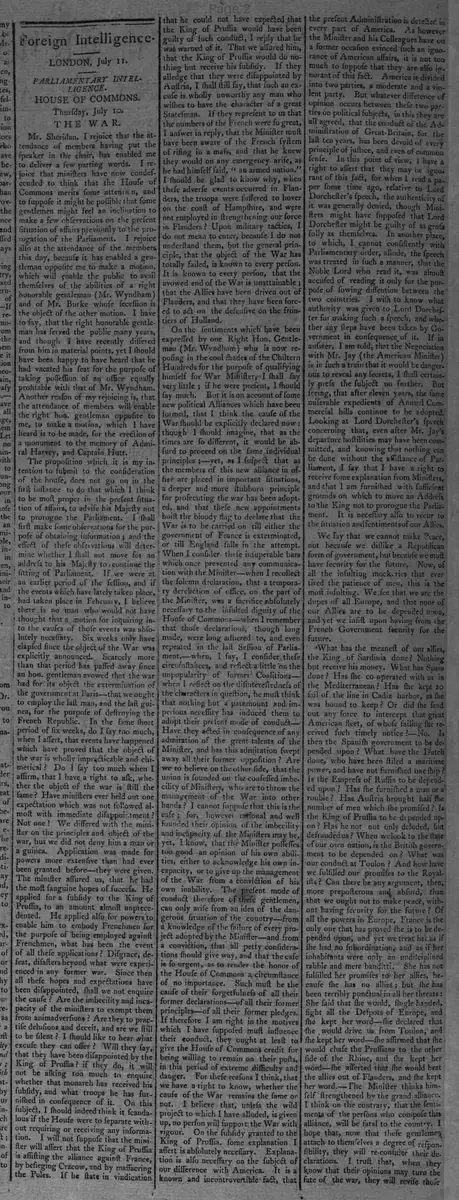
Mr. Sheridan. I rejoice that the attendance of members having put the Speaker in the chair, has enabled me to deliver a few parting words. I rejoice that ministers have now condescended to think that the House of Commons merits some attention, and to suppose it might be possible that some gentlemen might feel an inclination to make a few observations on the present situation of affairs previously to the prorogation of the Parliament. I rejoice also at the attendance of the members this day, because it has enabled a gentleman opposite me to make a motion, which will enable the public to avail themselves of the abilities of a right honorable gentleman (Mr. Wyndham) and of Mr. Burke whose secession is the object of the other motion. I have to say, that the right honorable gentleman has served the public many years, and though I have recently differed from him in material points, yet I should have been happy to have heard that he had vacated his seat for the purpose of taking possession of an office equally profitable with that of Mr. Wyndham. Another reason of my rejoicing is, that the attendance of members will enable the right hon. gentleman opposite to me, to make a motion, which I have heard is to be made, for the erection of a monument to the memory of Admiral Harvey, and Captain Hutt.
The proposition which it is my intention to submit to the consideration of the house, does not go on in the first instance to do that which I think to be most proper in the present situation of affairs, to advise his Majesty not to prorogue the Parliament. I shall first make some observations for the purpose of obtaining information; and the effect of these observations will determine whether I shall not move for an address to his Majesty to continue the sitting of Parliament. If we were at an earlier period of the session, and if the events which have lately taken place, had taken place in February, I believe there is no man who would not have thought that a motion for inquiring into the causes of those events was absolutely necessary. Six weeks only have elapsed since the object of the War was explicitly announced. Scarcely more than that period has passed away since an hon. gentleman avowed that the war had for its object the extermination of the government at Paris—that we ought to employ the last man, and the last guinea, for the purpose of destroying the French Republic. In the same short period of six weeks, do I say too much, when I assert, that events have happened which have proved that the object of the war is wholly impracticable and chimerical? Do I say too much when I affirm, that I have a right to ask, whether the object of the war is still the same? Have ministers ever held out one expectation which was not followed almost with immediate disappointment? Not one! We differed with the minister on the principles and object of the war, but we did not deny him a man or a guinea. Application was made for powers more extensive than had ever been granted before—they were given. The minister assured us, that he had the most sanguine hopes of success. He applied for a subsidy to the King of Prussia, to an amount almost unprecedented. He applied also for powers to enable him to embody Frenchmen for the purpose of being employed against Frenchmen, what has been the event of all these applications? Disgrace, defeat, disasters beyond what were experienced in any former war. Since then all these hopes and expectations have been disappointed, shall we not enquire the cause? Are the imbecility and incapacity of the ministers to exempt them from animadversions? Are they to practice delusions and deceit, and are we still to be silent? I should like to hear what excuse they can offer? Will they say, that they have been disappointed by the King of Prussia? if they do, it will not be asking too much to enquire whether that monarch has received his subsidy, and what troops he has furnished in consequence of it. On this subject, I should indeed think it scandalous if the House were to separate without requiring or receiving any information. I will not suppose that the minister will assert that the King of Prussia is assisting the alliance against France, by besieging Cracow, and by massacring the Poles. If he state in vindication that he could not have expected that the King of Prussia would have been guilty of such conduct, I reply that he was warned of it. That we assured him, that the King of Prussia would do nothing but receive his subsidy. If they allege that they were disappointed by Austria, I shall still say, that such an excuse is wholly unworthy any man who wishes to have the character of a great Statesman. If they represent to us that the numbers of the French were so great, I answer in reply, that the Minister must have been aware of the French system of rising in a mass, and that he knew they would on any emergency arise, as he had himself said, "an armed nation."
I should be glad to know why, when these adverse events occurred in Flanders, the troops were suffered to hover on the coast of Hampshire, and were not employed in strengthening our force in Flanders? Upon military tactics, I do not mean to enter, because I do not understand them, but the general principle, that the object of the War has totally failed, is known to every person. It is known to every person, that the avowed end of the War is unattainable; that the Allies have been driven out of Flanders, and that they have been forced to act on the defensive on the frontiers of Holland.
On the sentiments which have been expressed by one Right Hon. Gentleman (Mr. Wyndham) who is now reposing in the cool shades of the Chiltern Hundreds for the purpose of qualifying himself for War Minister, I shall say very little; if he were present, I should say much. But it is on account of some new political Alliances which have been formed, that I think the cause of the War should be explicitly declared now: though I should imagine, that as the times are so different, it would be absurd to proceed on the same individual principles;—yet, as I suspect that as the members of this new alliance in office are placed in important situations, a deeper and more stubborn principle for prosecuting the war has been adopted, and that these new appointments hoist the bloody flag to declare that the War is to be carried on till either the government of France is exterminated, or till England falls in the attempt.
When I consider these insuperable barriers which once prevented any communication with the Minister—when I recollect the solemn declaration, that a temporary dereliction of office, on the part of the Minister, was a sacrifice absolutely necessary to the insulted dignity of the House of Commons—when I remember that those declarations, though long made, were long adhered to, and even repeated in the last Session of Parliament,—when, I say, I consider, these circumstances, and reflect a little on the unpopularity of former Coalitions—when I reflect on the disinterestedness of the characters in question, he must think that nothing but a paramount and imperious necessity has induced them to adopt their present mode of conduct. Have they acted in consequence of any admiration of the great talents of this Minister, and has this admiration swept away all their former opposition? Are we to believe on the other side, that the union is founded on the confessed imbecility of Ministers, who are to throw the management of the War into other hands? I cannot suppose that this is the case; for, however rational and well founded their opinion of the imbecility and incapacity of the Ministers may be, yet, I know, that the Minister possesses too good an opinion of his own abilities, either to acknowledge his own incapacity, or to give up the management of the War from a conviction of his own inability. The present mode of conduct therefore of these gentlemen, can only arise from an idea of the dangerous situation of the country—from a knowledge of the failure of every project adopted by the Minister—and from a conviction, that all petty considerations should give way, and that the case is so urgent, as to render the honor of the House of Commons' a circumstance of no importance. Such must be the cause of their forgetfulness of all their former declarations of all their former principles—of all their former pledges.
If therefore I am right in the motives which I have supposed must influence their conduct, they ought at least to give the House of Commons credit for being willing to remain on their posts, in this period of extreme difficulty and danger. For these reasons I think, that we have a right to know, whether the cause of the War remains the same or not. I believe that, unless the wild project to which I have alluded, is given up, no person will support the War with vigour. On the subsidy granted to the King of Prussia. some explanation I assert is absolutely necessary. Explanation is also necessary on the subject of our difference with America. It is a known and incontrovertible fact, that the present Administration is detested in every part of America, As however the Minister and his Colleagues have on a former occasion evinced such an ignorance of American affairs, it is not too much to suppose that they are also ignorant of this fact. America is divided into two parties, a moderate and a violent party. But whatever difference of opinion occurs between these two parties on political subjects, in this they are all agreed, that the conduct of the Administration of Great Britain, for the last ten years, has been devoid of every principle of justice, and even of common sense. In this point of view, I have a right to assert that they may be ignorant of this fact, for when I read a paper some time ago, relative to Lord Dorchester's speech, the authenticity of it was generally denied, though Ministers might have supposed that Lord Dorchester might be guilty of as gross folly as themselves. In another place, to which, I cannot consistently with Parliamentary order, allude, the speech was treated in such a manner, that the Noble Lord who read it, was almost accused of reading it only for the purpose of sowing dissension between the two countries. I wish to know what authority was given to Lord Dorchester for making such a speech, and whether any steps have been taken by Government in consequence of it. If in answer, I am told, that the Negociation with Mr. Jay (the American Minister) is in such a train that it would be dangerous to reveal any secrets, I shall certainly press the subject no further. But seeing, that after eleven years, the same miserable expedients of Annual Commercial bills continue to be adopted. Looking at Lord Dorchester's speech concerning that, even after Mr. Jay's departure hostilities may have been commenced, and knowing that nothing can be done without the assistance of Parliament, I say that I have a right to receive some explanation from Ministers, and that I am furnished with sufficient grounds on which to move an Address to the King not to prorogue the Parliament. It is necessary also to recur to the situation and sentiments of our Allies. We say that we cannot make Peace, not because we dislike a Republican form of government, but because we must have security for the future. Now, of all the insulting mockeries that ever tried the patience of men, this is the most insulting. We see that we are the dupes of all Europe, and that none of our Allies are to be depended upon, and yet we insist upon having from the French Government security for the future.
What has the meanest of our allies, the King of Sardinia done? Nothing but receive his money. What has Spain done? Has he co-operated with us in the Mediterranean? Has She kept 20 sail of the line in Cadiz harbor, as he was bound to keep? Or did she send out any force to intercept that great American fleet, of whose sailing he received such timely notice? No. Is then the Spanish government to be depended upon? What have the Dutch done, who have been styled a maritime power, and have not furnished one ship? Is the Empress of Russia to be depended upon? Has she furnished a man or a rouble? Has Austria brought half the number of men which he promised? Is the King of Prussia to be depended upon? Has he not not only deluded, but defrauded us? When we look to the state of our own nation, is the British government to be depended on? What was our conduct at Toulon? And how have we fulfilled our promises to the Royalists? Can there be any argument, then, more preposterous and absurd, than that we ought not to make peace, without having security for the future? Of all the powers in Europe, France is the only one that has proved she is to be depended upon, and yet we treat her as if she had no subordination, and as if her inhabitants were only an undisciplined rabble and mere banditti. She has not fulfilled her promises to her allies, because she has no allies: but she has been terribly punctual in all her threats: She said that she would, single handed, fight all the Despots of Europe, and she kept her word—she declared that she would drive us from Toulon, and she kept her word—she affirmed that she would chase the Prussians to the other side of the Rhine. and she kept her word she asserted that she would beat the allies out of Flanders. and she kept her word.—The Minister thinks himself strengthened by the grand alliance. I think on the contrary, that the sentiments of the persons who compose this alliance, will be fatal to the country. I hope that, now that these gentlemen attach to themselves a degree of responsibility, they will re-consider their declarations. I trust that, when they know that their opinions may turn the fate of the war, they will revise those opinions.
opinions. They will I hope, recollect the wisdom and warning of Mr. Fox, and take the first opportunity of making peace with the reprobated Republic of France! I am yet sanguine enough to entertain such a hope; but, if nothing but a new effusion of harshness is to be gained to the administration, I will tell the Minister, that however competent he may be, the deluded nation will lose, and soon lose its delusion, and its patience. I have to regret the absence of my right honorable friend, (Mr. Fox) but that absence affords me an opportunity of saying, that none will think that he looks less because he is left alone. Some there are who think he stands on higher ground by being less surrounded. To that great man, the nation will, I know, turn at last, and they will find him like a great sea mark, defying and braving every storm.
I shall now move first, "For an account to his Majesty,"—and secondly, "For an account of money issued to his Prussian Majesty, account of what troops have been furnished in consequence of such money."
I assert that the Parliament ought to continue sitting, but I think it necessary to submit first to your consideration, the two motions which I have just read.
Mr. Grey seconded the motions.
Mr. Pitt said, that it was not his intention to trouble the house very much at length upon the subject introduced by the Hon. Gentleman, but before he should proceed to the main question, he should say a very few words in reply to some observations which had fallen from him with regard to the absence of some of those gentlemen with whom he had the honor to act. In the first place there was not the least idea that such a motion would be brought forward at so late a period of the session, when it was understood that all public business had been concluded, and that the prorogation of Parliament had been delayed merely on account of some necessary arrangements which were to take place; but in fact it was not altogether unexpected the idea of no business being to be brought forward, that the gentlemen particularly alluded to had absented themselves. One of them, Mr. Wyndham, as the Hon. gentleman (Mr. Sheridan) observed, was not at present a member of that house, nor had he, as yet, actually taken upon himself any active department in the administration; the other right hon. gentleman (Mr. Dundas) to whom an allusion had been made, was kept away by a misfortune of a domestic nature, and no one would be more ready, he was convinced, to admit the fairness of that apology that the hon. gentleman (Mr. Sheridan) himself. With regard to the speech of that hon. gentleman, it appeared to him to consist of three distinct parts; first, he wished to know the object of the war; in the next place what forces had been supplied by Prussia, in consequence of the subsidy he had received from this country, and how those troops have been employed; and lastly, the situation of affairs between this country and America, the result of which was, that the house should recommend to his Majesty, not to separate his Parliament, but to keep them sitting by short adjournments, in order that he should take its advice in the present critical situation of affairs if found necessary. The first part he would answer, not in that equivocal manner in which that honorable gentleman and his friends had been used to speak, of the object of the war, but in that fair, open, and candid manner, in which it had been repeatedly avowed by his Majesty's ministers in their places in that house, and in the gracious speech of his Majesty from the Throne at the conclusion of the late, and the commencement of the present session of Parliament. The hon. gentleman and his friends, had either adopted their idea of the nature and object of the war from their own imaginations, or from the misrepresentation of what had fallen on a former occasion from his hon. friend (Mr. Jenkinson) whom they alleged to have declared the present to be a war jugue ad internecionem, which was in fact a term first used by themselves only. for he had never heard it from any of their friends. It was not in his opinion a war internecionem, or a war of extermination, the object of it was the destruction of the present Jacobin system, in order to the establishment of some regular form of government upon which the country could depend, and with whom we might treat with security and upon the effecting of which, the ultimate safety and prosperity of this nation depend. But should we despond to effect this great and desirable object on account of some few temporary misfortunes or accidental obstructions? It was well known, that Brabant in all wars had been the consequence of the success or failure of a continental campaign; and though it might be lost by the misfortunes of the present, he did not doubt but the success of a future campaign would restore it.
LS.
Far from seeming depressed by those occasional accidents, which must ever be the lot of war, he felt as firm a confidence as ever in the ultimate success of our arms; and he and those who acted with him, were as fully convinced of the necessity of prosecuting the war, and straining every nerve and exerting the last efforts of the country to insure its success. In this opinion he was firm, because he was convinced the regular powers of Europe, whom the hon. gentleman, in compliance with the French phraseology, termed despots, still possessed resources sufficient to subdue and bring to a just sense of propriety and moderation those intolerable tyrants who now rule in France, whose conduct, tho' the hon. gentleman (Mr. Sheridan) sometimes wishes to become their apologist, cannot but reprobate. He contended that the object of the war was to save France from destruction, and not to make a conquest of her territories. It was a war not jugue ad internecionem, but for her preservation. With respect to the second topic urged by the hon. gentleman, he thought it unfit to enquire why the troops furnished by the King of Prussia acted rather in one place than another, because it might tend to prejudice the operations of the campaign to disclose such facts; but whether they existed or not, or why they were employed in one part of the world rather than another, it was not then a fit time to enquire. His Majesty's ministers were responsible for such treaties as they had advised his Majesty to enter into; they were also responsible if they did not use every means in their power to compel the performance of the conditions contained in such treaties; so much for that point.
The last point contained in the right hon. gentleman's speech, was, respecting the state of affairs in America: upon this head he declared he should say very little, for the best reason in the world, because the time is most improper for any discussion upon that subject, and he feared that already the hon. gentleman had spoken more freely on that head than was consistent with sound discretion. There was now in this country, a person empowered by the American government to settle all differences arising from former jealousies, or recent discontent. The hon. gentleman says, that any person who has any common correspondence with America, must have heard how unpopular administration were in America; at the same time he admitted there was a Jacobin Faction in America, with whom he supposed the hon. gentleman corresponded, as he was not in other respects, nice in the choice of his correspondents; with that faction, he believed administration were unpopular, and trusted they ever would be so, not only in America, but in every other country where Jacobin principles might find their way. But it was well known the hon. gentleman himself, and his party were unpopular in this country with all those who were the enemies of Jacobinism. Upon these three points the hon. gentleman proposes to address his Majesty to continue the parliament sitting by short prorogations, and if after what he had heard he should persist in his motion, it should have his decided negative. For with regard to the campaign, Ministers were to carry it on in the manner which might seem most advisable to them, for which they were responsible to Parliament and therefore it did not require the sitting of Parliament to observe the conduct of the campaign. It was not necessary it should be kept sitting on account of the Prussian Subsidy, in order to observe whether the King of Prussia fulfilled the terms of the treaty; and it was least of all necessary that they should continue sitting on account of the affairs with America; and under the present circumstances, any parliamentary interference on that subject would be highly injudicious and improper. On these several accounts he felt such an address to his Majesty would be improper and unnecessary.
He then entered into a vindication of those gentlemen who had lately joined administration; in his opinion so far from deserving reproach it was an action highly laudable. It was now become the duty of every honest man to shew his zeal and lend the aid of his talents and his character; they were not now to sacrifice their country for punctilio because the contention was no longer about particular constitutional acts, about the mode of which he (Mr. Pitt) and those gentlemen might have formerly differed; they now contended for the existence of the thing itself our constitution and our country were now at stake. It was no longer about a mere legislative point they disputed or what would be the best system for the management of India as on a former occasion; we had now to take care let none of these things should be left for future discussion. He condemned the manner in which Mr. Sheridan and his friends had acted with regard to their promised support of the war for they had done every thing in their power to obstruct the operations of government, and disconcerted as far as their opposition could disconcert, every plan adopted by ministers for the benefit and advantage of the country or to the ultimate success of the war. After the first campaign ministers had done what they thought most likely to call forth the zeal and energy of the people in the cause in which we had embarked, by proposing raising voluntary corps, by public subscription; this they opposed upon the ground that it would be destructive to the constitution; the House judged otherwise and approved the plan—the constitution has survived it & is strengthened by it, and the success with which it has been crowned does honour to the zeal the loyalty and gallantry of the nation. After some of our allies were exhausted by the war, and whose great military skill we had the utmost reliance upon, we proposed what was judged the most effectual way of benefiting by that skill and enabling them to continue their assistance,—a subsidy. The hon. gentleman and his friends opposed this measure but the House approved and their opposition was again rendered ineffectual. The next measure proposed as the most likely to be attended with success, was the embodying of certain foreign troops in British pay who might be the best adapted to act in concert with the disaffected part of their countrymen in France—this they also opposed though the House ultimately approved the measure: In fact in every shape in which their opposition could thwart administration it has not been spared. He then recapitulated the heads of the several arguments he had used and concluded by declaring his decided disapprobation of the motions.
(To be Continued.)
What sub-type of article is it?
What keywords are associated?
What entities or persons were involved?
Where did it happen?
Foreign News Details
Primary Location
Flanders
Event Date
Thursday, July 10
Key Persons
Outcome
disgrace, defeat, disasters in flanders; allies driven out of flanders and acting defensively on holland frontiers; french successes at toulon and against prussians
Event Details
Mr. Sheridan criticizes the war's objectives as impracticable, allies' failures including Prussian subsidy misuse, Austrian shortcomings, and British conduct at Toulon; questions Anglo-American relations via Lord Dorchester's speech and Jay negotiations; proposes motions for accounts on Prussian subsidy and troops, and against prorogation. Mr. Pitt defends war aim to destroy Jacobin system for secure government, expresses confidence in success despite setbacks, deems inquiries untimely, and rejects motions.