Thank you for visiting SNEWPapers!
Sign up free
Daily National Intelligencer
Washington, District Of Columbia
What is this article about?
Pope Pius VII's allocution in secret consistory on September 4, 1815, expresses joy at the Congress of Vienna's restoration of papal provinces including Ancona, Romagna, and others; thanks monarchs like Austria's Francis II, France's Louis XVIII, Russia's Alexander I, and England's Prince Regent for diplomatic support via Cardinal Consalvi; protests loss of Avignon, Venaissin, and Ferrara's left bank; addresses German church affairs.
Clipping
OCR Quality
Full Text
FROM THE LONDON COURIER
ROME, SEPTEMBER 6.
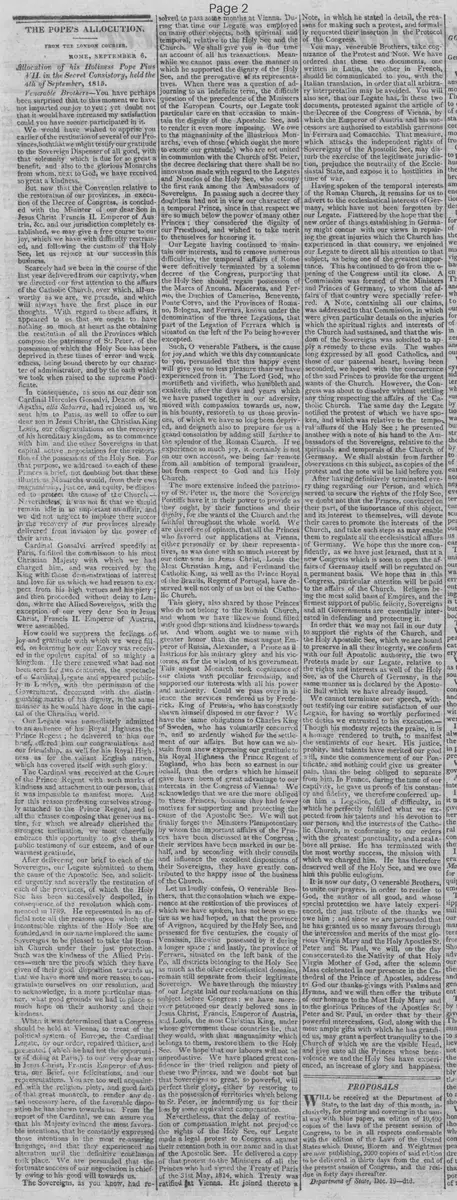
Allocution of his Holiness Pope Pius VII. in the Secret Consistory, held the 4th of September, 1815.
Venerable Brothers—You have perhaps been surprised that to this moment we have not imparted our joy to you; yet doubt not that it would have increased my satisfaction could you have sooner participated in it.
We would have wished to apprise you earlier of the restitution of several of our Provinces, both that we might testify our gratitude to the Sovereign Dispenser of all good, with that solemnity which is due for so great a benefit, and also to the glorious Monarchs from whom, next to God, we have received so great a kindness.
But now that the Convention relative to the restoration of our provinces, in execution of the Decree of Congress, is concluded with the Minister of our dear Son in Jesus Christ Francis II. Emperor of Austria, &c. and our jurisdiction completely established, we may give a free course to our joy, which we have with difficulty restrained, and following the custom of the Holy See, let us rejoice at our success in this business.
Scarcely had we been in the course of the last year delivered from our captivity, when we directed our first attention to the affairs of the Catholic Church, over which, all-unworthy as we are, we preside, and which will always have the first place in our thoughts. With regard to these affairs, it appeared to us that we ought to have nothing so much at heart as the obtaining the restitution of all the Provinces which compose the patrimony of St. Peter, of the possession of which the Holy See has been deprived in these times of error and wickedness, being bound thereto by our character of administrator, and by the oath which we took when raised to the supreme Pontificate.
In consequence, as soon as our dear son Cardinal Hercules Gonsalvi, Deacon of St. Agatha, alla Saburra, had rejoined us, we sent him to Paris, as well to offer to our dear son in Jesus Christ, the Christian King Louis, our congratulations on the recovery of his hereditary kingdom, as to commence with him and the other Sovereigns in that capital active negociations for the restoration of the possessions of the Holy See. For that purpose, we addressed to each of these Princes a brief, not doubting but that these illustrious Monarchs would, from their own magnanimity, justice, and equity, be disposed to protect the cause of the Church.
Nevertheless, it was not fit that we should remain idle in so important an affair, and we did not neglect to implore their succor in the recovery of our provinces already delivered from invasion by the power of their arms.
Cardinal Gonsalvi arrived speedily at Paris, fulfilled the commission to his most Christian Majesty with which we had charged him, and was received by the King with those demonstrations of interest and love for us which we had reason to expect from his high virtues and his piety; and then proceeded without delay to London, where the Allied Sovereigns, with the exception of our very dear Son in Jesus Christ, Francis II. Emperor of Austria, were assembled.
How could we suppress the feelings of joy and gratitude with which we were filled, on learning how our Envoy was received in the opulent capital of so mighty a kingdom. He there renewed what had not been seen for two centuries, the spectacle of a Cardinal Legate and appeared publicly in London, with the permission of the Government, decorated with the distinguishing marks of his dignity, in the same manner as he would have done in the capital of the Christian world.
Our Legate was immediately admitted to an audience of his Royal Highness the Prince Regent; he delivered to him our brief, offered him our congratulations and our friendship, as well for his Royal Highness as for the valiant English nation, which has covered itself with such glory.
The Cardinal was received at the Court of the Prince Regent with such marks of kindness and attachment to our person, that it was impossible to manifest more. And for this reason professing ourselves strongly attached to the Prince Regent, and to all the classes composing that generous nation, for which we already cherished the strongest inclination, we most cheerfully embrace this opportunity to give them a public testimony of our esteem, and of our warmest gratitude.
After delivering our brief to each of the Sovereigns, our Legate submitted to them the cause of the Apostolic See, and solicited urgently and severally the restitution of each of the provinces, of which the Holy See has been successively despoiled, in consequence of the revolution which commenced in 1789. He represented in an official note all the reasons upon which the incontestible rights of the Holy See are founded, and in our name implored the same Sovereigns to be pleased to take the Romish Church under their just protection.
Such was the kindness of the Allied Princes—such are the proofs which they have given of their good disposition towards us, that we have more and more reason to congratulate ourselves on our resolution, and to acknowledge, in a more particular manner, what good grounds we had to place so much hope on their authority and their kindness.
When it was determined that a Congress should be held at Vienna, to treat of the political system of Europe, the Cardinal Legate, by our order, repaired thither, and presented (which he had not the opportunity of doing at Paris,) to our very dear son in Jesus Christ, Francis Emperor of Austria, our Brief, our felicitations, and our representations. You are too well acquainted with the religion, piety, and good faith of that great monarch, to render any detail necessary here, of the favorable disposition he has shewn towards us. From the report of the Cardinal, we can assure you that his Majesty evinced the most favorable intentions, that he constantly expressed those intentions in the most re-assuring language, and that they experienced no alteration until the definitive conclusion took place. We are persuaded that the fortunate success of our negociation is chiefly owing to his good will towards us.
The Sovereigns, as you know, had resolved to pass some months at Vienna. During that time our Legate was employed on many other objects, both spiritual and temporal, relative to the Holy See and the Church. We shall give you in due time an account of all his transactions. Meanwhile we cannot pass over the manner in which he supported the dignity of the Holy See, and the prerogative of its representatives. When there was a question of adjourning to an indefinite term, the difficult question of the precedence of the Ministers of the European Courts, our Legate took particular care on that occasion to maintain the dignity of the Apostolic See, and to render it even more imposing. We owe to the magnanimity of the illustrious Monarchs, even of those (which ought the more to excite our gratitude) who are not united in communion with the Church of St. Peter, the decree declaring that there shall be no innovation made with regard to the Legates and Nuncios of the Holy See, who occupy the first rank among the Ambassadors of Sovereigns. In passing such a decree they doubtless had not in view our character of a temporal Prince, since in that respect we are so much below the power of many other Princes; they considered the dignity of our Priesthood, and wished to take merit to themselves for honoring it.
Our Legate having continued to maintain our interests, and to remove numerous difficulties, the temporal affairs of Rome were definitively terminated by a solemn decree of the Congress, purporting that the Holy See should regain possession of the Marches of Ancona, Macerata, and Fermo, the Duchies of Camerino, Benevento, Ponte Corvo, and the Provinces of Romagna, Bologna, and Ferrara, known under the denomination of the three Legations, that part of the Legation of Ferrara which is situated on the left of the Po being however excepted.
Such, O venerable Fathers, is the cause for joy, and which we this day communicate to you, persuaded that this happy event will give you no less pleasure than we have experienced from it. The Lord God, who mortifieth and vivifieth, who humbleth and exalteth; after the days and years which we have passed together in our adversity, moved with compassion towards us, now, in his bounty, restoreth to us those provinces, of which we have so long been deprived, and deigneth also to prepare for us a grand consolation by adding still farther to the splendor of the Roman Church. If we experience so much joy, it certainly is not on our own account, we being far remote from all ambition of temporal grandeur, but from respect to God and his Holy Church.
The more extensive indeed the patrimony of St. Peter is, the more the Sovereign Pontiffs have it in their power to provide as they ought, by their functions and their dignity, for the wants of the Church and the faithful throughout the whole world. We are therefore of opinion, that all the Princes who favored our applications at Vienna, either personally or by their representatives, as was done with so much interest by our dear sons in Jesus Christ, Louis the Most Christian King, and Ferdinand the Catholic King, as well as the Prince Royal of the Brazils, Regent of Portugal, have deserved well not only of us but of the Catholic Church.
This glory, also shared by those Princes who do not belong to the Romish Church, and whom we have likewise found filled with good dispositions and kindness towards us. And whom ought we to name with greater honor than the most august Emperor of Russia, Alexander, a Prince as illustrious for his military glory and his victories, as for the wisdom of his government. This august Monarch took cognizance of our claims with peculiar friendship, and supported our interests with all his power and authority. Could we pass over in silence the services rendered us by Frederick, King of Prussia, who has constantly shewn himself disposed in our favor? We have the same obligations to Charles King of Sweden, who has voluntarily concurred in, and so ardently wished for the settlement of our affairs. But how can we abstain from anew expressing our gratitude to his Royal Highness the Prince Regent of England, who has been so earnest in our behalf, that the orders which he himself gave have been of great advantage to our interests in the Congress of Vienna! We acknowledge that we are the more obliged to these Princes, because they had fewer motives for supporting and protecting the cause of the Apostolic See. We will not finally forget the Ministers Plenipotentiary by whom the important affairs of the Princes have been discussed at the Congress; their services have been marked in our behalf, and by seconding with their councils and influence the excellent dispositions of their Sovereigns, they have greatly contributed to the happy issue of the business of the Church.
Let us loudly confess, O venerable Brothers, that the consolation which we experience at the restitution of the provinces of which we have spoken, has not been so entire as we had hoped, in that the province of Avignon, acquired by the Holy See, and possessed for five centuries, the county of Venaissin, likewise possessed by it during a longer space; and lastly, the province of Ferrara, situated on the left bank of the Po, all districts belonging to the Holy See as much as the other ecclesiastical domains, remain still separate from their legitimate Sovereign. We have through the ministry of our Legate laid our reclamations on this subject before Congress: we have moreover petitioned our dearly beloved sons in Jesus Christ, Francis, Emperor of Austria, and Louis, the most Christian King, under whose government these countries lie, that they would, with that magnanimity which belongs to them, restore them to the Holy See. We hope that our labours will not be unproductive. We have placed great confidence in the tried religion and piety of these two Princes, and we doubt not but that Sovereigns so great, so powerful, will perfect their glory, either by restoring to us the possession of territories which belong to St. Peter, or indemnifying us for their loss by some equivalent compensation.
Nevertheless, that the delay of restitution or compensation might not prejudice the rights of the Holy See, our Legate made a legal protest to Congress against their retention both in our name and in that of the Apostolic See. He delivered a copy of that protest to the Ministers of all the Princes who had signed the Treaty of Paris of the 30th May, 1814, which Treaty was ratified at Vienna. He joined thereto a Note, in which he stated in detail the reasons for making such a protest, and formally requested their insertion in the Protocol of the Congress.
You may, venerable Brothers, take cognizance of the Protest and Note. We have ordered that these two documents, one written in Latin, the other in French, should be communicated to you, with the Italian translation, in order that all arbitrary interpretation may be avoided. You will also see, that our Legate has, in these two documents, protested against the article of the Decree of the Congress of Vienna, by which the Emperor of Austria and his successors are authorised to establish garrisons in Ferrara and Comacchio. That measure, which attacks the independent rights of Sovereignty of the Apostolic See, may disturb the exercise of the legitimate jurisdiction, prejudice the neutrality of the Ecclesiastical State, and expose it to hostilities in time of war.
Having spoken of the temporal interests of the Roman Church, it remains for us to advert to the ecclesiastical interests of Germany, which have not been forgotten by our Legate. Flattered by the hope that the new order of things establishing in Germany might concur with our views in repairing the great injuries which the Church has experienced in that country, we enjoined our Legate to direct all his attention to that subject, as being one of the greatest importance. This he continued to do from the opening of the Congress until its close. A Commission was formed of the Ministers and Princes of Germany, to whom the affairs of that country were specially referred. A Note, containing all our claims, was addressed to that Commission, in which were given particular details on the injuries which the spiritual rights and interests of the Church had sustained, and that the wisdom of the Sovereigns was solicited to apply a remedy to these evils. The wishes long expressed by all good Catholics, and those of our paternal heart, having been seconded, we hoped with the concurrence of the said Princes to provide for the urgent wants of the Church. However, the Congress was about to dissolve without settling any thing respecting the affairs of the Catholic Church. The same day the Legate notified the protest of which we have spoken, and which was relative to the temporal affairs of the Holy See: he presented another with a note of his hand to the Ambassadors of the Sovereigns, relative to the spirituals and temporals of the Church of Germany. We shall abstain from farther observations on this subject, as copies of the protest and the note will be laid before you.
After having definitively terminated every thing regarding our Person, and which served to secure the rights of the Holy See, we doubt not that the Princes, convinced on their part, of the importance of this object, and its interest to themselves, will devote their cares to promote the interests of the Church, and take such steps as may enable them to regulate all the ecclesiastical affairs of Germany. We hope this the more confidently, as we have just learned, that at a new Congress which is soon to open the affairs of Germany itself will be regulated on a permanent basis. We hope that in this Congress, particular attention will be paid to the affairs of the Church. Religion being the most solid basis of Empires, and the firmest support of public felicity, Sovereigns and all Governments are essentially interested in defending and protecting it.
In order that we may not fail in our duty to support the rights of the Church, and the Holy Apostolic See, which we are bound to preserve in all their integrity, we confirm with our full Apostolic authority, the two Protests made by our Legate, relative to the rights and interests as well of the Holy See, as of the Church of Germany, in the same manner as is declared by the Apostolic Bull which we have already issued.
We cannot terminate our speech, without testifying our entire satisfaction of our Legate, for having so worthily performed the duties we entrusted to his execution. Though his modesty rejects the praise, it is a homage rendered to truth, to manifest the sentiments of our heart. His justice, probity, and talents have merited our good will, since the commencement of our Pontificate, and nothing could give us greater pain, than the being obliged to separate from him. In France, during the time of our captivity, he gave us proofs of his constancy and fidelity, we therefore conferred upon him a Legation, full of difficulty, in which he perfectly fulfilled what we expected from his talents and his devotion to our person, and the interests of the Catholic Church, in conforming to our orders with the greatest punctuality, and a zeal above all praise. He has terminated with the most worthy success, the mission with which we charged him. He has therefore deserved well of the Holy See, and we owe him this public eulogium.
It is now our duty, O venerable Brothers, to unite our prayers, in order to render to God, the author of all good, and whose special protection we have lately experienced, the just tribute of the thanks we owe him; and since we are persuaded that he has granted us so many favours through the intercession and merits of the most glorious Virgin Mary and the Holy Apostles St. Peter and St. Paul, we will, on the day consecrated to the Nativity of that Holy Virgin Mother of God, after the solemn Mass celebrated in our presence in the Cathedral of the Prince of Apostles, address to God our thanks-givings with Psalms and Hymns, and we will then offer the tribute of our homage to the Most Holy Mary and to the glorious Princes of the Apostles St. Peter and St. Paul, in order that by their powerful intercessions, God, along with the most ample gifts with which he has gratified us, may grant a perfect tranquillity to the Church of which we are the visible Head, and give unto all the Princes whose benevolence we and the Holy See have experienced, an increase of glory and happiness.
What sub-type of article is it?
What keywords are associated?
What entities or persons were involved?
Where did it happen?
Foreign News Details
Primary Location
Rome
Event Date
The 4th Of September, 1815
Key Persons
Outcome
restoration of marches of ancona, macerata, fermo; duchies of camerino, benevento, ponte corvo; provinces of romagna, bologna, ferrara (except left bank of po); protests against retention of avignon, venaissin, and ferrara's left bank; austrian garrisons in ferrara and comacchio protested; german church affairs unresolved with protests.
Event Details
Pope Pius VII addresses cardinals on the successful negotiations by Cardinal Consalvi in Paris, London, and Vienna for restoring papal territories post-Napoleon; details diplomatic efforts, receptions by monarchs, Congress decree on provinces; expresses gratitude to allied sovereigns; notes protests for unrestituted territories and German ecclesiastical issues; praises Consalvi's mission.