Thank you for visiting SNEWPapers!
Sign up free
The Morning Star And Catholic Messenger
New Orleans, Orleans County, Louisiana
What is this article about?
Correspondent's report from Dublin on May 21, 1874, covering the Galway Election Petition trial echoing 1872 case with landlord vs. clergy tensions; University of Dublin's secular reforms rejecting Catholic integration; Home Rule MPs challenging government in Commons; and updates on Father Burke and Bishop Duggan.
Clipping
OCR Quality
Full Text
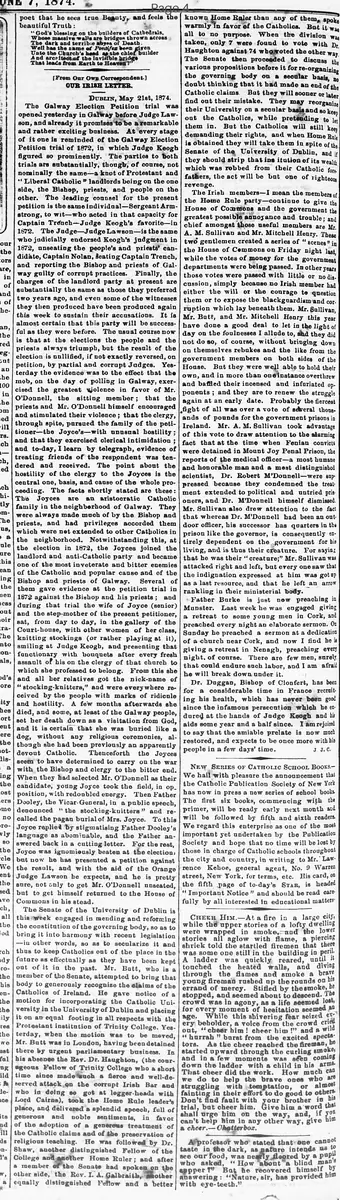
OUR IRISH LETTER.
Dublin, May 21st, 1874.
The Galway Election Petition trial was opened yesterday in Galway before Judge Lawson, and already it promises to be a remarkable and rather exciting business. At every stage of it one is reminded of the Galway Election Petition trial of 1872, in which Judge Keogh figured so prominently. The parties to both trials are substantially, though, of course, not nominally the same—a knot of Protestant and "Liberal Catholic" landlords being on the one side, the Bishop, priests, and people on the other. The leading counsel for the present petition is the same individual—Sergeant Armstrong, to wit—who acted in that capacity for Captain Trench—Judge Keogh's favorite—in 1872. The Judge—Judge Lawson—is the same who judicially endorsed Keogh's judgment in 1872, unseating the people's and priests' candidate, Captain Nolan, seating Captain Trench, and reporting the Bishop and priests of Galway guilty of corrupt practices. Finally, the charges of the landlord party at present are substantially the same as those they preferred two years ago, and even some of the witnesses they then produced have been produced again this week to sustain their accusations. It is almost certain that this party will be successful as they were before. The usual course now is that at the elections the people and the priests always triumph, but the result of the election is nullified, if not exactly reversed, on petition, by partial and corrupt Judges. Yesterday the evidence was to the effect that the mob, on the day of polling in Galway, exercised the greatest violence in favor of Mr. O'Donnell, the sitting member; that the priests and Mr. O'Donnell himself encouraged and stimulated their violence; that the clergy, through spite, pursued the family of the petitioner—the Joyces—with unusual hostility; and that they exercised clerical intimidation; and to-day, I learn by telegraph, evidence of treating friends of the respondent was tendered and received. The point about the hostility of the clergy to the Joyces is the central one, basis, and cause of the whole proceeding. The facts shortly stated are these:
The Joyces are an aristocratic Catholic family in the neighborhood of Galway. They were always made much of by the Bishop and priests, and had privileges accorded them which were not extended to other Catholics in the neighborhood. Notwithstanding this, at the election in 1872, the Joyces joined the landlord and anti-Catholic party and became one of the most inveterate and bitter enemies of the Catholic and popular cause and of the Bishop and priests of Galway. Several of them gave evidence at the petition trial in 1872 against the Bishop and his priests; and during that trial the wife of Joyce (senior) and the step-mother of the present petitioner, sat, from day to day, in the gallery of the Court-house, with other women of her class, knitting stockings (or rather playing at it), smiling at Judge Keogh, and presenting that functionary with bouquets after every fresh assault of his on the clergy of that church to which she professed to belong. From this she and all her relatives got the nick-name of "stocking-knitters," and were everywhere received by the people with marks of ridicule and hostility. A few months afterwards she died, and some, at least of the Galway people, set her death down as a visitation from God, and it is certain that she was buried like a dog, without any religious ceremonies, although she had been previously an apparently devout Catholic.
Thenceforth the Joyces seem to have determined to carry on the war with the Bishop and clergy to the bitter end. When they had selected Mr. O'Donnell as their candidate, young Joyce took the field, in opposition, with redoubled energy. Then Father Dooley, the Vicar-General, in a public speech, denounced "the stocking-knitters" and recalled the pagan burial of Mrs. Joyce. To this Joyce replied by stigmatising Father Dooley's language as abominable, and the Father answered back in a cutting letter. For the rest, Joyce was ignominiously beaten at the election, but now he has presented a petition against the result, and with the aid of the Orange Judge Lawson he expects, and he is pretty sure, not only to get Mr. O'Donnell unseated, but to get himself returned to the House of Commons in his stead.
The Senate of the University of Dublin is this week engaged in mending and reforming the constitution of the governing body, so as to bring it into harmony with recent legislation—in other words, so as to secularize it and thus to keep Catholics out of the place in the future as effectually as they have been kept out of it in the past. Mr. Butt, who is a member of the Senate, attempted to bring that body to generously recognize the claims of the Catholics of Ireland. He gave notice of a motion for incorporating the Catholic University in the University of Dublin and placing it on an equal footing in all respects with the Protestant institution of Trinity College. Yesterday, when the motion was to be moved, Mr. Butt was in London, having been detained there by urgent parliamentary business. In his absence the Rev. Dr. Haughton, (the courageous Fellow of Trinity College who a short time since made such a fierce and well-deserved attack on the corrupt Irish Bar and who in doing so got at logger-heads with Lord Cairns), took the Home Rule leader's place, and delivered a splendid speech, full of generous and noble sentiments, in favor of the adoption of a generous treatment of the Catholic claims and of the preservation of religious teaching. He was followed by Dr. Shaw, another distinguished Fellow of the College and another Home Ruler; and after a member of the Senate had spoken on the other side, the Rev. I. A. Galbraith, another equally distinguished Fellow and a better known Home Ruler than any of them, spoke warmly in favor of the Catholics. But it was all to no purpose. When the division was taken, only 7 were found to vote with Dr. Haughton against 74 who voted the other way
The Senate then proceeded to discuss the various propositions before it for re-organizing the governing body on a secular basis, no doubt thinking that it had made an end of the Catholic claims. But they will sooner or later find out their mistake. They may reorganize their University on a secular basis and so keep out the Catholics, while pretending to let them in. But the Catholics will still keep demanding their rights, and when Home Rule is obtained they will take them in spite of the Senate of the University of Dublin, and if they should strip that institution of its wealth which was robbed from their Catholic forefathers, the act will be but one of righteous revenge.
The Irish members—I mean the members of the Home Rule party—continue to give the House of Commons and the government the greatest possible annoyance and trouble; and chief amongst those useful members are Mr. A. M. Sullivan and Mr. Mitchell Henry. These two gentlemen created a series of "scenes" in the House of Commons on Friday night last while the votes of money for the government departments were being passed. In other years those votes were passed with little or no discussion, simply because no Irish member had either the will or the courage to question them or to expose the blackguardism and corruption which lay beneath them. Mr. Sullivan, Mr. Butt, and Mr. Mitchell Henry this year have done a good deal to let in the light of day on the foulnesses I allude to, and they did not do so, of course, without bringing down on themselves rebukes and the like from the government members on both sides of the House. But they were well able to hold their own, and in more than one instance overthrew and baffled their incensed and infuriated opponents; and they are to renew the struggle again at an early date. Probably the fiercest fight of all was over a vote of several thousands of pounds for the government prisons in Ireland. Mr. A. M. Sullivan took advantage of this vote to draw attention to the alarming fact that at the time when Fenian convicts were detained in Mount Joy Penal Prison, the reports of the medical officer—a most humane and honorable man and a most distinguished scientist, Dr. Robert M'Donnell—were suppressed because they condemned the treatment extended to political and untried prisoners, and Dr. M'Donnell himself dismissed. Mr. Sullivan also drew attention to the fact that whereas Dr. M'Donnell had been an out door officer, his successor has quarters in the prison like the governor, is consequently entirely dependent on the government for his living, and is thus their creature. For saying that he was their "creature;" Mr. Sullivan was attacked right and left, but every one saw that the indignation expressed at him was got up as a last resource, and that he left an arrow rankling in their ministerial body.
Father Burke is just now preaching in Munster. Last week he was engaged giving a retreat to some young men in Cork, and preached every night an elaborate sermon. On Sunday he preached a sermon at a dedication of a church near Cork, and now I find he is giving a retreat in Nenagh, preaching every night, of course. There are few men, surely that could endure such labor, and I am afraid he will break down under it.
Dr. Duggan, Bishop of Clonfert, has been for a considerable time in France recruiting his health, which has never been good since the infamous persecution which he endured at the hands of Judge Keogh and his aids some year and a half since. I am rejoiced to say that the amiable prelate is now much restored, and expects to be once more with his people in a few days' time.
J. J. C.
What sub-type of article is it?
What themes does it cover?
What keywords are associated?
What entities or persons were involved?
Letter to Editor Details
Author
J. J. C.
Main Argument
reports on ongoing irish political tensions, including biased election petitions favoring landlords over clergy and people, resistance to catholic integration in university of dublin, home rule challenges in parliament exposing government corruption, and updates on clerical figures amid historical persecutions.
Notable Details