Thank you for visiting SNEWPapers!
Sign up free
Editorial
October 23, 1885
South Branch Intelligencer
Romney, Hampshire County, West Virginia
What is this article about?
Editorial correspondence from Okonoko, WV, on October 17, describing a trip via the Levels, local farming recovery from drought with good prospects for grain and corn, village life along the Potomac with railroad workers and businesses, a romantic ascent of Mt. Sinai, visits to local farms, and a humorous anecdote.
Clipping
OCR Quality
95%
Excellent
Full Text
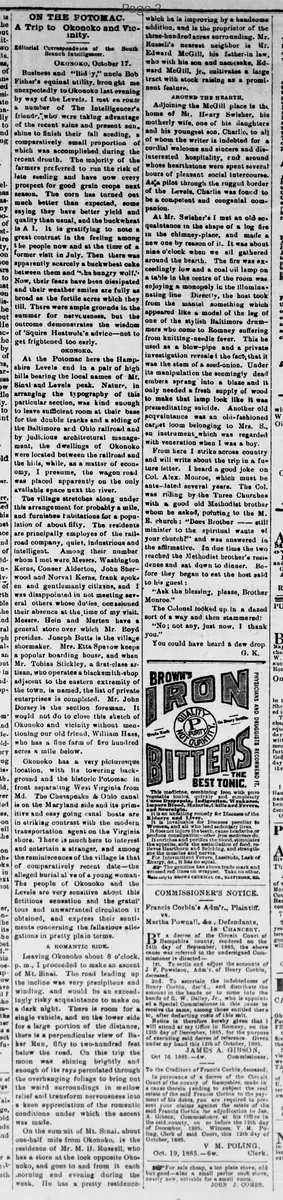
ON THE POTOMAC.
A Trip to Okonoko and Vicinity.
Editorial Correspondence of the South Branch Intelligencer.
OKONOKO, October 17.
Business and "Biddy," uncle Bob Fisher's equine utility, brought me unexpectedly to Okonoko last evening by way of the Levels. I met en route a number of The Intelligencer's friends, who were taking advantage of the recent rains and present sunshine to finish their fall seeding, a comparatively small proportion of which was accomplished during the recent drought. The majority of the farmers preferred to run the risk of late seeding and have now every prospect for good grain crops next season. The corn has turned out much better than expected, some saying they have better yield and quality than usual, and the buckwheat is A 1. It is gratifying to note a great contrast in the feeling among the people now and at the time of a former visit in July. Then there was apparently scarcely a buckwheat cake between them and "the hungry wolf." Now, their fears have been dissipated and their weather smiles as fully as broad as the fertile acres which they till. There were ample grounds in the summer for nervousness, but the outcome demonstrates the wisdom of 'Squire Hoatwole's advice—not to get frightened too early.
OKONOKO.
At the Potomac here the Hampshire Levels end in a pair of high hills bearing the local names of Mt. Sinai and Levels Peak. Nature, in arranging the topography of this particular section, was kind enough to leave sufficient room at their base for the double tracks and a siding of the Baltimore and Ohio railroad and by judicious architectural management, the dwellings of Okonoko were located between the railroad and the hills, while, as a matter of economy, I presume, the wagon road was placed apparently on the only available space next the river. The village stretches along under this arrangement for probably a mile, and furnishes habitations for a population of about fifty. The residents are principally employees of the railroad company, quiet, industrious and intelligent. Among their number whom I met were Messrs. Washington Kerns, Conser Alderton, John Sherwood and Norval Kerns, frank spoken and gentlemanly citizens, and I was disappointed in not meeting several others whose duties occasioned their absence at the time of my visit. Messrs. Hein and Merten have a general store over which Mr. Boyd presides. Joseph Butts is the village shoemaker. Mrs. Etta Speiow keeps a popular boarding house, and when Mr. Tobias Stickley, a first-class artisan, who operates a blacksmith-shop adjacent to the eastern extremity of the town, is named, the list of private enterprises is completed. Mr. John Dorsey is the section foreman. It would not do to close this sketch of Okonoko and vicinity without mentioning our old friend, William Hass, who has a fine farm of five hundred acres a mile below. Okonoko has a very picturesque location, with its towering background and the historic Potomac in front separating West Virginia from Md. The Chesapeake & Ohio Canal is on the Maryland side and its primitive and easy going canal boats are in striking contrast with the modern transportation agent on the Virginia shore. There is much here to interest and entertain a stranger, and among the reminiscences of the village is that of comparatively recent date—the alleged burial alive of a young woman. The people of Okonoko and the Levels are very sensitive about this fictitious sensation and the gratuitous and unwarranted circulation it obtained, and express their sentiments concerning the fallacious allegations in pretty plain terms.
A ROMANTIC RIDE.
Leaving Okonoko about 8 o'clock, p. m., I proceeded to make an ascent of Mt. Sinai. The road leading up the incline was very precipitous and winding, and would be an exceedingly risky acquaintance to make on a dark night. There is room for a single vehicle, and on the lower side for a large portion of the distance, there is a perpendicular view of Baker Run, fifty to two-hundred feet below the road. On this trip the moon was shining brightly and enough of its rays percolated through the overhanging foliage to bring out the weird surroundings in mellow relief and transform nervousness into a keen appreciation of the romantic conditions under which the ascent was made.
On the summit of Mt. Sinai, about one-half mile from Okonoko, is the residence of Mr. M. H. Russell, who has a store at the lock opposite Okonoko, and goes to and from it each morning and evening during the week. He has a pretty residence which he is improving by a handsome addition, and is the proprietor of the three-hundred acres surrounding. Mr. Russell's nearest neighbor is Mr. Edward McGill, his father-in-law, who with his son and namesake, Edward McGill, jr., cultivates a large tract with stock raising as a prominent feature.
AROUND THE HEARTH
Adjoining the McGill place is the home of Mr. Henry Swisher, his motherly wife, one of his daughters and his youngest son, Charlie, to all of whom the writer is indebted for a cordial welcome and sincere and disinterested hospitality, and around whose hearthstone were spent several hours of pleasant social intercourse. As a pilot through the rugged border of the Levels, Charlie was found to be a competent and congenial companion. At Mr. Swisher's I met an old acquaintance in the shape of a log fire in the chimney-place, and made a new one by reason of it. It was about nine o'clock when we all gathered around the hearth. The fire was exceedingly low and a coal oil lamp on a table in the centre of the room was enjoying a monopoly in the illuminating line. Directly, the host took from the mantel something which appeared like a model of the leg of one of the stylish Baltimore drummers who come to Romney suffering from knitting-needle fever. This he used as a blow-pipe and a private investigation revealed the fact that it was the stem of a seed-onion. Under its manipulation the seemingly dead embers sprang into a blaze and it only needed a fresh supply of wood to make that lamp look like it was premeditating suicide. Another old acquaintance was an old-fashioned carpet loom belonging to Mrs. S., an instrument which was regarded with veneration when I was a boy. From here I strike across country and will write about the trip in a future letter. I heard a good joke on Col. Alex. Monroe, which must be ante-dated several years. The Col. was riding by the Three Churches with a good old Methodist brother whom he asked, pointing to the M. E. church: "Does Brother --- still minister to the spiritual wants of your church?" and was answered in the affirmative. In due time the two reached the Methodist brother's residence and sat down to dinner. Before they began to eat the host said to his guest: "Ask the blessing, please, Brother Monroe." The Colonel looked up in a dazed sort of a way and then stammered: "No; not any, just now, I thank you." You could have heard a dew drop.
G. K.
A Trip to Okonoko and Vicinity.
Editorial Correspondence of the South Branch Intelligencer.
OKONOKO, October 17.
Business and "Biddy," uncle Bob Fisher's equine utility, brought me unexpectedly to Okonoko last evening by way of the Levels. I met en route a number of The Intelligencer's friends, who were taking advantage of the recent rains and present sunshine to finish their fall seeding, a comparatively small proportion of which was accomplished during the recent drought. The majority of the farmers preferred to run the risk of late seeding and have now every prospect for good grain crops next season. The corn has turned out much better than expected, some saying they have better yield and quality than usual, and the buckwheat is A 1. It is gratifying to note a great contrast in the feeling among the people now and at the time of a former visit in July. Then there was apparently scarcely a buckwheat cake between them and "the hungry wolf." Now, their fears have been dissipated and their weather smiles as fully as broad as the fertile acres which they till. There were ample grounds in the summer for nervousness, but the outcome demonstrates the wisdom of 'Squire Hoatwole's advice—not to get frightened too early.
OKONOKO.
At the Potomac here the Hampshire Levels end in a pair of high hills bearing the local names of Mt. Sinai and Levels Peak. Nature, in arranging the topography of this particular section, was kind enough to leave sufficient room at their base for the double tracks and a siding of the Baltimore and Ohio railroad and by judicious architectural management, the dwellings of Okonoko were located between the railroad and the hills, while, as a matter of economy, I presume, the wagon road was placed apparently on the only available space next the river. The village stretches along under this arrangement for probably a mile, and furnishes habitations for a population of about fifty. The residents are principally employees of the railroad company, quiet, industrious and intelligent. Among their number whom I met were Messrs. Washington Kerns, Conser Alderton, John Sherwood and Norval Kerns, frank spoken and gentlemanly citizens, and I was disappointed in not meeting several others whose duties occasioned their absence at the time of my visit. Messrs. Hein and Merten have a general store over which Mr. Boyd presides. Joseph Butts is the village shoemaker. Mrs. Etta Speiow keeps a popular boarding house, and when Mr. Tobias Stickley, a first-class artisan, who operates a blacksmith-shop adjacent to the eastern extremity of the town, is named, the list of private enterprises is completed. Mr. John Dorsey is the section foreman. It would not do to close this sketch of Okonoko and vicinity without mentioning our old friend, William Hass, who has a fine farm of five hundred acres a mile below. Okonoko has a very picturesque location, with its towering background and the historic Potomac in front separating West Virginia from Md. The Chesapeake & Ohio Canal is on the Maryland side and its primitive and easy going canal boats are in striking contrast with the modern transportation agent on the Virginia shore. There is much here to interest and entertain a stranger, and among the reminiscences of the village is that of comparatively recent date—the alleged burial alive of a young woman. The people of Okonoko and the Levels are very sensitive about this fictitious sensation and the gratuitous and unwarranted circulation it obtained, and express their sentiments concerning the fallacious allegations in pretty plain terms.
A ROMANTIC RIDE.
Leaving Okonoko about 8 o'clock, p. m., I proceeded to make an ascent of Mt. Sinai. The road leading up the incline was very precipitous and winding, and would be an exceedingly risky acquaintance to make on a dark night. There is room for a single vehicle, and on the lower side for a large portion of the distance, there is a perpendicular view of Baker Run, fifty to two-hundred feet below the road. On this trip the moon was shining brightly and enough of its rays percolated through the overhanging foliage to bring out the weird surroundings in mellow relief and transform nervousness into a keen appreciation of the romantic conditions under which the ascent was made.
On the summit of Mt. Sinai, about one-half mile from Okonoko, is the residence of Mr. M. H. Russell, who has a store at the lock opposite Okonoko, and goes to and from it each morning and evening during the week. He has a pretty residence which he is improving by a handsome addition, and is the proprietor of the three-hundred acres surrounding. Mr. Russell's nearest neighbor is Mr. Edward McGill, his father-in-law, who with his son and namesake, Edward McGill, jr., cultivates a large tract with stock raising as a prominent feature.
AROUND THE HEARTH
Adjoining the McGill place is the home of Mr. Henry Swisher, his motherly wife, one of his daughters and his youngest son, Charlie, to all of whom the writer is indebted for a cordial welcome and sincere and disinterested hospitality, and around whose hearthstone were spent several hours of pleasant social intercourse. As a pilot through the rugged border of the Levels, Charlie was found to be a competent and congenial companion. At Mr. Swisher's I met an old acquaintance in the shape of a log fire in the chimney-place, and made a new one by reason of it. It was about nine o'clock when we all gathered around the hearth. The fire was exceedingly low and a coal oil lamp on a table in the centre of the room was enjoying a monopoly in the illuminating line. Directly, the host took from the mantel something which appeared like a model of the leg of one of the stylish Baltimore drummers who come to Romney suffering from knitting-needle fever. This he used as a blow-pipe and a private investigation revealed the fact that it was the stem of a seed-onion. Under its manipulation the seemingly dead embers sprang into a blaze and it only needed a fresh supply of wood to make that lamp look like it was premeditating suicide. Another old acquaintance was an old-fashioned carpet loom belonging to Mrs. S., an instrument which was regarded with veneration when I was a boy. From here I strike across country and will write about the trip in a future letter. I heard a good joke on Col. Alex. Monroe, which must be ante-dated several years. The Col. was riding by the Three Churches with a good old Methodist brother whom he asked, pointing to the M. E. church: "Does Brother --- still minister to the spiritual wants of your church?" and was answered in the affirmative. In due time the two reached the Methodist brother's residence and sat down to dinner. Before they began to eat the host said to his guest: "Ask the blessing, please, Brother Monroe." The Colonel looked up in a dazed sort of a way and then stammered: "No; not any, just now, I thank you." You could have heard a dew drop.
G. K.
What sub-type of article is it?
Agriculture
Infrastructure
What keywords are associated?
Okonoko
Potomac
Farming
Drought
Railroad
Hampshire Levels
Mt Sinai
Rural Life
What entities or persons were involved?
Uncle Bob Fisher
Squire Hoatwole
Washington Kerns
Conser Alderton
John Sherwood
Norval Kerns
Hein And Merten
Mr. Boyd
Joseph Butts
Mrs. Etta Speiow
Tobias Stickley
John Dorsey
William Hass
M. H. Russell
Edward Mcgill
Henry Swisher
Charlie Swisher
Col. Alex. Monroe
Editorial Details
Primary Topic
Trip To Okonoko And Local Rural Conditions
Stance / Tone
Observational And Positive
Key Figures
Uncle Bob Fisher
Squire Hoatwole
Washington Kerns
Conser Alderton
John Sherwood
Norval Kerns
Hein And Merten
Mr. Boyd
Joseph Butts
Mrs. Etta Speiow
Tobias Stickley
John Dorsey
William Hass
M. H. Russell
Edward Mcgill
Henry Swisher
Charlie Swisher
Col. Alex. Monroe
Key Arguments
Farmers Finished Fall Seeding After Drought With Good Prospects For Grain Crops
Corn Yield Better Than Expected, Buckwheat Excellent
Contrast In Local Sentiment From July Drought Fears To Current Optimism
Description Of Okonoko Village Layout And Residents
Picturesque Location With Railroad, Canal, And Potomac River
Romantic Ascent Of Mt. Sinai
Hospitality At Swisher Home And Rural Domestic Scenes
Debunking Of Burial Alive Rumor