Thank you for visiting SNEWPapers!
Sign up free
Letter to Editor
October 14, 1847
Watchman And Observer
Richmond, Virginia
What is this article about?
A narrative warns against lotteries by recounting how a post-Revolutionary War farmer in Western Massachusetts wins $2,000, abandons industry for extravagance, loses everything, and contrasts with neighbors who prosper through hard work.
Clipping
OCR Quality
95%
Excellent
Full Text
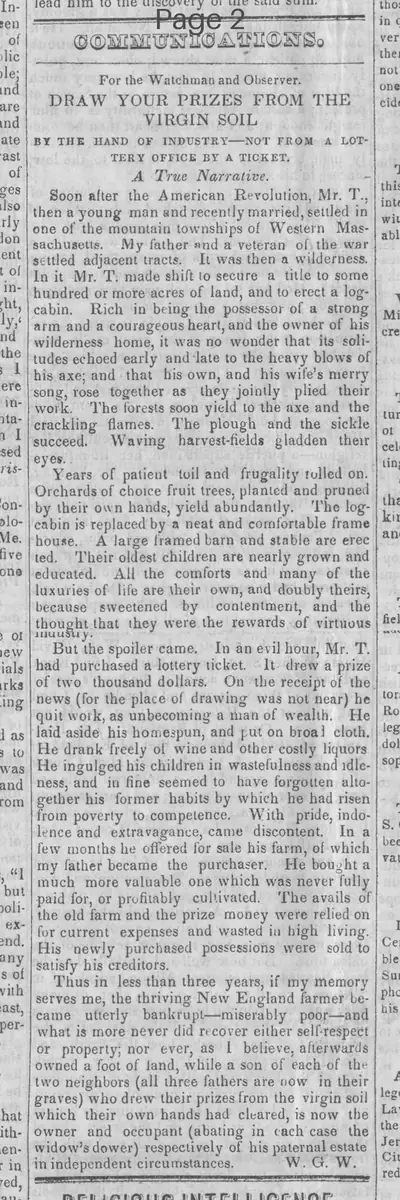
COMMUNICATIONS.
For the Watchman and Observer.
DRAW YOUR PRIZES FROM THE VIRGIN SOIL BY THE HAND OF INDUSTRY—NOT FROM A LOTTERY OFFICE BY A TICKET.
A True Narrative.
Soon after the American Revolution, Mr. T. then a young man and recently married, settled in one of the mountain townships of Western Massachusetts. My father and a veteran of the war settled adjacent tracts. It was then a wilderness In it Mr. T. made shift to secure a title to some hundred or more acres of land, and to erect a log-cabin. Rich in being the possessor of a strong arm and a courageous heart, and the owner of his wilderness home, it was no wonder that its solitudes echoed early and late to the heavy blows of his axe; and that his own, and his wife's merry song, rose together as they jointly plied their work. The forests soon yield to the axe and the crackling flames. The plough and the sickle succeed. Waving harvest-fields gladden the eyes.
Years of patient toil and frugality rolled on. Orchards of choice fruit trees, planted and pruned by their own hands, yield abundantly. The log cabin is replaced by a neat and comfortable frame house. A large framed barn and stable are erected. Their oldest children are nearly grown and educated. All the comforts and many of the luxuries of life are their own, and doubly theirs, because sweetened by contentment, and the thought that they were the rewards of virtuous industry.
But the spoiler came. In an evil hour, Mr. T had purchased a lottery ticket. It drew a prize of two thousand dollars. On the receipt of the news (for the place of drawing was not near) he quit work, as unbecoming a man of wealth. He laid aside his homespun, and put on broad cloth. He drank freely of wine and other costly liquors He indulged his children in wastefulness and idleness, and in fine seemed to have forgotten altogether his former habits by which he had risen from poverty to competence. With pride, indolence and extravagance, came discontent. In a few months he offered for sale his farm, of which my father became the purchaser. He bought a much more valuable one which was never fully paid for, or profitably cultivated. The avails of the old farm and the prize money were relied on for current expenses and wasted in high living. His newly purchased possessions were sold to satisfy his creditors.
Thus in less than three years, if my memory serves me, the thriving New England farmer became utterly bankrupt—miserably poor—and what is more never did recover either self-respect or property; nor ever, as I believe, afterwards owned a foot of land, while a son of each of the two neighbors (all three fathers are now in their graves) who drew their prizes from the virgin soil which their own hands had cleared, is now the owner and occupant (abating in each case the widow's dower) respectively of his paternal estate in independent circumstances.
W.G. W.
For the Watchman and Observer.
DRAW YOUR PRIZES FROM THE VIRGIN SOIL BY THE HAND OF INDUSTRY—NOT FROM A LOTTERY OFFICE BY A TICKET.
A True Narrative.
Soon after the American Revolution, Mr. T. then a young man and recently married, settled in one of the mountain townships of Western Massachusetts. My father and a veteran of the war settled adjacent tracts. It was then a wilderness In it Mr. T. made shift to secure a title to some hundred or more acres of land, and to erect a log-cabin. Rich in being the possessor of a strong arm and a courageous heart, and the owner of his wilderness home, it was no wonder that its solitudes echoed early and late to the heavy blows of his axe; and that his own, and his wife's merry song, rose together as they jointly plied their work. The forests soon yield to the axe and the crackling flames. The plough and the sickle succeed. Waving harvest-fields gladden the eyes.
Years of patient toil and frugality rolled on. Orchards of choice fruit trees, planted and pruned by their own hands, yield abundantly. The log cabin is replaced by a neat and comfortable frame house. A large framed barn and stable are erected. Their oldest children are nearly grown and educated. All the comforts and many of the luxuries of life are their own, and doubly theirs, because sweetened by contentment, and the thought that they were the rewards of virtuous industry.
But the spoiler came. In an evil hour, Mr. T had purchased a lottery ticket. It drew a prize of two thousand dollars. On the receipt of the news (for the place of drawing was not near) he quit work, as unbecoming a man of wealth. He laid aside his homespun, and put on broad cloth. He drank freely of wine and other costly liquors He indulged his children in wastefulness and idleness, and in fine seemed to have forgotten altogether his former habits by which he had risen from poverty to competence. With pride, indolence and extravagance, came discontent. In a few months he offered for sale his farm, of which my father became the purchaser. He bought a much more valuable one which was never fully paid for, or profitably cultivated. The avails of the old farm and the prize money were relied on for current expenses and wasted in high living. His newly purchased possessions were sold to satisfy his creditors.
Thus in less than three years, if my memory serves me, the thriving New England farmer became utterly bankrupt—miserably poor—and what is more never did recover either self-respect or property; nor ever, as I believe, afterwards owned a foot of land, while a son of each of the two neighbors (all three fathers are now in their graves) who drew their prizes from the virgin soil which their own hands had cleared, is now the owner and occupant (abating in each case the widow's dower) respectively of his paternal estate in independent circumstances.
W.G. W.
What sub-type of article is it?
Persuasive
Ethical Moral
What themes does it cover?
Morality
What keywords are associated?
Lottery Dangers
Virtuous Industry
American Revolution
Western Massachusetts
Moral Ruin
Extravagance
Frugality
What entities or persons were involved?
W.G. W.
For The Watchman And Observer.
Letter to Editor Details
Author
W.G. W.
Recipient
For The Watchman And Observer.
Main Argument
true prosperity comes from patient industry and frugality on the land, not from lottery winnings, which lead to idleness, extravagance, and ruin, as illustrated by the downfall of a successful farmer who won a prize and lost everything within three years.
Notable Details
References American Revolution
Set In Western Massachusetts Wilderness
Contrasts With Neighbors' Sons Who Inherited And Maintained Estates Through Industry