Thank you for visiting SNEWPapers!
Sign up free
The Union Daily Times
Union, Union County, South Carolina
What is this article about?
The 69th Congress opened on December 7, 1925, in Washington with turbulent House proceedings where Republicans elected Nicholas Longworth Speaker despite opposition, and a calm Senate session swearing in new senators including Robert La Follette.
Merged-components note: Headline merged with the corresponding story about the opening of the 69th Congress.
Clipping
OCR Quality
Full Text
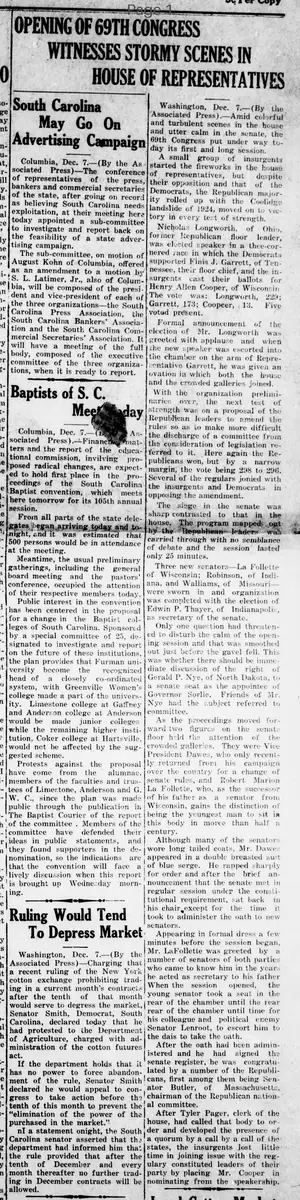
WITNESSES STORMY SCENES IN HOUSE OF REPRESENTATIVES
Washington, Dec. 7.—(By the Associated Press).—Amid colorful and turbulent scenes in the house and utter calm in the senate, the 69th Congress put under way today its first and long session.
A small group of insurgents started the fireworks in the house of representatives, but despite their opposition and that of the Democrats, the Republican majority rolled up with the Coolidge landslide of 1924, moved on to victory in every test of strength.
Nicholas Longworth, of Ohio, former Republican floor leader, was elected speaker in a three-cornered race in which the Democrats supported Finis J. Garrett, of Tennessee, their floor chief, and the insurgents cast their ballots for Henry Allen Cooper, of Wisconsin.
The vote was: Longworth, 229; Garrett, 173; Cooper, 13. Five voted present.
Formal announcement of the election of Mr. Longworth was greeted with applause and when the new speaker was escorted into the chamber on the arm of Representative Garrett, he was given an ovation in which both the house and the crowded galleries joined.
With the organization preliminaries over, the next test of strength was on a proposal of the Republican leaders to amend the rules so as to make more difficult the discharge of a committee from the consideration of legislation referred to it. Here again the Republicans won, but by a narrow margin, the vote being 298 to 296.
Several of the regulars joined with the insurgents and Democrats in opposing the amendment.
The siege in the senate was sharp contrasted to that in the house. The program mapped out by the Republican leaders was carried through with no semblance of debate and the session lasted only 25 minutes.
Three new senators—La Follette of Wisconsin; Robinson, of Indiana, and Williams, of Missouri—were sworn in and organization was completed with the election of Edwin P. Thayer, of Indianapolis, as secretary of the senate.
Only one question had threatened to disturb the calm of the opening session and that was smoothed out just before the gavel fell. This was whether there should be immediate discussion of the right of Gerald P. Nye, of North Dakota, to a senate seat as the appointee of Governor Sorlie. Friends of Mr. Nye had the subject referred to committee.
As the proceedings moved forward two figures on the senate floor held the attention of the crowded galleries. They were Vice President Dawes, who only recently returned from his campaign over the country for a change of senate rules, and Robert Marion La Follette, who, as the successor of his father as a senator from Wisconsin, gains the distinction of being the youngest man to sit in this body in more than half a century.
Although many of the senators wore long tailed coats, Mr. Dawes appeared in a double breasted suit of blue serge. He rapped sharply for order and after the brief announcement that the senate met in regular session under the constitutional requirement, sat back in his chair except for the time it took to administer the oath to new senators.
Appearing in formal dress a few minutes before the session began, Mr. LaFollette was greeted by a number of senators of both parties who came to know him in the years he acted as secretary to his father.
When the session opened, the young senator took a seat in the rear of the chamber until time for his colleague and political enemy, Senator Lenroot, to escort him to the dais to take the oath.
After the oath had been administered and he had signed the senate register, he was congratulated by a number of the Republicans, first among them being Senator Butler, of Massachusetts, chairman of the Republican national committee.
After Tyler Page, clerk of the house, had called that body to order and developed the presence of a quorum by a call of the states, the insurgents lost little time in joining issue with the regularly constituted leaders of their party by placing Mr. Cooper in nomination for the speakership.
What sub-type of article is it?
What themes does it cover?
What keywords are associated?
What entities or persons were involved?
Where did it happen?
Story Details
Key Persons
Location
Washington
Event Date
Dec. 7, 1925
Story Details
Republicans elected Nicholas Longworth Speaker of the House 229-173-13 amid insurgent and Democratic opposition, passed rules amendment 298-296; Senate calmly swore in new senators including young La Follette and elected secretary.