Thank you for visiting SNEWPapers!
Sign up free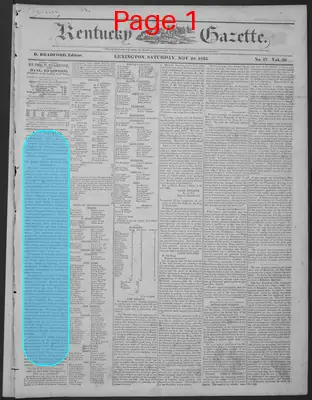
Letter to Editor
November 28, 1835
Kentucky Gazette
Lexington, Fayette County, Kentucky
What is this article about?
A corrected letter to President Andrew Jackson, published in the Kentucky Gazette on November 28, 1835, denounces lifetime franking privileges for Congress as unconstitutional and calls for their abolition to prevent privileged orders and protect the mail system.
Clipping
OCR Quality
95%
Excellent
Full Text
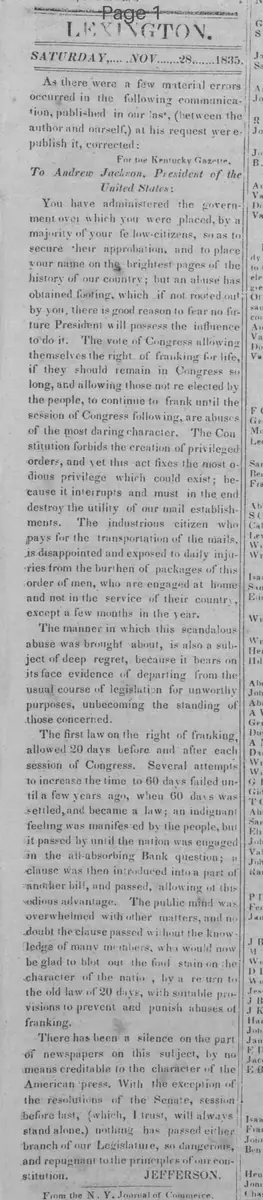
LEXINGTON.
SATURDAY.....NOV......28......1835.
As there were a few material errors occurred in the following communication, published in our last, (between the author and ourself.) at his request we publish it, corrected:
For the Kentucky Gazette.
To Andrew Jackson, President of the United States:
You have administered the government over which you were placed, by a majority of your fellow-citizens, so as to secure their approbation, and to place your name on the brightest pages of the history of our country; but an abuse has obtained footing, which if not rooted out by you, there is good reason to fear no future President will possess the influence to do it. The vote of Congress allowing themselves the right of franking for life, if they should remain in Congress so long, and allowing those not re-elected by the people, to continue to frank until the session of Congress following, are abuses of the most daring character. The Constitution forbids the creation of privileged orders, and this act fixes the most odious privilege which could exist; because it interrupts and must in the end destroy the utility of our mail establishments. The industrious citizen who pays for the transportation of the mails, is disappointed and exposed to daily injuries from the burden of packages of this order of men, who are engaged at home and not in the service of their country, except a few months in the year.
The manner in which this scandalous abuse was brought about, is also a subject of deep regret, because it bears on its face evidence of departing from the usual course of legislation for unworthy purposes, unbecoming the standing of those concerned.
The first law on the right of franking, allowed 20 days before and after each session of Congress. Several attempts to increase the time to 60 days failed until a few years ago, when 60 days was settled, and became a law; an indignant feeling was manifested by the people, but it passed by until the nation was engaged in the all-absorbing Bank question; a clause was then introduced into a part of another bill, and passed, allowing of this odious advantage. The public mind was overwhelmed with other matters, and no doubt the clause passed without the knowledge of many members, who would now be glad to blot out the foul stain on the character of the nation, by a return to the old law of 20 days, with suitable provisions to prevent and punish abuses of franking.
There has been a silence on the part of newspapers on this subject, by no means creditable to the character of the American press. With the exception of the resolutions of the Senate, session before last, (which, I trust, will always stand alone,) nothing has passed either branch of our Legislature, so dangerous, and repugnant to the principles of our constitution.
JEFFERSON.
SATURDAY.....NOV......28......1835.
As there were a few material errors occurred in the following communication, published in our last, (between the author and ourself.) at his request we publish it, corrected:
For the Kentucky Gazette.
To Andrew Jackson, President of the United States:
You have administered the government over which you were placed, by a majority of your fellow-citizens, so as to secure their approbation, and to place your name on the brightest pages of the history of our country; but an abuse has obtained footing, which if not rooted out by you, there is good reason to fear no future President will possess the influence to do it. The vote of Congress allowing themselves the right of franking for life, if they should remain in Congress so long, and allowing those not re-elected by the people, to continue to frank until the session of Congress following, are abuses of the most daring character. The Constitution forbids the creation of privileged orders, and this act fixes the most odious privilege which could exist; because it interrupts and must in the end destroy the utility of our mail establishments. The industrious citizen who pays for the transportation of the mails, is disappointed and exposed to daily injuries from the burden of packages of this order of men, who are engaged at home and not in the service of their country, except a few months in the year.
The manner in which this scandalous abuse was brought about, is also a subject of deep regret, because it bears on its face evidence of departing from the usual course of legislation for unworthy purposes, unbecoming the standing of those concerned.
The first law on the right of franking, allowed 20 days before and after each session of Congress. Several attempts to increase the time to 60 days failed until a few years ago, when 60 days was settled, and became a law; an indignant feeling was manifested by the people, but it passed by until the nation was engaged in the all-absorbing Bank question; a clause was then introduced into a part of another bill, and passed, allowing of this odious advantage. The public mind was overwhelmed with other matters, and no doubt the clause passed without the knowledge of many members, who would now be glad to blot out the foul stain on the character of the nation, by a return to the old law of 20 days, with suitable provisions to prevent and punish abuses of franking.
There has been a silence on the part of newspapers on this subject, by no means creditable to the character of the American press. With the exception of the resolutions of the Senate, session before last, (which, I trust, will always stand alone,) nothing has passed either branch of our Legislature, so dangerous, and repugnant to the principles of our constitution.
JEFFERSON.
What sub-type of article is it?
Persuasive
Political
Ethical Moral
What themes does it cover?
Politics
Constitutional Rights
What keywords are associated?
Franking Privilege
Congressional Abuse
Constitutional Violation
Mail System
Andrew Jackson
What entities or persons were involved?
Jefferson.
Andrew Jackson, President Of The United States
Letter to Editor Details
Author
Jefferson.
Recipient
Andrew Jackson, President Of The United States
Main Argument
the letter criticizes the lifetime franking privileges for congress members as unconstitutional abuses that burden the mail system and urges president jackson to eliminate them before they become entrenched.
Notable Details
History Of Franking Laws From 20 Days To 60 Days And Then Lifetime Via A Clause In Another Bill During The Bank Question
Silence Of Newspapers On The Issue
References To Senate Resolutions