Thank you for visiting SNEWPapers!
Sign up free
The Rhode Island American, And General Advertiser
Providence, Providence County, Rhode Island
What is this article about?
In a House of Representatives debate on January 30, Virginia's Mr. Jackson and Mr. Randolph defend the 1799-1800 establishment of a state armory, clarifying it aimed to arm militia against potential Adams-era oppression, not to rebel against federal authority, invoking revolutionary resistance principles.
Clipping
OCR Quality
Full Text
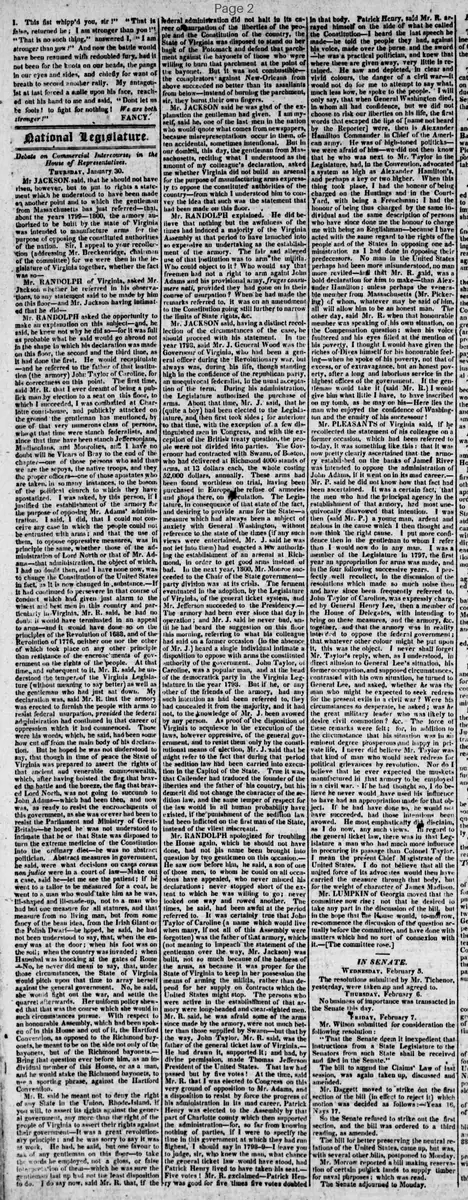
Debate on Commercial Intercourse, in the
House of Representatives.
Thursday, January 30.
Mr. JACKSON said, that he should not have
risen, however, but to put to rights a statement
which he understood to have been made
on another point and to which the gentleman
from Massachusetts has just referred—that,
about the years 1799-1800, the armory authorized
to be built by the state of Virginia
was intended to manufacture arms for the
purpose of opposing the constituted authorities
of the nation. Sir, I appeal to your recollection
(addressing Mr. Breckenridge, chairman
of the committee) for we were then in the legislature
of Virginia together, whether the fact
was so—
Mr. RANDOLPH of Virginia, asked Mr.
Jackson whether he referred in his observations,
to any statement said to be made by him
on this floor—and Mr. Jackson having intimated
that he did—
Mr. RANDOLPH asked the opportunity to
make an explanation on this subject—and, he
said, he knew not why he did so—for it was full
as probable what he said would go abroad not
in the shape in which his declaration was made
on this floor, the second and the third time, as
it had done the first. He would recapitulate
—and he referred to the father of that institution
(the armory) John Taylor of Caroline, for
his correctness on this point. The first time,
said Mr. R. that I ever dreamt of being a publick
man by election to a seat on this floor, to
which I succeeded, I was combated at Charlotte
court-house, and publickly attacked on
the ground the gentleman has mentioned, by
one of that very numerous class of persons,
who at that time were stanch federalists, and
since that time have been stanch Jeffersonians,
Madisonians, and Monroites, and I have no
doubt will be Vicars of Bray to the end of the
chapter—one of those persons who said that
we are the sepoys, the native troops, and they
the proper officers—one of those apostates who
are taken, in so many instances, to the bosom
of the political church to which they have
apostatized. I was asked, by this person, if I
justified the establishment of the armory for
the purpose of opposing Mr. Adams' administration.
I said, I did, that I could not conceive
any case in which the people could not
be entrusted with arms; and that the use of
them, to oppose oppressive measures, was in
principle the same, whether those of the administration
of Lord North or that of Mr. Adams—that
administration, the object of which,
I had no doubt then, and I have none now, was
to change the Constitution of the United States
in fact, as it is now changed in substance.—If
it had continued to persevere in that course of
conduct which had given just alarm to the
wisest and best men in this country and particularly
in Virginia, Mr. R. said, he had no
doubt it would have terminated in an appeal
to arms—and it would have done so on the
principles of the Revolution of 1688, and of the
Revolution of 1776, neither one nor the other
of which took place on any other principle
than resistance of the encroachments of government
on the rights of the people. At that
time, and subsequent to it, Mr. R. said, he understood
the temper of the Virginia Legislature
(without meaning to say better) as well as
the gentleman who had just sat down. My
declaration was, said Mr. R. that the armory
was erected to furnish the people with arms to
resist federal usurpation, provided the federal
administration had continued in that career of
oppression which it had commenced. Those
were his words, which, he said, had been somehow
cut off from the main body of his declaration.
But he hoped he was not understood to
say, that though in time of peace the State of
Virginia was prepared to assert the rights of
that ancient and venerable commonwealth,
which, after having hoisted the flag that brayed
the battle and the breeze, the flag that braved
Lord North, was not going to succumb to
John Adams—which had been then, and now
was, as ready to resist the encroachments of
this government, as she was or ever had been to
resist the Parliament and Ministry of Great
Britain—he hoped he was not understood to
intimate that he or that State was disposed to
turn the extreme medicine of the Constitution
into the ordinary diet—he was no abstract
politician. Abstract measures in government,
he said, were what decisions on cases coram
non judice were in a court of law—Make out
a case, said he—let me see the patient; if he
went to a tailor to be measured for a coat, he
went to a man who would take him as he was,
ill-shaped and ill-made-up, not to a man who
had but one measure for all statures, and that
measure from no living man, but from some
fancy of the beau ideal, from the Irish Giant or
the Polish Dwarf—he hoped, he said, he had
not been understood to say, that, when the enemy
was at the door; when his foot was on
the soil; when the country was invaded; when
Hannibal was knocking at the gates of Rome
No, he never did mean to say, that, under
those circumstances, the State of Virginia
would pitch upon that time to array herself
against the general government. No, he said,
she would fight out the war, and settle the
quarrel afterwards. Her uniform policy showed
that that was the course which she would in
such circumstances pursue. With respect to
an honourable Assembly, which had been spoken
of in this House and out of it, the Hartford
Convention, as opposed to the Richmond bayonets,
he meant to be on the side not only of the
bayonets, but of the Richmond bayonets.—
Bring that question ever before him, as an individual
member of this House, or as a man,
and he would stake the Richmond bayonets, to
use a sporting phrase, against the Hartford
Convention.
Mr. R. said he meant not to deny the right
of any State in the Union. Rhode-Island, if
you will, to assert its rights against the general
government, any more than the right of the
people of Virginia to assert their rights against
their government—It was a great revolutionary
principle; and he was sorry to say it was
at work. He had, he said, but one favour to
ask of any gentleman on this floor—to take
the words he employed, not a gloss, or false
interpretation of them—which he was sure the
gentleman last up had not the least disposition
to do. I do say now, said Mr. R. that, if the
Federal administration did not halt in its career
of usurpation of the liberties of the people
and the Constitution of the country, the
State of Virginia was disposed to stand on her
bank of the Potomac and defend that parchment
against the bayonets of those who were
willing to burn that parchment at the point of
the bayonet. But it was not combustible—
the conspirators against New-Orleans from
above succeeded no better than its assailants
from below—instead of burning the parchment,
sir, they burnt their own fingers.
Mr. JACKSON said he was glad of the explanation
the gentleman had given. I am myself,
said he, one of the last men in the nation
who would quote what comes from newspapers,
because misrepresentations occur in them, of
ten accidental, sometimes intentional. But in
our domestic, this day, the gentleman from Massachusetts,
reciting what I understood as the
amount of my colleague's declaration, asked
me whether Virginia did not build an arsenal
for the purpose of manufacturing arms expressly
to oppose the constituted authorities of the
country—from which I understood him to convey
the idea that such was the statement that
had been made on this floor.
Mr. RANDOLPH explained. He did believe
that nothing but the awfulness of the
times had induced a majority of the Virginia
Assembly at that period to have launched into
so expensive an undertaking as the establishment
of the armory. The fair and alleged
use of that institution was to arm the militia.
Who could object to it? Who would say that
freemen had not a right to arm against John
Adams and his provisional army, fruges consumere
nati, provided they had gone on in their
course of usurpation? When he had made the
remarks referred to, it was on an amendment
to the Constitution going still further to narrow
the limits of State rights, &c.
Mr. JACKSON said, having a distinct recollection
of the circumstances of the case, he
should proceed with his statement. In the
year 1798, said Mr. J. General Wood was the
Governour of Virginia, who had been a general
officer during the Revolutionary war, but
always was, during his life, though standing
high in the confidence of the republican party.
an unequivocal federalist, in the usual acceptation
of the term. During his administration,
the Legislature authorized the purchase of
arms. About that time, Mr. J. said, that he
(quite a boy) had been elected to the Legislature,
and then first took sides; for anterior
to that time, with the exception of a few distinguished
men in Congress, and with the exception
of the British treaty question, the people
were not divided into parties. The Governour
had contracted with Swann, of Boston,
who had delivered at Richmond 4000 stands of
arms, at 13 dollars each, the whole costing
52,000 dollars, annually. These arms had
been found worthless on trial, having been
purchased in Europe. the refuse of armories
and shops there, on speculation. The Legislature,
in consequence of that state of the fact,
and desiring to provide arms for the State—a
measure which had always been a subject of
anxiety with General Washington, without
reference to the state of the times (if any such
views were entertained, Mr. J. said he was
not let into them) had enacted a law authorizing
the establishment of an arsenal at Richmond,
in order to get good arms instead of
bad. In the next year, 1800, Mr. Monroe succeeded
to the Chair of the State government—
party division was at its crisis. The ferment
eventuated in the adoption, by the Legislature
of Virginia, of the general ticket system, and
Mr. Jefferson succeeded to the Presidency.—
The armory had been ever since that day in
operation; and Mr. J. said he never had, until
he had heard the suggestion on this floor
this morning, referring to what his colleague
had said on a former occasion (in the absence
of Mr. J.) heard a single individual intimate a
disposition to oppose with arms the constituted
authority of the government. John Taylor, of
Caroline, was a popular man, and at the head
of the democratick party in the Virginia Legislature
in the year 1798. But if he, or any
other of the friends of the armory, had any
such intention as had been referred to, they
had concealed it from the majority, and it had
not, to the knowledge of Mr. J. been avowed
by any person. As proof of the disposition of
Virginia to acquiesce in the execution of the
laws, however oppressive, of the general government,
and to resist them only by the constitutional
means of election, Mr. J. said that he
might refer to the fact that during that period
the sedition law had been carried into execution
in the Capitol of the State. True it was,
that Callender had traduced the founder of the
liberties and the father of his country, but his
demerit did not change the character of the sedition
law, and the same temper of respect for
the law would in all human probability have
existed, if the punishment of the sedition law
had been inflicted on the first man of the State,
instead of the vilest miscreant.
Mr. RANDOLPH apologized for troubling
the House again, which he should not have
done, had not his name been brought into
question by two gentlemen on this occasion.—
He saw now before him, he said, a son of one
of those men, to whom he could on all occasions
have appealed, who never minced his
declarations; never stopped short of the extent
to which he was willing to go; never
looked one way and rowed another. The
times, he said, had been awful at the period
referred to. It was certainly true that John
Taylor of Caroline (a name which would live
when many, if not all of this Assembly were
forgotten) was the father of that armory, which
(not meaning to impeach the statement of the
gentleman over the way, Mr. Jackson) was
built, not so much because of the badness of
the arms, as because it was proper for the
State of Virginia to keep in her possession the
means of arming the militia, rather than depend
for her supply on contracts which the
United States might stop. The persons who
were active in the establishment of that armory
were long-headed and clear-sighted men.
Mr. R. said, he was afraid some of the arms
since made by the armory, were not much better
than those supplied by Swann—but that
by the way. John Taylor, Mr. R. said, was the
father of the general ticket law of Virginia.—
He had drawn it, supported it; and had, by
divine permission, made Thomas Jefferson
President of the United States. That law had
passed but by five votes! At the time, said
Mr. R. that I was elected to Congress on this
very ground of opposition to Mr. Adams, and
a disposition to resist by force the progress of
his administration in its mad career, Patrick
Henry was elected to the Assembly by that
part of Charlotte county which then supported
the administration—for, so far from knowing
nothing of parties, if I were to specify the
time in this government at which they had run
highest, I should say in 1798-9—I leave you
to judge, sir, who knew the man, what chance
the general ticket law would have stood, had
Patrick Henry lived to have taken his seat.—
Five votes! Mr. R. exclaimed—Patrick Henry
was good for five times five votes doubled
in that body. Patrick Henry, said Mr. R. arrayed
himself on the side of what he called
the Constitution—I heard this last speech he
made—he told the people they had, against
his voice, made over the purse and the sword
he was a practical politician, and knew that
where these are given away, very little is retained.
He saw and depicted, in clear and
vivid colours, the danger of a civil war—it
would not do for me to attempt to say what,
much less how, he spoke to the people. I will
only say, that when General Washington died,
in whom all had confidence, but we did not
choose to risk our liberties on his life, the first
words that escaped the lips of [name not heard
by the Reporter) were, then is Alexander
Hamilton Commander in Chief of the American
army. He was of high-toned politicks—
we were afraid of him—we did not then know
that he who was next to Mr. Taylor in the
Legislature, had, in the Convention, advocated
a system as high as Alexander Hamilton's,
and perhaps a key or two higher. When this
thing took place, I had the honour of being
charged on the Hustings and in the Court-
Yard, with being a Frenchman; I had the
honour of being thus charged by the same individual
and the same description of persons
who have since done me the honour to charge
me with being an Englishman—because I have
acted with the same regard to the rights of the
people and of the States in opposing one administration
as I had done in opposing their
predecessors. No man in the United States
perhaps had been more misunderstood, no man
more reviled—at that Mr. R. said, was a
bold declaration for him to make than Alexander
Hamilton; unless perhaps the venerable
member from Massachusetts (Mr. Pickering)
of whom, whatever may be said of him,
all will allow him to be an honest man. The
other day, said Mr. R. when that honourable
member was speaking of his own situation, on
the Compensation question; when his voice
faultered and his eyes filled at the mention of
his poverty, I thought I would have given the
riches of Dives himself for his honourable feeling—when
he spoke of his poverty, not that of
excess, or of extravagance, but an honest poverty,
after a long and laborious service in the
highest offices of the government. If the gentleman
would take it (said Mr. R.) I would
give him what little I have, to have inscribed
on my tomb, as he may on his—Here lies the
man who enjoyed the confidence of Washington
and the enmity of his successor!
Mr. PLEASANTS of Virginia said, if he
recollected the statement of his colleague on a
former occasion, which had been referred to
to-day, it was something like this: that it was
now pretty clearly ascertained that the armory
established on the banks of James River
was intended to oppose the administration of
John Adams, if it went on in its mad career.—
Mr. P. said he did not know how that fact had
been ascertained. It was a certain fact; that
the men who had the principal agency in the
establishment of that armory, had most unequivocally
disavowed that intention. I was
then (said Mr. P.) a young man, ardent and
zealous in the cause which I then thought and
now think the right cause. I put more confidence
then in the gentleman to whom I refer
than I would now do in any man. I was a
member of the Legislature in 1797, the first
year an appropriation for arms was made, and
in the four following successive years. I perfectly
well recollect, in the discussion of the
resolutions which made so much noise then
and have since been frequently referred to,
John Taylor of Caroline, was expressly charged
by General Henry Lee, then a member of
the House of Delegates, with intending to
bring on these measures, and the armory, &c.
together, and that the armory was in reality
intended to oppose the federal government;
that whatever other colour might be put upon
it, this was the object. I never shall forget
Mr. Taylor's reply, when, as I understood, in
direct allusion to General Lee's situation, his
former occupation, and supposed circumstances,
contrasted with his own situation, he turned to
General Lee, and asked, whether he was the
man who might be expected to seek redress
for the present evils in a civil war? Were his
circumstances so desperate, he asked; was he
the great military leader who was likely to
desire civil commotion? &c. The force of
these remarks were felt; for, in addition to
the circumstance that his situation was in an
eminent degree prosperous and happy in private
life, I never did believe Mr. Taylor was
that kind of man who would seek redress for
political grievances by revolution, Nor do I
believe that he ever expected the muskets
manufactured in that armory to be employed
in a civil war. If he had thought so, I do believe
he never would have used his influence
to have had an appropriation made for that object.
If he had have done so, he would not
have succeeded, had those intentions been
avowed. He most emphatically did disclaim,
as I do now, any such views. In regard to
the general ticket law, there was in that Legislature
a man who had much more influence
in procuring its passage than Colonel Taylor.
I mean the present Chief Magistrate of the
United States. I do not believe that all the
united force of its advocates would then have
carried the measure through that body, but
for the weight of character of James Madison.
Mr. LUMPKIN of Georgia moved that the
committee now rise; not that he desired to
take any part in the discussion of the bill, but
in the hope that the House would, to-morrow,
re-commence the discussion of the question actually
before the committee, and have done with
matters which had no sort of connexion with
it.—[The committee rose.]
What sub-type of article is it?
What themes does it cover?
What keywords are associated?
What entities or persons were involved?
Where did it happen?
Story Details
Key Persons
Location
House Of Representatives
Event Date
Thursday, January 30
Story Details
Debate in the House where Mr. Jackson and Mr. Randolph clarify statements about the Virginia armory established in 1799-1800, asserting it was to arm the militia against potential federal usurpation under Adams' administration, not to oppose constituted authorities, drawing on revolutionary principles.