Thank you for visiting SNEWPapers!
Sign up free
Literary
September 30, 1789
Gazette Of The United States
New York, New York County, New York
What is this article about?
An essay from 'THE TABLET.-No. XLIX.' defends the coxcomb's character, arguing he is active in pursuing fashion, immune to romantic entanglements due to self-admiration, and guarded against vices like intemperance, making it a relatively unexceptionable trait for a vain youth with limited talents.
Clipping
OCR Quality
98%
Excellent
Full Text
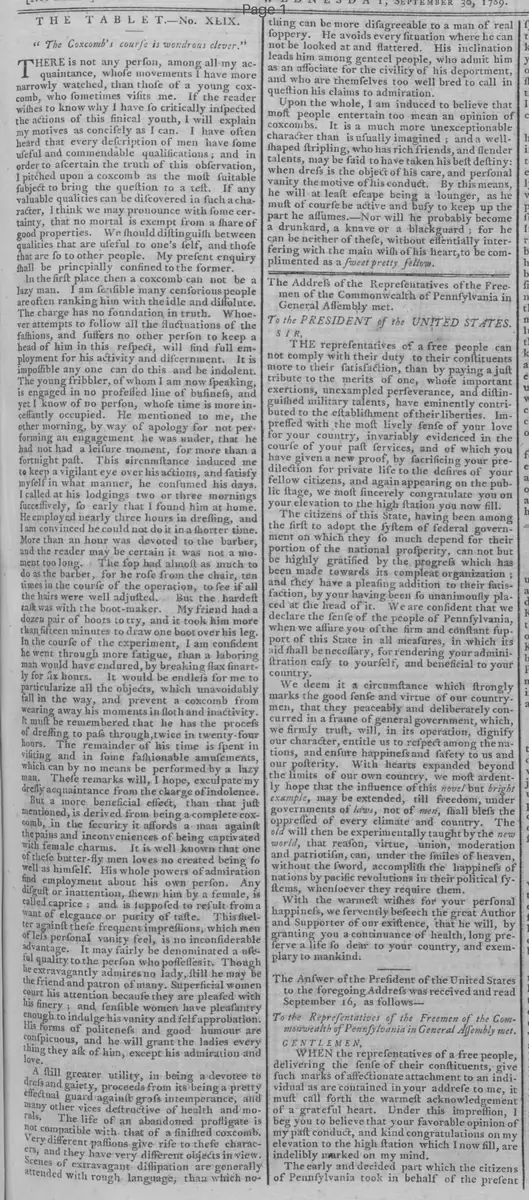
THE TABLET.-No. XLIX.
"The Coxcomb's course is wondrous clever."
There is not any person, among all my acquaintance, whose movements I have more narrowly watched, than those of a young coxcomb, who sometimes visits me. If the reader wishes to know why I have so critically inspected the actions of this finical youth, I will explain my motives as concisely as I can. I have often heard that every description of men have some useful and commendable qualifications; and in order to ascertain the truth of this observation, I pitched upon a coxcomb as the most suitable subject to bring the question to a test. If any valuable qualities can be discovered in such a character, I think we may pronounce with some certainty, that no mortal is exempt from a share of good properties. We should distinguish between qualities that are useful to one's self, and those that are so to other people. My present enquiry shall be principally confined to the former.
In the first place then a coxcomb cannot be a lazy man. I am sensible many censorious people are often ranking him with the idle and dissolute. The charge has no foundation in truth. Whoever attempts to follow all the fluctuations of the fashions, and suffers no other person to keep a head of him in this respect, will find full employment for his activity and discernment. It is impossible any one can do this and be indolent. The young fribbler, of whom I am now speaking, is engaged in no professed line of business, and yet I know of no person, whose time is more incessantly occupied. He mentioned to me, the other morning, by way of apology for not performing an engagement he was under, that he had not had a leisure moment, for more than a fortnight past. This circumstance induced me to keep a vigilant eye over his actions, and satisfy myself in what manner, he consumed his days.
I called at his lodgings two or three mornings successively, so early that I found him at home. He employed nearly three hours in dressing, and I am convinced he could not do it in a shorter time. More than an hour was devoted to the barber, and the reader may be certain it was not a moment too long. The fop had almost as much to do as the barber, for he rose from the chair, ten times in the course of the operation, to see if all the hairs were well adjusted. But the hardest task was with the boot-maker. My friend had a dozen pair of boots to try, and it took him more than fifteen minutes to draw one boot over his leg. In the course of the experiment, I am confident he went through more fatigue, than a laboring man would have endured, by breaking flax smartly for six hours. It would be endless for me to particularize all the objects, which unavoidably fall in the way, and prevent a coxcomb from wearing away his moments in sloth and inactivity.
It must be remembered that he has the process of dressing to pass through, twice in twenty-four hours. The remainder of his time is spent in visiting and in some fashionable amusements, which can by no means be performed by a lazy man. These remarks will, I hope, exculpate my dressy acquaintance from the charge of indolence.
But a more beneficial effect, than that just mentioned, is derived from being a complete coxcomb, in the security it affords a man against the pains and inconveniences of being captivated with female charms. It is well known that one of these butterfly men loves no created being so well as himself. His whole powers of admiration find employment about his own person. Any disgust or inattention, shown him by a female, is called caprice; and is supposed to result from a want of elegance or purity of taste. This shelter against these frequent impressions, which men of less personal vanity feel, is no inconsiderable advantage. It may fairly be denominated a useful quality to the person who possesses it. Though he extravagantly admires no lady, still he may be the friend and patron of many. Superficial women court his attention because they are pleased with his finery; and sensible women have pleasantry enough to indulge his vanity and self-approbation.
His forms of politeness and good humour are conspicuous, and he will grant the ladies every thing they ask of him, except his admiration and love.
A still greater utility, in being a devotee to dress and gaiety, proceeds from its being a pretty effectual guard against gross intemperance, and many other vices destructive of health and morals. The life of an abandoned profligate is not compatible with that of a finished coxcomb. Very different passions give rise to these characters, and they have very different objects in view. Scenes of extravagant dissipation are generally attended with rough language, than which nothing can be more disagreeable to a man of real foppery. He avoids every situation where he cannot be looked at and flattered. His inclination leads him among genteel people, who admit him as an associate for the civility of his deportment, and who are themselves too well bred to call in question his claims to admiration.
Upon the whole, I am induced to believe that most people entertain too mean an opinion of coxcombs. It is a much more unexceptionable character than is usually imagined; and a well-shaped stripling, who has rich friends, and slender talents, may be said to have taken his best destiny: when dress is the object of his care, and personal vanity the motive of his conduct. By this means, he will at least escape being a lounger, as he must of course be active and busy to keep up the part he assumes. Nor will he probably become a drunkard, a knave or a blackguard; for he can be neither of these, without essentially interfering with the main wish of his heart, to be complimented as a sweet pretty fellow.
"The Coxcomb's course is wondrous clever."
There is not any person, among all my acquaintance, whose movements I have more narrowly watched, than those of a young coxcomb, who sometimes visits me. If the reader wishes to know why I have so critically inspected the actions of this finical youth, I will explain my motives as concisely as I can. I have often heard that every description of men have some useful and commendable qualifications; and in order to ascertain the truth of this observation, I pitched upon a coxcomb as the most suitable subject to bring the question to a test. If any valuable qualities can be discovered in such a character, I think we may pronounce with some certainty, that no mortal is exempt from a share of good properties. We should distinguish between qualities that are useful to one's self, and those that are so to other people. My present enquiry shall be principally confined to the former.
In the first place then a coxcomb cannot be a lazy man. I am sensible many censorious people are often ranking him with the idle and dissolute. The charge has no foundation in truth. Whoever attempts to follow all the fluctuations of the fashions, and suffers no other person to keep a head of him in this respect, will find full employment for his activity and discernment. It is impossible any one can do this and be indolent. The young fribbler, of whom I am now speaking, is engaged in no professed line of business, and yet I know of no person, whose time is more incessantly occupied. He mentioned to me, the other morning, by way of apology for not performing an engagement he was under, that he had not had a leisure moment, for more than a fortnight past. This circumstance induced me to keep a vigilant eye over his actions, and satisfy myself in what manner, he consumed his days.
I called at his lodgings two or three mornings successively, so early that I found him at home. He employed nearly three hours in dressing, and I am convinced he could not do it in a shorter time. More than an hour was devoted to the barber, and the reader may be certain it was not a moment too long. The fop had almost as much to do as the barber, for he rose from the chair, ten times in the course of the operation, to see if all the hairs were well adjusted. But the hardest task was with the boot-maker. My friend had a dozen pair of boots to try, and it took him more than fifteen minutes to draw one boot over his leg. In the course of the experiment, I am confident he went through more fatigue, than a laboring man would have endured, by breaking flax smartly for six hours. It would be endless for me to particularize all the objects, which unavoidably fall in the way, and prevent a coxcomb from wearing away his moments in sloth and inactivity.
It must be remembered that he has the process of dressing to pass through, twice in twenty-four hours. The remainder of his time is spent in visiting and in some fashionable amusements, which can by no means be performed by a lazy man. These remarks will, I hope, exculpate my dressy acquaintance from the charge of indolence.
But a more beneficial effect, than that just mentioned, is derived from being a complete coxcomb, in the security it affords a man against the pains and inconveniences of being captivated with female charms. It is well known that one of these butterfly men loves no created being so well as himself. His whole powers of admiration find employment about his own person. Any disgust or inattention, shown him by a female, is called caprice; and is supposed to result from a want of elegance or purity of taste. This shelter against these frequent impressions, which men of less personal vanity feel, is no inconsiderable advantage. It may fairly be denominated a useful quality to the person who possesses it. Though he extravagantly admires no lady, still he may be the friend and patron of many. Superficial women court his attention because they are pleased with his finery; and sensible women have pleasantry enough to indulge his vanity and self-approbation.
His forms of politeness and good humour are conspicuous, and he will grant the ladies every thing they ask of him, except his admiration and love.
A still greater utility, in being a devotee to dress and gaiety, proceeds from its being a pretty effectual guard against gross intemperance, and many other vices destructive of health and morals. The life of an abandoned profligate is not compatible with that of a finished coxcomb. Very different passions give rise to these characters, and they have very different objects in view. Scenes of extravagant dissipation are generally attended with rough language, than which nothing can be more disagreeable to a man of real foppery. He avoids every situation where he cannot be looked at and flattered. His inclination leads him among genteel people, who admit him as an associate for the civility of his deportment, and who are themselves too well bred to call in question his claims to admiration.
Upon the whole, I am induced to believe that most people entertain too mean an opinion of coxcombs. It is a much more unexceptionable character than is usually imagined; and a well-shaped stripling, who has rich friends, and slender talents, may be said to have taken his best destiny: when dress is the object of his care, and personal vanity the motive of his conduct. By this means, he will at least escape being a lounger, as he must of course be active and busy to keep up the part he assumes. Nor will he probably become a drunkard, a knave or a blackguard; for he can be neither of these, without essentially interfering with the main wish of his heart, to be complimented as a sweet pretty fellow.
What sub-type of article is it?
Essay
Satire
What themes does it cover?
Social Manners
Moral Virtue
What keywords are associated?
Coxcomb
Fashion
Vanity
Indolence
Intemperance
Social Virtues
Literary Details
Title
The Tablet. No. Xlix.
Subject
On The Useful Qualities Of A Coxcomb
Form / Style
Observational Prose Essay
Key Lines
"The Coxcomb's Course Is Wondrous Clever."
If Any Valuable Qualities Can Be Discovered In Such A Character, I Think We May Pronounce With Some Certainty, That No Mortal Is Exempt From A Share Of Good Properties.
Upon The Whole, I Am Induced To Believe That Most People Entertain Too Mean An Opinion Of Coxcombs.