Thank you for visiting SNEWPapers!
Sign up free
Story
March 6, 1840
Burlington Free Press
Burlington, Chittenden County, Vermont
What is this article about?
An article quotes John M. Niles' book on Perry praising William Henry Harrison's military and civil services, especially the Battle of the Thames in the War of 1812, defending him against critics and highlighting his honorable retirement.
Clipping
OCR Quality
98%
Excellent
Full Text
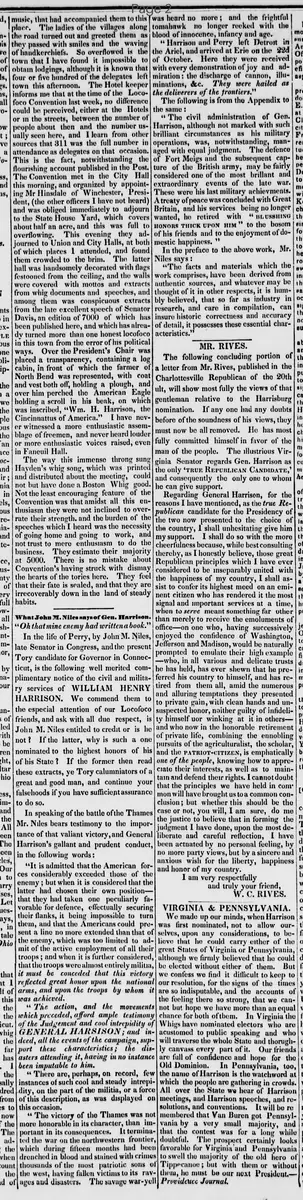
What John M. Niles says of Gen. Harrison.
"Oh that mine enemy had written a book."
In the life of Perry, by John M. Niles, late Senator in Congress, and the present Tory candidate for Governor in Connecticut, is the following well merited complimentary notice of the civil and military services of WILLIAM HENRY HARRISON. We commend them to the especial attention of our Locofoco friends, and ask with all due respect, is John M. Niles entitled to credit or is he not? If the latter, why is such a one nominated to the highest honors of his State? If the former then read these extracts, ye Tory calumniators of a great and good man, and continue your falsehoods if you have sufficient assurance to do so.
In speaking of the battle of the Thames Mr. Niles bears testimony to the importance of that valiant victory, and General Harrison's gallant and prudent conduct, in the following words:
"It is admitted that the American forces considerably exceeded those of the enemy; but when it is considered that the latter had chosen their own position—that they had taken one peculiarly favorable for defence, effectually securing their flanks, it being impossible to turn them, and that the Americans could present a line no more extended than that of the enemy, which was too limited to admit of the active employment of all their troops; and when it is further considered, that the troops were almost entirely militia, it must be conceded that this victory reflected great honor upon the national arms, and upon the troops by whom it was achieved.
"The action, and the movements which preceded, afford ample testimony of the judgment and cool intrepidity of GENERAL HARRISON; and indeed, all the events of the campaign, support these characteristics; the disasters attending it, having in no instance been imputable to him. There are, perhaps, on record, few instances of such cool and steady intrepidity, on the part of the militia, or a force of this description, as was displayed on this occasion.
"The victory of the Thames was not more honorable in its character, than important in its consequences. It terminated the war on the northwestern frontier, which during fifteen months had been drenched in blood and stained with crimes thousands of the most patriotic sons of the west, having fallen victims to its ravages and disasters. The savage war-yell was heard no more; and the frightful tomahawk no longer reeked with the blood of innocence, infancy and age.
"Harrison and Perry left Detroit in the Ariel, and arrived at Erie on the 22d of October. Here they were received with every demonstration of joy and admiration: the discharge of cannon, illuminations, &c. They were hailed as the deliverers of the frontiers."
The following is from the Appendix to the same:
"The civil administration of Gen. Harrison, although not marked with such brilliant circumstances as his military operations, was, notwithstanding, managed with equal judgment. The defence of Fort Meigs and the subsequent capture of the British army, may be fairly considered one of the most brilliant and extraordinary events of the late war. These were his last military achievements. A treaty of peace was concluded with Great Britain, and his services being no longer wanted, he retired with "BLUSHING HONORS THICK UPON HIM" to the bosom of his friends and to the enjoyment of domestic happiness.
"Oh that mine enemy had written a book."
In the life of Perry, by John M. Niles, late Senator in Congress, and the present Tory candidate for Governor in Connecticut, is the following well merited complimentary notice of the civil and military services of WILLIAM HENRY HARRISON. We commend them to the especial attention of our Locofoco friends, and ask with all due respect, is John M. Niles entitled to credit or is he not? If the latter, why is such a one nominated to the highest honors of his State? If the former then read these extracts, ye Tory calumniators of a great and good man, and continue your falsehoods if you have sufficient assurance to do so.
In speaking of the battle of the Thames Mr. Niles bears testimony to the importance of that valiant victory, and General Harrison's gallant and prudent conduct, in the following words:
"It is admitted that the American forces considerably exceeded those of the enemy; but when it is considered that the latter had chosen their own position—that they had taken one peculiarly favorable for defence, effectually securing their flanks, it being impossible to turn them, and that the Americans could present a line no more extended than that of the enemy, which was too limited to admit of the active employment of all their troops; and when it is further considered, that the troops were almost entirely militia, it must be conceded that this victory reflected great honor upon the national arms, and upon the troops by whom it was achieved.
"The action, and the movements which preceded, afford ample testimony of the judgment and cool intrepidity of GENERAL HARRISON; and indeed, all the events of the campaign, support these characteristics; the disasters attending it, having in no instance been imputable to him. There are, perhaps, on record, few instances of such cool and steady intrepidity, on the part of the militia, or a force of this description, as was displayed on this occasion.
"The victory of the Thames was not more honorable in its character, than important in its consequences. It terminated the war on the northwestern frontier, which during fifteen months had been drenched in blood and stained with crimes thousands of the most patriotic sons of the west, having fallen victims to its ravages and disasters. The savage war-yell was heard no more; and the frightful tomahawk no longer reeked with the blood of innocence, infancy and age.
"Harrison and Perry left Detroit in the Ariel, and arrived at Erie on the 22d of October. Here they were received with every demonstration of joy and admiration: the discharge of cannon, illuminations, &c. They were hailed as the deliverers of the frontiers."
The following is from the Appendix to the same:
"The civil administration of Gen. Harrison, although not marked with such brilliant circumstances as his military operations, was, notwithstanding, managed with equal judgment. The defence of Fort Meigs and the subsequent capture of the British army, may be fairly considered one of the most brilliant and extraordinary events of the late war. These were his last military achievements. A treaty of peace was concluded with Great Britain, and his services being no longer wanted, he retired with "BLUSHING HONORS THICK UPON HIM" to the bosom of his friends and to the enjoyment of domestic happiness.
What sub-type of article is it?
Biography
Historical Event
Heroic Act
What themes does it cover?
Bravery Heroism
Triumph
Justice
What keywords are associated?
William Henry Harrison
Battle Of The Thames
John M Niles
War Of 1812
Military Victory
Heroic Conduct
Civil Administration
What entities or persons were involved?
John M. Niles
William Henry Harrison
Perry
Where did it happen?
Northwestern Frontier, Battle Of The Thames, Detroit, Erie
Story Details
Key Persons
John M. Niles
William Henry Harrison
Perry
Location
Northwestern Frontier, Battle Of The Thames, Detroit, Erie
Event Date
22d Of October
Story Details
John M. Niles praises General Harrison's judgment, intrepidity, and leadership in the Battle of the Thames, which ended the northwestern war; highlights his civil administration, defense of Fort Meigs, and honorable retirement after peace with Britain.