Thank you for visiting SNEWPapers!
Sign up free
Daily National Intelligencer
Washington, District Of Columbia
What is this article about?
Henry Clay's speech in the US House defends the War of 1812's justice and outcomes, argues for direct taxes to pay public debt and maintain military preparedness, critiques opponents, and advocates for national defense and internal improvements. Delivered amid post-war fiscal debates around 1816.
Merged-components note: These two components form a continuous speech by Mr. Clay on the direct tax, spanning pages 2 and 3 in sequential reading order.
Clippings
1 of 2
OCR Quality
Full Text
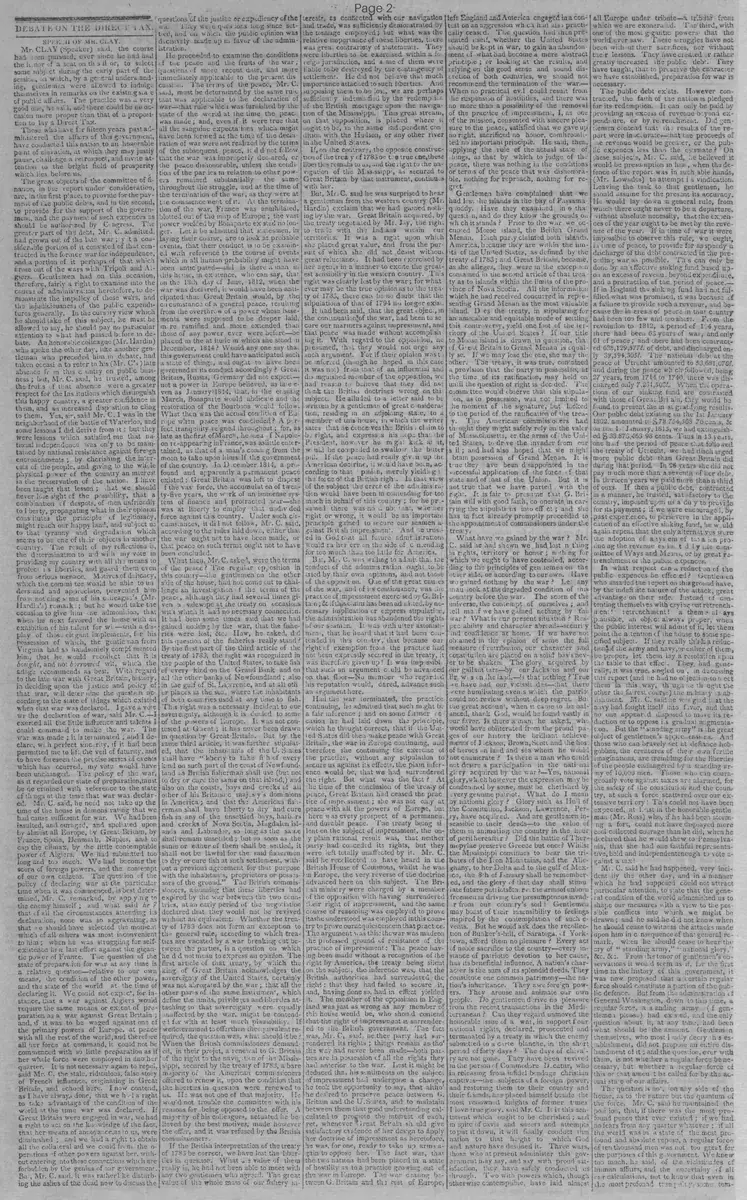
SPEECH OF MR. CLAY.
Mr. CLAY (Speaker) said, the course had been pursued, ever since he had had the honor of a seat on this floor, to select some subject during the early part of the session, on which, by a general understanding, gentlemen were allowed to indulge themselves in remarks on the existing state of public affairs. The practice was a very good one, he said, and there could be no occasion more proper than that of a proposition to lay a Direct Tax.
Those who have for fifteen years past administered the affairs of this government have conducted this nation to an honorable point of elevation, at which they may justly pause, challenge a retrospect, and invite attention to the bright field of prosperity which lies before us.
The great objects of the committee of finance, in the report under consideration, are, in the first place, to provide for the payment of the public debts, and in the second, to provide for the support of the government, and the payment of such expenses as should be authorized by Congress. The greater part of the debt, Mr. C. admitted, had grown out of the late war; yet a considerable portion of it consisted of that contracted in the former war for independence, and a portion of it perhaps of that which arose out of the wars with Tripoli and Algiers. Gentlemen had on this occasion, therefore, fairly a right to examine into the course of administration heretofore, to demonstrate the impolicy of those wars, and the injudiciousness of the public expenditures generally. In the cursory view which he should take of this subject, he must be allowed to say, he should pay no particular attention to what had passed before in debate. An honorable colleague (Mr. Hardin) who spoke the other day, like another gentleman who preceded him in debate, had taken occasion to refer to his (Mr. C's) late absence from this country on public business; but, Mr. C. said, he trusted, among the fruits of that absence were a greater respect for the institutions which distinguish this happy country, a greater confidence in them, and an increased disposition to cling to them. Yes, sir, said Mr. C. I was in the neighborhood of the battle of Waterloo, and some lessons I did derive from it: but they were lessons which satisfied me that national independence was only to be maintained by national resistance against foreign encroachments; by cherishing the interests of the people, and giving to the whole physical power of the country an interest in the preservation of the nation. I have been taught that lesson; that we should never lose sight of the possibility, that a combination of despots, or men unfriendly to liberty, propagating what in their opinion constitutes the principle of legitimacy, might reach our happy land, and subject us to that tyranny and degradation which seems to be one of their objects in another country. The result of my reflections is, the determination to aid with my vote in providing my country with all the means to protect its liberties, and guard them even from serious menace. Motives of delicacy, which the committee would be able to understand and appreciate, prevented him from noticing some of his colleague's (Mr. Hardin's) remarks; but he would take the occasion to give him one admonition, that when he next favored the house with an exhibition of his talent for wit—with a display of those elegant implements, for his possession of which, the gentleman from Virginia had so handsomely complimented him, that he would recollect that it is bought, and not borrowed wit, which the adage recommends as best. With regard to the late war with Great Britain, history, in deciding upon the justice and policy of that war, will determine the question according to the state of things which existed when that war was declared. I gave a vote for the declaration of war, said Mr. C. I exerted all the little influence and talents I could command to make the war. The war was made; it is terminated; and I declare, with perfect sincerity, if it had been permitted me to lift the veil of futurity, and to have foreseen the precise series of events which has occurred, my vote would have been unchanged. The policy of the war, as it regarded our state of preparation, must be determined with reference to the state of things at the time that war was declared. Mr. C. said, he need not take up the time of the house in demonstrating that we had cause sufficient for war. We had been insulted, outraged, and spoliated upon by almost all Europe, by Great Britain, by France, Spain, Denmark, Naples, and to cap the climax, by the little contemptible power of Algiers. We had submitted too long and too much. We had become the scorn of foreign powers, and the contempt of our own citizens. The question of the policy of declaring war at the particular time when it was commenced, is best determined, Mr. C. remarked, by applying to the enemy himself; and what said he? that of all the circumstances attending its declaration, none was so aggravating, as that he should have selected the moment which of all others was most inconvenient to him; when he was struggling for self-existence in a last effort against the gigantic power of France. The question of the state of preparation for war at any time is a relative question—relative to our own means, the condition of the other power, and the state of the world at the time of declaring it. We could not expect, for instance, that a war against Algiers would require the same means or extent of preparation as a war against Great Britain; and, if it was to be waged against one of the primary powers of Europe, at peace with all the rest of the world, and therefore all her force at command, it could not be commenced with so little preparation as it was, when her whole force were employed in another quarter. It is not necessary again to repel, said Mr. C. the stale, ridiculous, false story of French influence, originating in Great Britain, and echoed here. I now contend, as I have always done, that we had a right to take advantage of the condition of the world at the time war was declared. If Great Britain were engaged in war, we had a right to act on the knowledge of the fact, that her means of annoyance, as to us, were diminished: and we had a right to obtain all the collateral aid we could from the operations of other powers against her, without entering into those connections which are forbidden by the genius of our government.
But, Mr. C. said, it was rather like disturbing the ashes of the dead now to discuss the questions of the justice or expediency of the war. They were questions long since settled, and on which the public opinion was decisively made up in favor of the administration.
He proceeded to examine the conditions of the peace and the fruits of the war; questions of more recent date, and more immediately applicable to the present discussion. The terms of the peace, Mr. C. said, must be determined by the same rule that was applicable to the declaration of war—that rule which was furnished by the state of the world at the time the peace was made; and, even if it were true that all the sanguine expectations which might have been formed at the time of the declaration of war were not realized by the terms of the subsequent peace, it did not follow that the war was improperly declared, or the peace dishonorable, unless the condition of the parties in relation to other powers remained substantially the same throughout the struggle, and at the time of the termination of the war, as they were at the commencement of it. At the termination of the war, France was annihilated, blotted out of the map of Europe: the vast power wielded by Bonaparte existed no longer. Let it be admitted that statesmen, in laying their course, are to look at probable events, that their conduct is to be examined with reference to the course of events which in all human probability might have been anticipated—and is there a man in this house, in existence, who can say, that on the 18th day of June, 1812, when the war was declared, it would have been anticipated that Great Britain would, by the circumstance of a general peace, resulting from the overthrow of a power whose foundations were supposed to be deeper laid, more ramified and more extended than those of any power ever were before—be placed in the attitude in which she stood in December, 1814? Would any one say that this government could have anticipated such a state of things, and ought to have been governed in its conduct accordingly? Great Britain, Russia, Germany did not expect—not a power in Europe believed, as late even as January 1814, that, in the ensuing March, Bonaparte would abdicate and the restoration of the Bourbons would follow.
What then was the actual condition of Europe when peace was concluded? A perfect tranquility reigned throughout; for, as late as the first of March, the idea of Napoleon re-appearing in France, was as little entertained, as that of a man's coming from the moon to take upon himself the government of the country. In December 1814, a profound and apparently a permanent peace existed: Great Britain was left to dispose of the vast force, the accumulation of twenty-five years, the work of an immense system of finance and protracted war—she was at liberty to employ that undivided force against this country. Under such circumstances, it did not follow, Mr. C. said, according to the rules laid down, either that the war ought not to have been made, or that peace on such terms ought not to have been concluded.
What then, Mr. C. asked, were the terms of the peace? The regular opposition in this country—the gentlemen on the other side of the house, had not come out to challenge an investigation of the terms of the peace, although they had several times given a sidewipe at the treaty on occasions with which it had no necessary connection. It had been sometimes said that we had gained nothing by the war, that the fisheries were lost, &c. How, he asked, did this question of the fisheries really stand? By the first part of the third article of the treaty of 1783, the right was recognized in the people of the United States, to take fish of every kind on the Grand Bank and on all the other banks of Newfoundland; also in the gulf of St. Lawrence, and at all other places in the sea, where the inhabitants of both countries used at any time to fish. This right was a necessary incident to our sovereignty, although it is denied to some of the powers of Europe. It was not contested at Ghent: it has never been drawn in question by Great Britain. But by the same third article, it was further stipulated, that the inhabitants of the United States shall have "liberty to take fish of every kind on such part of the coast of Newfoundland as British fishermen shall use (but not to dry or cure the same on that island,) and also on the coasts, bays and creeks of all other of his Britannic majesty's dominions in America; and that the American fishermen shall have liberty to dry and cure fish in any of the unsettled bays, harbors and creeks of Nova Scotia, Magdalen Islands and Labrador, so long as the same shall remain unsettled: but so soon as the same or either of them shall be settled, it shall not be lawful for the said fishermen to dry or cure fish at such settlement, without a previous agreement for that purpose with the inhabitants, proprietors or possessors of the ground." The British commissioners, assuming that these liberties had expired by the war between the two countries, at an early period of the negotiation declared that they would not be revived without an equivalent. Whether the treaty of 1783 does not form an exception to the general rule, according to which treaties are vacated by a war breaking out between the parties, is a question on which he did not mean to express an opinion. The first article of that treaty, by which the king of Great Britain acknowledges the sovereignty of the United States, certainly was not abrogated by the war; that all the other parts of the same instrument, which define the limits, privileges and liberties attaching to that sovereignty were equally unaffected by the war, might be contended for with at least much plausibility. If we determined to offer them the equivalent required, the question was, what should it be? When the British commissioners demanded, in their projet, a renewal to G. Britain of the right to the navigation of the Mississippi, secured by the treaty of 1783, a bare majority of the American commissioners offered to renew it, upon the condition that the liberties in question were renewed to us. He was not one of that majority. He would not trouble the committee with his reasons for being opposed to the offer. A majority of his colleagues, actuated he believed by the best motives, made however the offer, and it was refused by the British commissioners.
If the British interpretation of the treaty of 1783 be correct, we have lost the liberties in question. What their value really is, he had not been able to meet with any two gentlemen who agreed. The great value of the whole mass of our fishery interests, as connected with our navigation and trade, was sufficiently demonstrated by the tonnage employed; but what was the relative importance of these liberties, there was great contrariety of statements. They were liberties to be exercised within a foreign jurisdiction, and some of them were liable to be destroyed by the contingency of settlement. He did not believe that much importance attached to such liberties. And supposing them to be lost, we are perhaps sufficiently indemnified by the redemption of the British mortgage upon the navigation of the Mississippi. This great stream, on that supposition, is placed where it ought to be, in the same independent condition with the Hudson, or any other river in the United States.
If, on the contrary, the opposite construction of the treaty of 1783 be the true one, these liberties remain to us, and the right to the navigation of the Mississippi, as secured to Great Britain by that instrument, continues with her.
But, Mr. C. said he was surprised to hear a gentleman from the western country (Mr. Hardin) exclaim that we had gained nothing by the war. Great Britain acquired, by the treaty negotiated by Mr. Jay, the right to trade with the Indians within our territories. It was a right upon which she placed great value, and from the pursuit of which she did not desist without great reluctance. It had been exercised by her agents in a manner to excite the greatest sensibility in the western country. This right was clearly lost by the war; for whatever may be the true opinion as to the treaty of 1783, there can be no doubt that the stipulations of that of 1794 no longer exist.
It had been said, that the great object, in the continuation of the war, had been to secure our mariners against impressment, and that peace was made without accomplishing it. With regard to the opposition, he presumed, that they would not urge any such argument. For if their opinion was to be inferred (though he hoped in this case it was not) from that of an influential and distinguished member of the opposition, we had reason to believe that they did not think the British doctrines wrong on this subject. He alluded to a letter said to be written by a gentleman of great consideration, residing in an adjoining state, to a member of this house, in which the writer states that he conceives the British claim to be right, and expresses his hope that the President, however he might kick at it, will be compelled to swallow the bitter pill. If the peace had really given up the American doctrine, it would have been, according to that opinion, merely yielding to the force of the British right. In that view of the subject the error of the administration would have been in contending for too much in behalf of this country; or he presumed there was no doubt that, whether right or wrong, it would be an important principle gained to secure our seamen against British impressment. And he trusted in God that all future administrations would rather err on the side of contending for too much than too little for America.
But, Mr. C. was willing to admit that the conduct of the administration ought to be tried by their own opinions, and not those of the opposition. One of the great causes of the war, and of its continuance, was the practice of impressment exercised by G. Britain; & if this claim has been admitted by necessary implication or express stipulation, the administration has abandoned the rights of our seamen. It was with utter astonishment, that he heard that it had been contended in this country, that because our right of exemption from the practice had not been expressly secured in the treaty, it was therefore given up! It was impossible that such an argument could be advanced on that floor—no member who regarded his reputation would dare, advance such an argument here.
Had the war terminated, the practice continuing, he admitted that such might be a fair inference; and on some former occasion he had laid down the principle, which he thought correct, that if the United States did then make peace with Great Britain, the war in Europe continuing, and therefore she continuing the exercise of the practice, without any stipulation to secure us against its effects, the plain inference would be, that we had surrendered the right. But what was the fact? At the time of the conclusion of the treaty of peace, Great Britain had ceased the practice of impressment; she was not only at peace with all the powers of Europe, but there was every prospect of a permanent and durable peace. The treaty being silent on the subject of impressment, the only plain rational result was, that neither party had conceded its rights, but they were left totally unaffected by it. Mr. C. said he recollected to have heard in the British House of Commons, whilst he was in Europe, the very reverse of the doctrine advanced here on this subject. The British ministry were charged by a member of the opposition with having surrendered their right of impressment, and the same course of reasoning was employed to prove it as he understood was employed in this country to prove our acquiescence in that practice. The argument was this: the war was made on the professed ground of resistance of the practice of impressment: the peace having been made without a recognition of the right by America, the treaty being silent on the subject, the inference was, that the British authorities had surrendered the right: that they had failed to secure it, and, having done so, had in effect yielded it. The member of the opposition in England was just as wrong as any member of this house would be, who should contend that the right of impressment is surrendered to the British government. The fact was, Mr. C. said, neither party had surrendered its rights; things remain as though the war had never been made—both parties are in possession of all the rights they had anterior to the war. Lest it might be deduced that his sentiments on the subject of impressment had undergone a change, he took the opportunity to say, that although he desired to preserve peace between G. Britain and the United States, and to maintain between them that good understanding calculated to promote the interest of each, yet, whenever Great Britain should give satisfactory evidence of her design to apply her doctrine of impressment as heretofore, he was, for one, ready to take up arms again to oppose her. The fact was, that the two nations had been placed in a state of hostility as to a practice growing out of the war in Europe. The war ceasing between G. Britain and the rest of Europe, left England and America engaged in a contest on an aggression which had also practically ceased. The question had then presented itself, whether the United States should be kept in war, to gain an abandonment of what had become a mere abstract principle; or looking at the results, and relying on the good sense and sound discretion of both countries, we should not recommend the termination of the war. When no practical evil could result from the suspension of hostilities, and there was no more than a possibility of the removal of the practice of impressment, I, as one of the mission, consented with sincere pleasure to the peace, satisfied that we gave up no right, sacrificed no honor, committed no important principle. He said, then, applying the rule of the actual state of things, as that by which to judge of the peace, there was nothing in the conditions or terms of the peace that was dishonorable, nothing for reproach, nothing for regret.
Gentlemen have complained that we had lost the islands in the bay of Passamaquoddy. Have they examined into that question, and do they know the grounds on which it stands? Prior to the war we occupied Moose island, the British Grand Menan. Each party claimed both islands. America, because they are within the limits of the United States, as defined by the treaty of 1783; and Great Britain, because, as she alleges, they were in the exception contained in the second article of that treaty as to islands within the limits of the province of Nova Scotia. All the information which he had received concurred in representing Grand Menan as the most valuable island. Does the treaty, in stipulating for an amicable and equitable mode of settling this controversy, yield one foot of the territory of the United States? If our title to Moose island is drawn in question, that of Great Britain to Grand Menan is equally so. If we may lose the one, she may the other. The treaty, it was true, contained a provision that the party in possession, at the time of its ratification, may hold on until the question of right is decided. The committee would observe that this stipulation, as to possession, was not limited to the moment of the signature, but looked to the period of the ratification of the treaty. The American commissioners had thought they might safely rely on the valor of Massachusetts, or the arms of the United States, to drive the invader from our soil; and had also hoped that we might obtain possession of Grand Menan. It is true they have been disappointed in the successful application of the force of that state and of that of the Union. But it is not true that we have parted with the right. It is fair to presume that G. Britain will with good faith, co-operate in carrying the stipulations into effect; and she has in fact already promptly proceeded to the appointment of commissioners under the treaty.
What have we gained by the war? Mr. C. said he had shewn we had lost nothing in rights, territory or honor; nothing for which we ought to have contended, according to the principles of gentlemen on the other side, or according to our own. Have we gained nothing by the war? Let any man look at the degraded condition of this country before the war. The scorn of the universe, the contempt of ourselves; and tell me if we have gained nothing by the war? What is our present situation? Respectability and character abroad—security and confidence at home. If we have not obtained in the opinion of some the full measure of retribution, our character and constitution are placed on a solid basis never to be shaken. The glory acquired by our gallant tars—by our Jacksons and our Browns on the land,—is that nothing? True we have had our vicissitudes—that there were humiliating events which the patriot could not review without deep regret. But the great account, when it came to be balanced, thank God, would be found vastly in our favor. Is there a man, he asked, who would have obliterated from the proud pages of our history the brilliant achievements of Jackson, Brown, Scott and the host of heroes on land and sea whom he would not enumerate? Is there a man who could not desire a participation in the national glory acquired by the war? Yes, national glory, which however the expression may be condemned by some, must be cherished by every genuine patriot. What do I mean by national glory? Glory such as Hull of the Constitution, Jackson, Lawrence, Perry, have acquired. And are gentlemen insensible to their deeds—to the value of them in animating the country in the hour of peril hereafter? Did the battle of Thermopylae preserve Greece but once? Whilst the Mississippi continues to bear the tributes of the Lion Mountains, and the Alleghany, to her Delta and to the gulf of Mexico, the 8th of January shall be remembered, and the glory of that day shall stimulate future patriots to serve the arms of unborn freemen in driving the presumptuous invader from our country's soil! Gentlemen may boast of their insensibility to feelings inspired by the contemplation of such events. But he would ask does the recollection of Bunker's-hill, of Saratoga, of Yorktown, afford them no pleasure? Every act of noble sacrifice to the country—every instance of patriotic devotion to her cause, has its beneficial influence. A nation's character is the sum of its splendid deeds. They constitute one common patrimony—the nation's inheritance. They awe foreign powers. They arouse and animate our own people. Do gentlemen derive no pleasure from the recent transactions in the Mediterranean? Can they regard unmoved the honorable issue of a war, in support of our national rights, declared, prosecuted and terminated by a treaty in which the enemy submitted to a carte blanche, in the short period of forty days? The days of chivalry are not gone. They have been revived in the person of Commodore Decatur, who in releasing from infidel bondage christian captives—the subjects of a foreign power, and restoring them to their country and their friends, has placed himself beside the most renowned knights of former times. I love true glory, said Mr. C. It is this sentiment which ought to be cherished; and in spite of cavils and sneers and attempts to put it down, it will finally conduct this nation to that height to which God and nature have destined it. Three wars, those who at present administer this government may say, and say with proud satisfaction, they have safely conducted us through. Two with powers which, though otherwise contemptible, have laid almost all Europe under tribute—a tribute from which we are exonerated. The third, with one of the most gigantic powers that the world ever saw. These struggles have not been without their sacrifices, nor without their lessons. They have created or rather greatly increased the public debt: They have taught, that to preserve the character we have established, preparation for war is necessary.
The public debt exists. However contracted, the faith of the nation is pledged for its redemption. It can only be paid by providing an excess of revenue beyond expenditure, or by retrenchment. Did gentlemen contend that the results of the report were inaccurate—that the proceeds of the revenue would be greater, or the public expenses less than the estimate? On these subjects, Mr. C. said, he believed it would be presumption in him, when the defence of the report was in such able hands, (Mr. Lowndes) to attempt its vindication. Leaving the task to that gentleman, he should assume for the present its accuracy.
He would lay down a general rule, from which there ought never to be a departure, without absolute necessity, that the expenses of the year ought to be met by the revenue of the year. If in time of war it were impossible to observe this rule, we ought, in time of peace, to provide for as speedy a discharge of the debt contracted in the preceding war as possible. This can only be done by an effective sinking fund based upon an excess of revenue beyond expenditure, and a protraction of the period of peace. If in England the sinking fund had not fulfilled what was promised, it was because of a failure to provide such a revenue, and because the interests of peace in that country had been too few and too short. From the revolution to 1813, a period of 124 years, there had been 63 years of war, and only 61 of peace; and there had been contracted 638,129,577l. of debt, and discharged only 39,594,305l. The national debt at the peace of Utrecht amounted to 53,681,076l. and during the peace which followed, being 27 years, from 1714 to 1740, there was discharged only 7,231,508l. When the operations of our sinking fund are contrasted with those of Great Britain, they would be found to present the most gratifying results. Our public debt existing on the 1st January 1802, amounted to $78,754,569 70 cents, & on the 1st January, 1815, we had extinguished $33,875,463 98 cents. Thus in 13 years, one half the period of peace that followed the treaty of Utrecht, we had discharged more public debt than Great Britain did during that period. In 26 years she did not pay much more than a seventh of her debt. In thirteen years we paid more than a third of ours. If then a public debt, contracted in a manner, he trusted, satisfactory to the country, imposed upon us a duty to provide for its payment; if we were encouraged, by past experience, to persevere in the application of an effective sinking fund, he would again repeat that the only alternatives were the adoption of a system of taxation producing the revenue estimated by the committee of Ways and Means, or by great retrenchment of the public expenses.
In what respect can a reduction of the public expenses be effected? Gentlemen who assailed the report on this ground have, by the indefinite nature of the attack, great advantage on their side. Instead of contenting themselves with crying out retrenchment! retrenchment! a theme always plausible, an object always proper, when the public interest will admit of it, let them point the attention of the house to some specified subject. If they really think a reduction of the army and navy, or either of them, be proper, let them lay a resolution upon the table to that effect. They had generally, it was true, singled out, in discussing this report (and he had no objection to meet them in this way, though he thought the other the fairest course) the military establishment. Mr. C. said he was glad that the navy had fought itself into favor, and that no one appeared disposed to move its reduction or to oppose its gradual augmentation. But the "standing army" is the great object of gentlemen's apprehensions. And those who can bravely set at defiance hobgoblins, the creatures of their own fertile imaginations, are trembling for the liberties of the people endangered by a standing army of 10,000 men. Those who can courageously vote against taxes are alarmed, for the safety of the constitution and the country, at such a force scattered over our extensive territory! This could not have been expected, at least in the honorable gentleman (Mr. Ross) who, if he had been storming a fort, could not have displayed more cool collected courage than he did, when he declared that he would shew to Pennsylvania, that she had one faithful representative, bold and independent enough to vote against a tax!
Mr. C. said he had happened, very incidentally the other day, and in a manner which he had supposed could not attract particular attention, to state that the general condition of the world admonished us to shape our measures with a view to the possible conflicts into which we might be drawn: and he said he did not know when he should cease to witness the attacks made upon him in consequence of that general remark, when he should cease to hear the cry of "standing army," "national glory," &c. &c. From the tenor of gentlemen's observations it would seem as if, for the first time in the history of this government, it was now proposed that a certain regular force should constitute a portion of the public defence. But from the administration of General Washington, down to this time, a regular force, a standing army (if gentlemen please) had existed, and the only question about it, at any time, had been what should be the amount. Gentlemen themselves, who most loudly decry this establishment, did not propose an entire disbandment of it; and the question, ever with them, is not whether a regular force be necessary, but whether a regular force of this or that amount be called for by the actual state of our affairs.
The question is not, on any side of the house, as to the nature but the quantum of the force. Mr. C. said he maintained the position, that, if there was the most profound peace that ever existed; if we had no fears from any quarter whatever: if all the world was in a state of the most profound and absolute repose, a regular force of ten thousand men was not too great for the purposes of this government. We know too much, he said, of the vicissitudes of human affairs, and the uncertainty of all human calculations, not to know that even in the most profound tranquility some tempest may arise.
Destiny may surely arise, and bring us a state requiring the exertion of military force, which cannot be created in a moment, but requires time for its collection, organization and discipline. When gentlemen talked of the force which was deemed sufficient some twenty years ago, what did they mean? That this force was not to be progressive? That the full grown man ought to wear the clothes and habits of his infancy? That the establishments maintained by this government, when its population amounted to four or five millions only, should be the standard by which our measures should be regulated in all subsequent states of the country? If gentlemen meant this, as it seemed to him they did, Mr. C. said he and they should not agree. He contended that establishments ought to be commensurate with the actual state of the country, should grow with its growth, and keep pace with its progress. Look at that map (said he, pointing to the large Map of the United States which hangs in the Hall of Representatives) at the vast extent of that country which stretches from the Lake of the Woods, in the northwest, to the Bay of Fundy in the east. Look at the vast extent of our maritime coast; recollect we have Indians and powerful nations conterminous on the whole frontier; and that we know not at what moment the savage enemy or Great Britain herself may seek to make war with us. Ought the force of the country to be graduated by the scale of our exposure, or are we to be uninfluenced by the increase of our liability to war? Have we forgotten that the power of France, as a counterpoise to that of Great Britain, is annihilated—gone; never to rise again, I believe, under the weak, unhappy and imbecile race who now sway her destinies? Any individual must, I think, come to the same conclusion with myself, who takes these considerations into view, and reflects on our growth, the state of our defence, the situation of the nations of the world, and above all, of that nation with whom we are most likely to come into collision—for it is in vain to conceal it; this country must have many a hard and desperate tug with Great Britain, let the two governments be administered how and by whom they may. That man must be blind to the indications of the future, who cannot see that we are destined to have war after war with Great Britain, until, if one of the two nations be not crushed, all grounds of collision shall have ceased between us. I repeat, said Mr. C. if the condition of France were that of perfect repose, instead of that of a volcano ready to burst out again with a desolating eruption; if with Spain our differences were settled; if the dreadful war raging in South America were terminated; if the marines of all the powers of Europe were resuscitated as they stood prior to the revolution of France: if there was universal repose, and profound tranquility among all the nations of the earth, considering the actual growth of our country, in his judgment, the force of ten thousand men would not be too great for its exigencies. Do gentlemen ask if I rely on the regular force entirely for the defence of the country? I answer, it is for garrisoning and keeping in order our fortifications, for the preservation of the national arms, for something like a safe depository of military science and skill, to which we may recur in time of danger, that I desire to maintain an adequate regular force: I know, that in the hour of peril, our great reliance must be on the whole physical force of the country, & that no detachment of it can be exclusively depended on. History proves that no nation, not destitute of the military art, whose people were united in its defence, ever was conquered. It is true that in countries where standing armies have been entirely relied on, the armies have been subdued, and the subjugation of the nation has been the consequence of it; but no example is to be found of a united people being conquered, who possessed an adequate degree of military knowledge. Look at the Grecian Republics struggling successfully against the overwhelming force of Persia; look more recently at Spain. I have great confidence in the militia, and I would go with my honorable colleague, (Mr. M'Kee) whose views I know are honest, hand in hand, in arming, disciplining and rendering effective the militia—I am for providing the nation with every possible means of resistance. I ask my honorable colleague, after I have gone thus far with him, to go a step farther with me, and let us retain the force we now have for the purposes I have already described. I ask gentlemen who propose to reduce the army, if they have examined in detail the number and extent of the posts and garrisons on our maritime and interior frontier? If they have not gone through this process of reasoning, how shall we arrive at the result that we can reduce the army with safety? There is not one of our forts adequately garrisoned at this moment: and there is nearly one-fourth of them that have not one solitary man. I said the other day, that I would rather vote for the augmentation than the reduction of the army. When returning to my country from its foreign service, and looking at this question, it appeared to me that the maximum was 20,000, the minimum 10,000 of the force we ought to retain. And I again say, that rather than reduce I would vote to increase the present force. A standing army, Mr. C. said, had been deemed necessary from the commencement of the government to the present time. The question was only as to the quantum of force; and not whether it should exist. No man who regards his political reputation would place himself before the people on a proposition for its absolute disbandment. He admitted a question as to quantum might be carried so far as to rise into a question of principle. If we were to propose to retain an army of thirty or forty or fifty thousand men, then truly the question would present itself, whether our rights were not in some danger from such a standing army, whether reliance was to be placed altogether on a standing army or on that natural safe defence which, according to the habits of the country and the principles of our government, is considered the bulwark of our liberties. But between five and ten thousand men, or any number under ten thousand, it could not be a question of principle: for, unless gentlemen were afraid of spectres, it was utterly impossible that any danger could be apprehended from ten thousand men, dispersed on a frontier of many thousand miles—here twenty or thirty, there an hundred, and the largest amount, at Detroit, not exceeding a third regiment. And, yet, brave gentlemen—gentlemen who are not alarmed at hobgoblins—who can intrepidly vote even against taxes, are alarmed by a force of this extent! What, he asked, was the amount of the army in the time of Mr. Jefferson, a time, the orthodoxy of which had been so ostentatiously proclaimed? It was true, when that gentleman came into power, it was with a determination to retrench as far as practicable. Under the full influence of these notions, in 1802, the bold step of wholly disbanding the army, never was thought of. The military peace establishment was then fixed at about four thousand men. But, before Mr. Jefferson went out of power, what was done—that is, in April 1808? In addition to the then existing peace establishment, eight regiments, amounting to between five and six thousand men, were authorised, making a total force precisely equal to the present peace establishment. It was true that all this force had never been actually enlisted and embodied; that the recruiting service had been suspended; and that at the commencement of the war we had far from this number: and, Mr. C. said, we have not now actually ten thousand men, being at least two thousand deficient of that number. Mr. C. adverted to what had been said on this and other occasions of Mr. Jefferson's not having seized the favorable moment for war which was afforded by the attack on the Chesapeake. He had always entertained the opinion, he said, that Mr. Jefferson on that occasion took the correct, manly and frank course, in saying to the British government—your officers have done this—it is an enormous aggression—do you approve the act, do you make it your cause or not? That government did not sanction the act; it disclaimed it, and promptly too—and, although by friction long time withheld the due redress, It was ultimately tendered. If Mr. Jefferson had used his power to carry the country into a war at that period, it might have been supported by public opinion during the moment of fever, but it would soon abate and the people would begin to ask, why this war had been made without understanding whether the British government approved the conduct of its officers, &c. If the threatening aspect of our relations with England had entered into the consideration which had caused the increase of the army at that time, Mr. C. said, there were considerations equally strong at this time, with our augmented population, for retaining our present force. If, however, there were no threatenings from any quarter, if the relative force of European nations, and the general balance of power existing before the French revolution were restored: if South America had not made the attempt, in which he trusted in God she would succeed, to achieve her independence; if our affairs with Spain were settled, he would repeat, that ten thousand men would not be too great a force for the necessities of the country, and with a view to future emergencies. He had taken the liberty the other day to make some observations which he might now repeat as furnishing auxiliary considerations for adopting a course of prudence and precaution. He had then said, that our affairs with Spain were not settled, &c. that the Spanish minister was reported to have made some inadmissible demands of our government. The fact turned out, Mr. C. said, as he had presented it. It appeared that what was then rumor was now fact; and Spain had taken the ground not only that there must be a discussion of our title to that part of Louisiana formerly called West-Florida (which it might be doubted whether it ought to take place) but had required that we must surrender the territory first and discuss the right to it afterwards. Besides this unsettled state of our relations with Spain, he said, there were other rumors—and he wished to God we had the same means of ascertaining their correctness, as we had found of ascertaining the truth of the rumor just noticed—it was rumored that the Spanish province of Florida had been ceded, with all her pretensions, to Great Britain. Would gentlemen tell him, then, that this was a time when any statesman would pursue the hazardous policy of disarming entirely—of quietly smoking our pipes by our firesides regardless of impending danger? It might be a palatable doctrine to some, but he was persuaded was condemned by the rules of conduct in private life, by those maxims of sound precaution by which individuals would regulate their private affairs. Mr. C. said, he did not here mean to take up the question in relation to South-America. Still it was impossible not to see that, in the progress of things, we might be called on to decide the question whether we would or would not lend them our aid. This opinion he boldly declared—and he entertained it, not in any pursuit of vain glory, but from a deliberate conviction of its being conformable to the best interests of the country—that, having a proper understanding with foreign powers—that understanding which prudence and a just precaution recommended—it would undoubtedly be good policy to take part with the patriots of South America He believed it could be shewn that, on the strictest principles of public law, we have a right to take part with them, that it is our interest to take part with them, and that our interposition in their favor would be effectual. But he confessed, with infinite regret, that he saw a supineness on this interesting subject throughout our country, which left him almost without hope, that what he believed the correct policy of the country would be pursued He considered the release of any part of America from the dominions of the old world, as adding to the general security of the new—He could not contemplate the exertions of the people of South-America, without wishing that they might triumph and nobly triumph. He believed the cause of humanity would be promoted by the interposition of any foreign power which should terminate the contest between the friends and enemies of independence in that quarter, for a more bloody and cruel war never had been carried on since the days of Adam than that which is now raging in South America—in which not the least regard is paid to the laws of war, to the rights of capitulation, to the rights of prisoners, nor even to the rights of kindred—I do not, said Mr. C. offer these views expecting to influence the opinions of others: they are opinions of my own, But, on the question of general policy, whether or not we shall interfere in the war in South America, it may turn out that, whether we will or will not choose to interfere in their behalf, we shall be drawn into the contest in the course of its progress. Among other demands by the minister of Spain, is the exclusion of the flag of Buenos Ayres and other parts of South America from our ports. Our government has taken a ground on this subject, of which I think no gentleman can disapprove—that all parties shall be admitted and hospitably treated in our ports, provided they conform to our laws whilst amongst us. What course Spain may take upon this subject, it was impossible now to say. Although I would not urge this as an argument for increasing our force, said Mr. C. I would place it among those considerations which ought to have weight with every enlightened mind in determining upon the propriety of its reduction. It is asserted that Great Britain has strengthened and is strengthening herself in the provinces adjoining us Is this a moment when in prudence we ought to disarm? No, sir. Preserve your existing force. It would be extreme indiscretion to lessen it. Mr. C. here made some observations to shew that a reduction of the army to from four to five thousand men, as had been suggested, would not occasion such a diminution of expense as to authorize the rejection of the report, or any essential alteration in the amount of revenue, which the system proposes to raise from internal taxes, and his colleague (Mr. M'Kee) appeared equally hostile to all of them. Having, however, shown that we cannot in safety reduce the army, Mr. C. would leave the details of the report in the abler hands of the honorable chairman, (Mr. Lowndes) who, he had no doubt, could demonstrate, that with all the retrenchments which had been recommended, the government would be bankrupt in less than three years, if most of these taxes were not continued. He would now hasten to that conclusion at which the committee could not regret more than he did, that he had not long since arrived. As to the attitude in which this country should be placed, the duty of Congress could not be mistaken. My policy is to preserve the present force, naval and military: to provide for the augmentation of the navy; and if the danger of war should increase, to increase the army also. Arm the militia, and give it the most effective character of which it is susceptible. Provide in the most ample manner, and place in proper depots, all the munitions and instruments of war. Fortify and strengthen the weak and vulnerable points indicated by experience. Construct military roads and canals—particularly from the Miami of the Ohio to the Miami of Erie: from the Scioto to the Bay of Sandusky: from the Hudson to Ontario; that the facilities of transportation may exist of the men and means of the country to points where they may be wanted. I would employ on this object a part of the army: which should also be employed on our line of frontier, territorial and maritime, in strengthening the works of defence. I would provide steam batteries for the Mississippi, for Borgne and Ponchartrain, and for the Chesapeake, and for any part of the north or east where they might be beneficially employed. In short, said Mr. C. I would act, seriously, effectively act, on the principle that in peace we ought to prepare for war; for I repeat, again and again, that in spite of all the prudence exerted by the government, and the forbearance of others, the hour of trial will come. These halcyon days of peace, this calm will yield to the storm of war, and when that comes, I am for being prepared to breast it. Has not the government been reproached for the want of preparation at the commencement of the late war? And yet the same gentlemen who utter these reproaches, instead of taking counsel from experience, would leave the country in an unprepared condition. He would as earnestly commence the great work, too long delayed, of internal improvement. He desired to see a chain of turnpike roads and canals from Passamaquoddy to New Orleans; and other similar roads intersecting the mountains, to facilitate intercourse between all parts of the country, and to bind and connect us together. He would also effectually protect our manufactories. We had given at least an implied pledge to do so, by the course of administration. He would afford them protection—not so much for the sake of the manufacturers themselves, as for the general interest We should thus have our wants supplied when foreign resources are cut off; and we should also lay the basis of a system of taxation, to be resorted to when the revenue from imports is stopt by war. Such, Mr. Chairman, is a rapid sketch of the policy which it seems to me it becomes us to pursue. It is for you now to decide, whether we shall draw wisdom from the past, or neglecting the lessons of recent experience, we shall go on headlong without foresight, meriting and receiving the reproaches of the community I trust, sir, notwithstanding the unpromising appearances sometimes presenting themselves, during the present session, we shall yet do our duty. I appeal to the friends around me—with whom I have been associated for years in public life—who nobly, manfully vindicated the national character by a war waged by a young people, unskilled in arms, single handed, against a veteran power; a war which the nation has emerged from, covered with laurels; let us now do something to ameliorate the internal condition of the country; let us shew that objects of domestic no less than those of foreign policy receive our attention; let us fulfil the just expectations of the public whose eyes are anxiously directed towards this session of Congress; let us, by a liberal and enlightened policy, entitle ourselves, upon our return home, to that best of all rewards, the grateful exclamation, "Well done thou good and faithful servant".
What sub-type of article is it?
What themes does it cover?
What keywords are associated?
What entities or persons were involved?
Where did it happen?
Story Details
Key Persons
Location
House Of Representatives, United States
Event Date
Post 1815
Story Details
Henry Clay delivers a speech defending the justice and benefits of the War of 1812, the Treaty of Ghent, and the need for direct taxes to fund public debt and maintain a standing army of 10,000 men for national defense. He critiques opponents, praises military heroes, and advocates for military preparedness, internal improvements, and support for South American independence.