Thank you for visiting SNEWPapers!
Sign up free
Kentucky Gazette
Lexington, Fayette County, Kentucky
What is this article about?
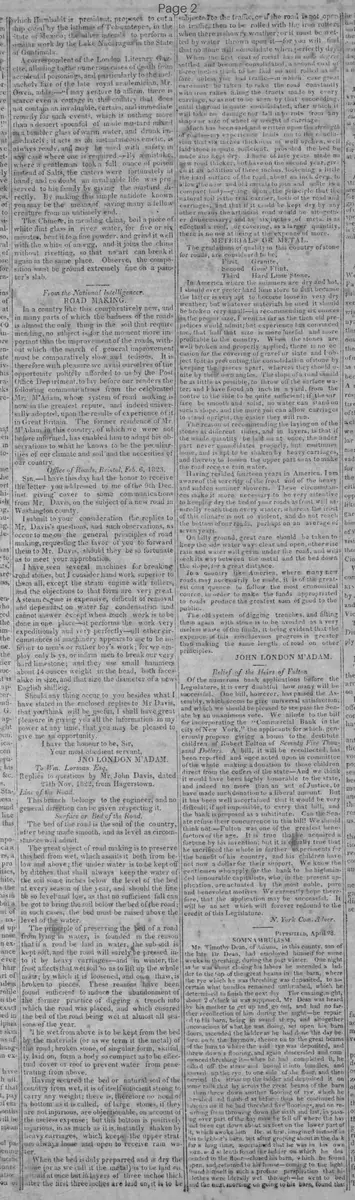
Article from the National Intelligencer featuring a letter from John Louis M'Adam dated February 6, 1823, detailing his road-making system for American conditions, including principles for road bed preparation, use of broken stone layers, material choices, and economical practices to improve infrastructure.
Clipping
OCR Quality
Full Text
ROAD MAKING.
In a country like this comparatively new, and in many parts of which the badness of the roads is almost the only thing in the soil that requires mending, no subject is for the moment more important than the improvement of the roads, without which the march of general improvement must be comparatively slow and tedious. It is therefore with pleasure we avail ourselves of the opportunity politely afforded to us by the Post Office Department, to lay before our readers the following communications from the celebrated Mr. M'Adam, whose system of road making is now in the greatest repute, and indeed universally adopted, upon the results of experience of it in Great Britain. The former residence of Mr. M'Adam in this country, of which we were not before informed, has enabled him to adapt his observations to what he knows to be the peculiarities of our climate and soil and the necessities of our country.
Office of Roads, Bristol, Feb. 6, 1823.
Sir,—I have this day had the honor to receive the letter you addressed to me of the 9th Dec. inst. giving cover to some communications from Mr. Davis, on the subject of a new road in Washington county.
I submit to your consideration the replies to Mr. Davis's questions, and such observations, as occur to me on the general principles of road making, requesting the favor of you to forward them to Mr. Davis, should they be so fortunate as to meet your approbation,
I have seen several machines for breaking road stones, but I consider hand work superior to them all, except the steam engine with rollers, and the objections to that form are very great. A steam engine is expensive, difficult of removal and dependant on water for condensation and cannot answer except when much work is to be done in one place; it performs the work very expeditiously and very perfectly—all other circumstances of machinery appears to me to be inferior to men's or rather boy's work; for we employ only boys, or infirm men to break our very hard limestone; and they use small hammers about 14 ounces weight in the head, both faces alike in size, and that size the diameter of a new English shilling.
Should any thing occur to you besides what I have stated in the enclosed replies to Mr. Davis, that you think will be useful, I shall have great pleasure in giving you all the information in my power at any time, that you may be pleased to give me an opportunity.
I have the honour to be, Sir,
Your most obedient servant,
JNO. LOUIS M'ADAM.
To Wm. Lorman Esq.
Replies to questions by Mr. John Davis, dated 27th Nov. 1822, from Hagerstown.
Line of the Road.
This branch belongs to the engineer, and no general direction can be given respecting it,
Surface or Bed of the Road.
The bed of the road is the soil of the country, after being made smooth, and as level as circumstances will admit,
The great object of road making is to preserve this bed from wet, which assails it both from below and above; the under water is to be kept off by ditches, that shall always keep the water of the soil some inches below the level of the bed at every season of the year, and should the line be so level and low, as that no sufficient fall can be got to bring the soil below the bed of the road: in such cases, the bed must be raised above the level of the water.
The principle of preserving the bed of a road from lying in water, is founded in the reason that if a road be laid in water, the sub-soil is kept soft, and the road will surely be pressed into it by heavy carriages—and in winter, the frost affects that wet soil so as to lift up the whole mass; by which it is loosened, and on a thaw, is broken to pieces. These reasons have been found sufficient to induce the abandonment of the former practice of digging a trench into which the road was placed, and which ensured the bed of the road being wet at almost all seasons of the year.
The wet from above is to be kept from the bed by the materials (or as we term it the metal) of the road; broken stone, of angular form, skilfully laid on, form a body so compact as to be effectual cover or roof to prevent water from penetrating from above.
Having secured the bed or natural soil of the country from wet, it is of itself sufficient strong to carry any weight; there is, therefore no need of a bottom as it is called, of large stones, if they are not injurious, are objectionable, on account of the useless expense; but this bottom is positively injurious, in as much as it is instantly shaken by heavy carriages, which keeps the upper stratum always loose and open to receive rain water.
When the bed is duly prepared and is dry the stone (or as we call it the metal) is to be laid on, not all at once but in layers of three inches thick; after the first three inches are laid on, it is to be subjected to the traffic, or if the road is not open to traffic, then to be rolled with the iron roller: when there is showery weather; or it must be wetted by water thrown upon it—for you will find that no stone will consolidate when perfectly dry.
When the first coat of metal has in some degree settled and become consolidated, a second coat of three inches thick to be laid on and rolled as before, unless you had traffic—in which case great care must be taken to rake the road constantly with iron rakes filling the tracts made by every carriage, so as not to be seen by that succeeding, until the road is quite consolidated, after which it will take no damage nor fall into ruts from any shape or size of wheel or weight of carriage.
Much has been said and written upon the strength of roads—my experience leads me to the conclusion that six inches thickness of well broken, well laid stone is quite sufficient, provided the bed be made and kept dry. I have of late years made no new road thicker; but have on the second year, given it an addition of three inches, loosening a little the hard surface of the road, about an inch deep, to allow the new and old metals to join and unite in a compact body—going upon the principle that the natural soil is the real carrier, both of the road and carriages; and that if it could be kept dry by any other means the artificial road would be altogether unnecessary, and as six inches of metal is as effectual a roof, or covering, as a larger quantity, there is no use in being at the expense of more.
MATERIALS OR METAL.
The gradations of quality in this country of stone for roads, are considered to be;
First Granite,
Second Good Flint,
Third Hard Lime Stone.
In America where the summers are dry and hot, I should ever prefer hard lime stone to flint because the latter is very apt to become loose in very dry weather; but whatever materials be used it should be broken very small—in recommending six ounces as the proper size, I went as far as the then old prejudices would admit; but experience has convinced me, that half that size is more useful and more profitable to the country. When the stones are well broken and properly applied, there is no occasion for the covering of gravel or slate and I object to it as preventing the consolidation of stone by keeping the pieces apart, whereas they should unite by their own angles. The slope of a road should be as little as possible, to throw off the surface water; and I have found an inch in a yard, from the centre to the side to be quite sufficient; if the surface be smooth and solid, no water can stand on such a slope, and the more you can allow carriages to stand upright, the easier they will run.
The reason of recommending the laying on of the stones at different times, and in layers, is that if the whole quantity be laid on at once, the under part never consolidates properly, but continues loose, and is apt to be shaken by heavy carriages, and thereby to loosen the upper part so as to make the road receive rain water.
Having resided fourteen years in America, I am aware of the severity of the frost and of the heavy and sudden summer showers. These circumstances make it more necessary to be very attentive to keeping dry the bed of your roads as frost will assuredly reach them every winter; whereas the frost of this climate is not so violent, and do not reach the bottom of our roads, perhaps on an average of seven years.
On hilly ground, great care should be taken to keep the side water ways clear and open, otherwise rain and water will get in under the road, and will seek its way between the metal and the bed down the slope, for a great distance.
In a country like America, where many new roads may necessarily be made, it is of the greatest consequence to follow the most economical course, in order to make the funds appropriated to roads produce the greatest sum of good to the public.
The old system of digging trenches, and filling them again with stone is to be avoided as a very useless waste of the funds, it being evident that the expense of this mischievous progress is greater than making the same length of road on other principles.
JOHN LOUIS M'ADAM.
What sub-type of article is it?
What keywords are associated?
What entities or persons were involved?
Where did it happen?
Story Details
Key Persons
Location
Bristol; Hagerstown; Washington County
Event Date
1823 02 06
Story Details
John Louis M'Adam provides detailed replies to John Davis's questions on road construction, advocating for a dry natural soil bed protected by ditches, layered broken angular stone (six inches total) to repel water, preference for hard limestone in America, hand-breaking stones, and avoiding old trench methods for economy.