Thank you for visiting SNEWPapers!
Sign up free
The Honolulu Republican
Honolulu, Honolulu County, Hawaii
What is this article about?
US shipping interests advocate extending coastwise laws and free trade to Philippines amid Senate debates on tariffs and revenue; no American inter-island ships yet, but barges en route; Treaty of Paris complicates by allowing Spanish access for 10 years.
Clipping
OCR Quality
Full Text
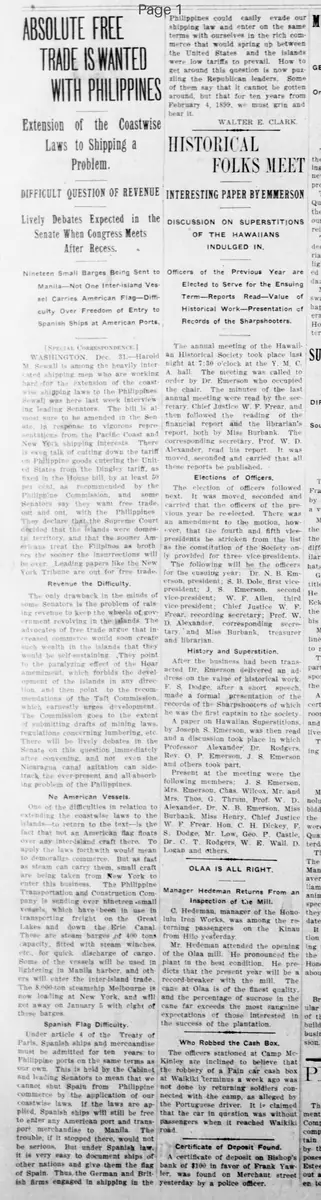
Extension of the Coastwise Laws to Shipping Problem.
DIFFICULT QUESTION OF REVENUE
Lively Debates Expected in the Senate When Congress Meets After Recess.
Nineteen Small Barges Being Sent to Manila Not One Inter-island Vessel Carries American Flag Difficulty Over Freedom of Entry to Spanish Ships at American Ports.
[SPECIAL CORRESPONDENCE]
WASHINGTON, Dec. 31.—Harold M. Sewall is among the heavily interested shipping men who are working hard for the extension of the coastwise shipping laws to the Philippines. Sewall was here last week interviewing leading Senators. The bill is almost sure to be amended in the Senate in response to vigorous representations from the Pacific Coast and New York shipping interests. There is even talk of cutting down the tariff on Philippine goods entering the United States from the Dingley tariff, as fixed in the House bill, by at least 50 per cent., as recommended by the Philippine Commission, and some Senators say they want free trade, out and out, with the Philippines. They declare that the Supreme Court decided that the Islands were domestic territory, and that the sooner Americans treat the Filipinos as brothers the sooner the insurrections will be over. Leading papers like the New York Tribune are out for free trade.
Revenue the Difficulty.
The only drawback in the minds of some Senators is the problem of raising revenue to keep the wheels of government revolving in the islands. The advocates of free trade argue that increased commerce would soon create such wealth in the Islands that they would be self-sustaining. They point to the paralyzing effect of the Hoar amendment, which forbids the development of the islands in any direction, and then point to the recommendations of the Taft Commission, which earnestly urges development. The Commission goes to the extent of submitting drafts of mining laws, regulations concerning lumbering, etc. There will be lively debates in the Senate on this question immediately after convening, and not even the Nicaragua canal agitation can sidetrack the ever present and all absorbing problem of the Philippines.
No American Vessels.
One of the difficulties in relation to extending the coastwise laws to the islands—to return to the text—is the fact that not an American flag floats over any interisland craft there. To apply the laws forthwith would mean to demoralize commerce. But as fast as steam can carry them, small craft are being taken from New York to enter this business. The Philippine Transportation and Construction Company is sending over nineteen small vessels, which have been in use in transporting freight on the Great Lakes and down the Erie Canal. These are steam barges of 400 tons capacity, fitted with steam winches, etc., for quick discharge of cargo. Some of the vessels will be used in lightering in Manila harbor, and others will enter the inter-island trade. The 5,000-ton steamship Melbourne is now loading at New York, and will get away on January 5 with eight of these barges.
Spanish Flag Difficulty.
Under article 4 of the Treaty of Paris, Spanish ships and merchandise must be admitted for ten years to Philippine ports on the same terms as our own. This is held by the Cabinet and leading Senators to mean that we cannot shut Spain from Philippine commerce by the application of our coastwise laws. If the laws are applied, Spanish ships will still be free to enter any American port and transport merchandise to Manila. The trouble, if it stopped there, would not be serious. But under Spanish law, it is very easy to document ships of other nations and give them the flag of Spain. Thus the German and British firms engaged in shipping in the Philippines could easily evade our shipping law and enter on the same terms with ourselves in the rich commerce that would spring up between the United States and the islands were low tariffs to prevail. How to get around this question is now puzzling the Republican leaders. Some of them say that it cannot be gotten around, but that for ten years from February 4, 1899, we must grin and bear it.
WALTER E. CLARK
What sub-type of article is it?
What keywords are associated?
What entities or persons were involved?
Where did it happen?
Foreign News Details
Primary Location
Philippines
Event Date
Dec. 31
Key Persons
Outcome
lively debates expected in senate; extension of coastwise laws likely amended; nineteen small barges being sent to manila; free trade advocated but revenue concerns persist; spanish ships admitted for ten years per treaty of paris
Event Details
Shipping interests push for extending US coastwise shipping laws to Philippines and free trade, interviewing Senators; Senate may cut tariffs by 50% or more; revenue challenges for island government; no American inter-island vessels currently, but small barges en route; Treaty of Paris allows Spanish ships equal access, complicating laws and enabling evasion by other nations