Thank you for visiting SNEWPapers!
Sign up free
Story
October 6, 1882
The True Northerner
Paw Paw, Van Buren County, Michigan
What is this article about?
In a 19th-century mill town, Mrs. Nettie Jarvis confronts her wealthy husband Donald about receiving wages for her unpaid household labor, highlighting her lack of financial independence. Through dialogue and reflection, he realizes the injustice, akin to slavery, and reforms, granting her autonomy.
Clipping
OCR Quality
98%
Excellent
Full Text
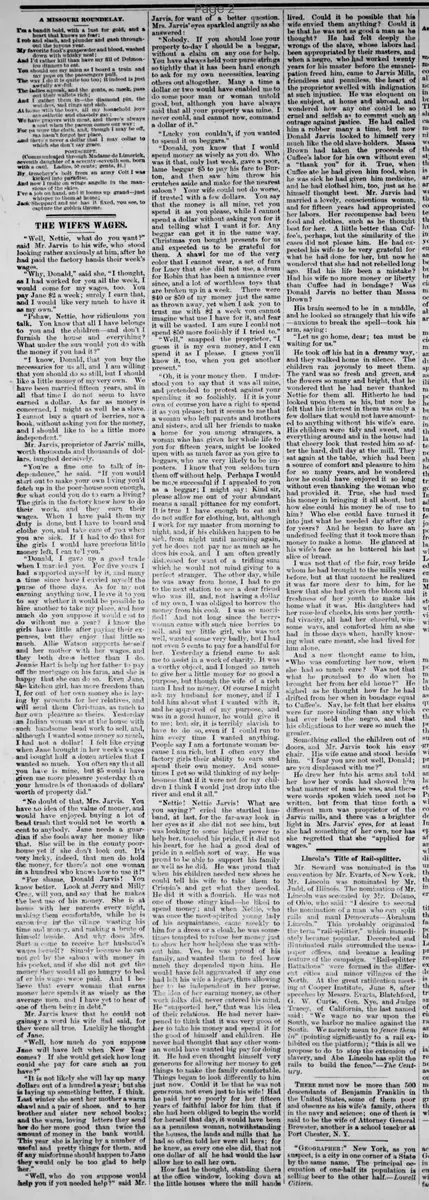
THE WIFE'S WAGES.
"Well, Nettie, what do you want?" said Mr. Jarvis to his wife, who stood looking rather anxiously at him, after he had paid the factory hands their week's wages.
"Why, Donald," said she, "I thought, as I had worked for you all the week, I would come for my wages, too. You pay Jane $2 a week; surely I earn that, and I would like very much to have it as my own."
"Pshaw, Nettie, how ridiculous you talk. You know that all I have belongs to you and the children—and don't I furnish the house and everything? What under the sun would you do with the money if you had it?"
"I know, Donald, that you buy the necessaries for us all, and I am willing that you should do so still, but I should like a little money of my very own. We have been married fifteen years, and in all that time I do not seem to have earned a dollar. As far as money is concerned, I might as well be a slave. I cannot buy a quart of berries, nor a book, without asking you for the money, and I should like to be a little more independent."
Mr. Jarvis, proprietor of Jarvis' mills, worth thousands and thousands of dollars, laughed derisively.
"You're a fine one to talk of independence," he said. "If you would start out to make your own living you'd fetch up in the poor-house soon enough, for what could you do to earn a living? The girls in the factory knew how to do their work, and they earn their wages. When I have paid them my duty is done, but I have to board and clothe you, and take care of you when you are sick. If I had to do that for the girls I would have precious little money left, I can tell you."
"Donald, I gave up a good trade when I married you. For five years I had supported myself by it, and many a time since have I envied myself the purse of those days. As for my not earning anything now, I leave it to you to say whether it would be possible to hire another to take my place, and how much do you suppose it would cost to do without me a year? I know the girls have little after paying their expenses, but they enjoy that little so much. Allie Watson supports herself and her mother with her wages, and they both dress better than I do. Jennie Hart is helping her father to pay off the mortgage on his farm, and she is happy that she can do so. Even Jane, the kitchen girl, has more freedom than I, for out of her own money she is laying by presents for her relatives, and will send them Christmas, as much to her own pleasure as theirs. Yesterday an Indian woman was at the house with such handsome bead work to sell, and, although I wanted some money so much, I had not a dollar! I felt like crying when Jane brought in her week's wages and bought half a dozen articles that I wanted so much. You often say that all you have is mine, but $5 would have given me more pleasure yesterday than your hundreds of thousands of dollars worth of property did."
"No doubt of that, Mrs. Jarvis. You have no idea of the value of money, and would have enjoyed buying a lot of bead trash that would not be worth a cent to anybody. Jane needs a guardian if she fools away her money like that. She will be in the county poor-house yet if she don't look out. It's very lucky, indeed, that men do hold the money, for there's not one woman in a hundred who knows how to use it!"
"For shame, Donald Jarvis! You know better. Look at Jerry and Milly Creg, will you, and say that he makes the best use of his money. She is at home with her parents every night, making them comfortable, while he is carousing in the village wasting his time and money, and making a brute of himself beside. And why does Mrs. Sartin come to receive her husband's wages herself? Simply because he cannot get by the saloon with money in his pocket, and if she did not get the money they would all go hungry to bed after his wages were paid. And I believe that every woman that earns money here spends it as wisely as the average men, and I have yet to hear of one of them being in debt."
Mr. Jarvis knew that he could not gainsay a word his wife had said, for they were all true. Luckily he thought of Jane.
"Well, how much do you suppose Jane will have left when New Year's comes? If she would get sick how long could she pay for care such as you have?"
"It is not likely she will lay up many dollars out of a hundred a year; but she is laying up something better, I think. Last winter she sent her mother a warm shawl and a pair of shoes, and to her brother and sister new school books; and the warm, loving letters they send her do her more good than twice the amount of money in the bank would. This year she is laying by a number of useful and pretty things for them, and if any misfortune should happen to Jane they would only be too glad to help her."
"Well, who do you suppose would help you if you needed help?" said Mr. Jarvis, for want of a better question.
Mrs. Jarvis' eyes sparkled angrily as she answered:
"Nobody. If you should lose your property to-day I should be a beggar, without a claim on any one for help. You have always held your purse strings so tightly that it has been hard enough to ask for my own necessities, leaving others out altogether. Many a time a dollar or two would have enabled me to do some poor man or woman untold good, but, although you have always said that all your property was mine, I never could, and cannot now, command a dollar of it."
"Lucky you couldn't, if you wanted to spend it on beggars."
"Donald, you know that I would spend money as wisely as you do. Who was it that, only last week, gave a poor, lame beggar $5 to pay his fare to Burton, and then saw him throw his crutches aside and make for the nearest saloon? Your wife could not do worse, if trusted with a few dollars. You say that the money is all mine, yet you spend it as you please, while I cannot spend a dollar without asking you for it and telling what I want it for. Any beggar can get it in the same way. Christmas you bought presents for us and expected us to be grateful for them. A shawl for me of the very color that I cannot wear, a set of furs for Lucy that she did not use, a drum for Robin that has been a nuisance ever since, and a lot of worthless toys that are broken up in a week. There were $40 or $50 of my money just the same as thrown away, yet when I ask you to trust me with $2 a week you cannot imagine what use I have for it, and fear it will be wasted. I am sure I could not spend $50 more foolishly if I tried to."
"Well," snapped the proprietor, "I guess it is my own money, and I can spend it as I please. I guess you'll know it, too, when you get another present."
"Oh, it is your money then. I understood you to say that it was all mine, and pretended to protest against your spending it so foolishly. If it is your own of course you have a right to spend it as you please; but it seems to me that a woman who left parents and brothers and sisters, and all her friends to make a home for you among strangers, a woman who has given her whole life to you for fifteen years, might be looked upon with as much favor as you give to beggars, who are very likely to be imposters. I know that you seldom turn them off without help. Perhaps I would be more successful if I appealed to you as a beggar: I might say: Kind sir, please allow me out of your abundant means a small pittance for my comfort. It is true I have enough to eat and do not suffer for clothing, but, although I work for my master from morning to night, and, if his children happen to be sick, from night until morning again, yet he does not pay me as much as he does his cook, and I am often greatly distressed for want of a trifling sum which he would not mind giving to a perfect stranger. The other day, while he was away from home, I had to go to the next station to see a dear friend who was ill, and, not having a dollar of my own, I was obliged to borrow the money from his cook. I was so mortified! And not long since the berry-woman came with such nice berries to sell, and my little girl, who was not well, wanted some very badly, but I had not even 5 cents to pay for a handful for her. Yesterday a friend came to ask me to assist in a work of charity. It was a worthy object, and I longed so much to give her a little money for so good a purpose, but though the wife of a rich man I had no money. Of course I might ask my husband for money, and if I told him about what I wanted with it, and he approved of my purpose, and was in a good humor, he would give it to me; but, sir, it is terribly slavish to have to do so, even if I could run to him every time I wanted anything. People say I am a fortunate woman because I am rich, but I often envy the factory girls their ability to earn and spend their own money. And sometimes I get so wild thinking of my helplessness that if it were not for my children I think I would just drop into the river and end it all."
"Nettie! Nettie Jarvis! What are you saying?" cried the startled husband, at last, for the far-away look in her eyes as if she did not see him, but was looking to some higher power to help her, touched his pride, if it did not his heart, for he had a good deal of pride in a selfish sort of way. He was proud to be able to support his family as well as he did. He was proud that when his children needed new shoes he could tell his wife to take them to Crispin's and get what they needed. He did it with a flourish. He was not one of those stingy kind—he liked to spend money; and when Nettie, who was once the most-spirited young lady of his acquaintance, came meekly to him for a dress or a cloak, he was sometimes tempted to refuse her money just to show her how helpless she was without him. Yes, he was proud of his family, and wanted them to feel how much they depended upon him. He would have felt aggravated if any one had left his wife a legacy, thus allowing her to be independent in her purse. The idea of her earning money, as other work folks did, never entered his mind. He "supported her," that was his idea of their relations. He had never happened to think that it was very good of her to take his money and spend it for the good of himself and children. He had even thought himself very generous for allowing her money to get things to make the family comfortable. Things began to look differently to him just now. Could it be that he was not generous, not even just to his wife! Had he paid her so poorly for her fifteen years of faithful labor for him that if she had been obliged to begin the world for herself that day, it would have been as a penniless woman, notwithstanding the houses, the lands and mills that he had so often told her were all hers; for he knew, as every one else did, that not one dollar of all he had would the law allow her to call her own.
How fast he thought, standing there at the office window, looking down at the little houses where the mill hands lived. Could it be possible that his wife envied them anything? Could it be that he was not as good a man as he thought? He had felt deeply the wrongs of the slave, whose labors had been appropriated by their masters, and when a negro, who had worked twenty years for his master before the emancipation freed him, came to Jarvis Mills, friendless and penniless, the heart of the proprietor swelled with indignation at such injustice. He was eloquent on the subject, at home and abroad, and wondered how any one could be so cruel and selfish as to commit such an outrage against justice. He had called him a robber many a time, but now Donald Jarvis looked to himself very much like the old slave-holders. Massa Brown had taken the proceeds of Cuffee's labor for his own without even a "thank you" for it. True, when Cuffee ate he had given him food, when he was sick he had given him medicine and he had clothed him, too, just as he himself thought best. Mr. Jarvis had married a lovely, conscientious woman, and for fifteen years had appropriated her labors. Her recompense had been food and clothes, such as he thought best for her. A little better than Cuffee's, perhaps, but the similarity of the cases did not please him. He had expected his wife to be very grateful for what he had done for her, but now he wondered that she had not rebelled long ago. Had his life been a mistake? Had his wife no more money or liberty than Cuffee had in bondage? Was Donald Jarvis no better than Massa Brown?
His brain seemed to be in a muddle, and he looked so strangely that his wife—anxious to break the spell—took his arm, saying:
"Let us go home, dear; tea must be waiting for us."
He took off his hat in a dreamy way, and they walked home in silence. The children ran joyously to meet them. The yard was so fresh and green, and the flowers so many and bright, that he wondered that he had never thanked Nettie for them all. Hitherto he had looked upon them as his, but now he felt that his interest in them was only a few dollars that would not have amounted to anything without his wife's care. His children were tidy and sweet, and everything around and in the house had that cheery look that rested him so after the hard, dull day at the mill. They sat again at the table, which had been a source of comfort and pleasure to him for so many years, and he wondered how he could have enjoyed it so long without even thanking the woman who had provided it. True, she had used his money in bringing it all about, but how else could his money be of use to him? Who else could have turned it into just what he needed day after day for years? And he began to have an undefined feeling that it took more than money to make a home. He glanced at his wife's face as he buttered his last slice of bread.
It was not that of the fair, rosy bride whom he had brought to the mills years before, but at that moment he realized it was far more dear to him, for he knew that she had given the bloom and freshness of her youth to make his home what it was. His daughters had her rose-leaf cheeks, his sons her youthful vivacity, all had her cheerful, winsome ways, and comforted him as she had in those days when, hardly knowing what care meant, she had lived for him alone.
And a new thought came to him,
"Who was comforting her now, when she had so much care? Was not that what he promised to do when he brought her from her old home?" He sighed as he thought how far he had drifted from her when in bondage equal to Cuffee's. Nay, he felt that her chains were far more binding than any which had ever held the negro, and that his obligations to her were so much the greater.
Something called the children out of doors, and Mr. Jarvis took his easy chair. His wife came and stood beside him. "I fear you are not well, Donald; are you displeased with me?"
He drew her into his arms and told her how her words had showed him what manner of man he was, and there were words spoken which need not be written, but from that time forth a different man was proprietor of the Jarvis mills, and there was a brighter light in Mrs. Jarvis' eyes, for at least she had something of her own, nor has she regretted that she "applied for wages."
"Well, Nettie, what do you want?" said Mr. Jarvis to his wife, who stood looking rather anxiously at him, after he had paid the factory hands their week's wages.
"Why, Donald," said she, "I thought, as I had worked for you all the week, I would come for my wages, too. You pay Jane $2 a week; surely I earn that, and I would like very much to have it as my own."
"Pshaw, Nettie, how ridiculous you talk. You know that all I have belongs to you and the children—and don't I furnish the house and everything? What under the sun would you do with the money if you had it?"
"I know, Donald, that you buy the necessaries for us all, and I am willing that you should do so still, but I should like a little money of my very own. We have been married fifteen years, and in all that time I do not seem to have earned a dollar. As far as money is concerned, I might as well be a slave. I cannot buy a quart of berries, nor a book, without asking you for the money, and I should like to be a little more independent."
Mr. Jarvis, proprietor of Jarvis' mills, worth thousands and thousands of dollars, laughed derisively.
"You're a fine one to talk of independence," he said. "If you would start out to make your own living you'd fetch up in the poor-house soon enough, for what could you do to earn a living? The girls in the factory knew how to do their work, and they earn their wages. When I have paid them my duty is done, but I have to board and clothe you, and take care of you when you are sick. If I had to do that for the girls I would have precious little money left, I can tell you."
"Donald, I gave up a good trade when I married you. For five years I had supported myself by it, and many a time since have I envied myself the purse of those days. As for my not earning anything now, I leave it to you to say whether it would be possible to hire another to take my place, and how much do you suppose it would cost to do without me a year? I know the girls have little after paying their expenses, but they enjoy that little so much. Allie Watson supports herself and her mother with her wages, and they both dress better than I do. Jennie Hart is helping her father to pay off the mortgage on his farm, and she is happy that she can do so. Even Jane, the kitchen girl, has more freedom than I, for out of her own money she is laying by presents for her relatives, and will send them Christmas, as much to her own pleasure as theirs. Yesterday an Indian woman was at the house with such handsome bead work to sell, and, although I wanted some money so much, I had not a dollar! I felt like crying when Jane brought in her week's wages and bought half a dozen articles that I wanted so much. You often say that all you have is mine, but $5 would have given me more pleasure yesterday than your hundreds of thousands of dollars worth of property did."
"No doubt of that, Mrs. Jarvis. You have no idea of the value of money, and would have enjoyed buying a lot of bead trash that would not be worth a cent to anybody. Jane needs a guardian if she fools away her money like that. She will be in the county poor-house yet if she don't look out. It's very lucky, indeed, that men do hold the money, for there's not one woman in a hundred who knows how to use it!"
"For shame, Donald Jarvis! You know better. Look at Jerry and Milly Creg, will you, and say that he makes the best use of his money. She is at home with her parents every night, making them comfortable, while he is carousing in the village wasting his time and money, and making a brute of himself beside. And why does Mrs. Sartin come to receive her husband's wages herself? Simply because he cannot get by the saloon with money in his pocket, and if she did not get the money they would all go hungry to bed after his wages were paid. And I believe that every woman that earns money here spends it as wisely as the average men, and I have yet to hear of one of them being in debt."
Mr. Jarvis knew that he could not gainsay a word his wife had said, for they were all true. Luckily he thought of Jane.
"Well, how much do you suppose Jane will have left when New Year's comes? If she would get sick how long could she pay for care such as you have?"
"It is not likely she will lay up many dollars out of a hundred a year; but she is laying up something better, I think. Last winter she sent her mother a warm shawl and a pair of shoes, and to her brother and sister new school books; and the warm, loving letters they send her do her more good than twice the amount of money in the bank would. This year she is laying by a number of useful and pretty things for them, and if any misfortune should happen to Jane they would only be too glad to help her."
"Well, who do you suppose would help you if you needed help?" said Mr. Jarvis, for want of a better question.
Mrs. Jarvis' eyes sparkled angrily as she answered:
"Nobody. If you should lose your property to-day I should be a beggar, without a claim on any one for help. You have always held your purse strings so tightly that it has been hard enough to ask for my own necessities, leaving others out altogether. Many a time a dollar or two would have enabled me to do some poor man or woman untold good, but, although you have always said that all your property was mine, I never could, and cannot now, command a dollar of it."
"Lucky you couldn't, if you wanted to spend it on beggars."
"Donald, you know that I would spend money as wisely as you do. Who was it that, only last week, gave a poor, lame beggar $5 to pay his fare to Burton, and then saw him throw his crutches aside and make for the nearest saloon? Your wife could not do worse, if trusted with a few dollars. You say that the money is all mine, yet you spend it as you please, while I cannot spend a dollar without asking you for it and telling what I want it for. Any beggar can get it in the same way. Christmas you bought presents for us and expected us to be grateful for them. A shawl for me of the very color that I cannot wear, a set of furs for Lucy that she did not use, a drum for Robin that has been a nuisance ever since, and a lot of worthless toys that are broken up in a week. There were $40 or $50 of my money just the same as thrown away, yet when I ask you to trust me with $2 a week you cannot imagine what use I have for it, and fear it will be wasted. I am sure I could not spend $50 more foolishly if I tried to."
"Well," snapped the proprietor, "I guess it is my own money, and I can spend it as I please. I guess you'll know it, too, when you get another present."
"Oh, it is your money then. I understood you to say that it was all mine, and pretended to protest against your spending it so foolishly. If it is your own of course you have a right to spend it as you please; but it seems to me that a woman who left parents and brothers and sisters, and all her friends to make a home for you among strangers, a woman who has given her whole life to you for fifteen years, might be looked upon with as much favor as you give to beggars, who are very likely to be imposters. I know that you seldom turn them off without help. Perhaps I would be more successful if I appealed to you as a beggar: I might say: Kind sir, please allow me out of your abundant means a small pittance for my comfort. It is true I have enough to eat and do not suffer for clothing, but, although I work for my master from morning to night, and, if his children happen to be sick, from night until morning again, yet he does not pay me as much as he does his cook, and I am often greatly distressed for want of a trifling sum which he would not mind giving to a perfect stranger. The other day, while he was away from home, I had to go to the next station to see a dear friend who was ill, and, not having a dollar of my own, I was obliged to borrow the money from his cook. I was so mortified! And not long since the berry-woman came with such nice berries to sell, and my little girl, who was not well, wanted some very badly, but I had not even 5 cents to pay for a handful for her. Yesterday a friend came to ask me to assist in a work of charity. It was a worthy object, and I longed so much to give her a little money for so good a purpose, but though the wife of a rich man I had no money. Of course I might ask my husband for money, and if I told him about what I wanted with it, and he approved of my purpose, and was in a good humor, he would give it to me; but, sir, it is terribly slavish to have to do so, even if I could run to him every time I wanted anything. People say I am a fortunate woman because I am rich, but I often envy the factory girls their ability to earn and spend their own money. And sometimes I get so wild thinking of my helplessness that if it were not for my children I think I would just drop into the river and end it all."
"Nettie! Nettie Jarvis! What are you saying?" cried the startled husband, at last, for the far-away look in her eyes as if she did not see him, but was looking to some higher power to help her, touched his pride, if it did not his heart, for he had a good deal of pride in a selfish sort of way. He was proud to be able to support his family as well as he did. He was proud that when his children needed new shoes he could tell his wife to take them to Crispin's and get what they needed. He did it with a flourish. He was not one of those stingy kind—he liked to spend money; and when Nettie, who was once the most-spirited young lady of his acquaintance, came meekly to him for a dress or a cloak, he was sometimes tempted to refuse her money just to show her how helpless she was without him. Yes, he was proud of his family, and wanted them to feel how much they depended upon him. He would have felt aggravated if any one had left his wife a legacy, thus allowing her to be independent in her purse. The idea of her earning money, as other work folks did, never entered his mind. He "supported her," that was his idea of their relations. He had never happened to think that it was very good of her to take his money and spend it for the good of himself and children. He had even thought himself very generous for allowing her money to get things to make the family comfortable. Things began to look differently to him just now. Could it be that he was not generous, not even just to his wife! Had he paid her so poorly for her fifteen years of faithful labor for him that if she had been obliged to begin the world for herself that day, it would have been as a penniless woman, notwithstanding the houses, the lands and mills that he had so often told her were all hers; for he knew, as every one else did, that not one dollar of all he had would the law allow her to call her own.
How fast he thought, standing there at the office window, looking down at the little houses where the mill hands lived. Could it be possible that his wife envied them anything? Could it be that he was not as good a man as he thought? He had felt deeply the wrongs of the slave, whose labors had been appropriated by their masters, and when a negro, who had worked twenty years for his master before the emancipation freed him, came to Jarvis Mills, friendless and penniless, the heart of the proprietor swelled with indignation at such injustice. He was eloquent on the subject, at home and abroad, and wondered how any one could be so cruel and selfish as to commit such an outrage against justice. He had called him a robber many a time, but now Donald Jarvis looked to himself very much like the old slave-holders. Massa Brown had taken the proceeds of Cuffee's labor for his own without even a "thank you" for it. True, when Cuffee ate he had given him food, when he was sick he had given him medicine and he had clothed him, too, just as he himself thought best. Mr. Jarvis had married a lovely, conscientious woman, and for fifteen years had appropriated her labors. Her recompense had been food and clothes, such as he thought best for her. A little better than Cuffee's, perhaps, but the similarity of the cases did not please him. He had expected his wife to be very grateful for what he had done for her, but now he wondered that she had not rebelled long ago. Had his life been a mistake? Had his wife no more money or liberty than Cuffee had in bondage? Was Donald Jarvis no better than Massa Brown?
His brain seemed to be in a muddle, and he looked so strangely that his wife—anxious to break the spell—took his arm, saying:
"Let us go home, dear; tea must be waiting for us."
He took off his hat in a dreamy way, and they walked home in silence. The children ran joyously to meet them. The yard was so fresh and green, and the flowers so many and bright, that he wondered that he had never thanked Nettie for them all. Hitherto he had looked upon them as his, but now he felt that his interest in them was only a few dollars that would not have amounted to anything without his wife's care. His children were tidy and sweet, and everything around and in the house had that cheery look that rested him so after the hard, dull day at the mill. They sat again at the table, which had been a source of comfort and pleasure to him for so many years, and he wondered how he could have enjoyed it so long without even thanking the woman who had provided it. True, she had used his money in bringing it all about, but how else could his money be of use to him? Who else could have turned it into just what he needed day after day for years? And he began to have an undefined feeling that it took more than money to make a home. He glanced at his wife's face as he buttered his last slice of bread.
It was not that of the fair, rosy bride whom he had brought to the mills years before, but at that moment he realized it was far more dear to him, for he knew that she had given the bloom and freshness of her youth to make his home what it was. His daughters had her rose-leaf cheeks, his sons her youthful vivacity, all had her cheerful, winsome ways, and comforted him as she had in those days when, hardly knowing what care meant, she had lived for him alone.
And a new thought came to him,
"Who was comforting her now, when she had so much care? Was not that what he promised to do when he brought her from her old home?" He sighed as he thought how far he had drifted from her when in bondage equal to Cuffee's. Nay, he felt that her chains were far more binding than any which had ever held the negro, and that his obligations to her were so much the greater.
Something called the children out of doors, and Mr. Jarvis took his easy chair. His wife came and stood beside him. "I fear you are not well, Donald; are you displeased with me?"
He drew her into his arms and told her how her words had showed him what manner of man he was, and there were words spoken which need not be written, but from that time forth a different man was proprietor of the Jarvis mills, and there was a brighter light in Mrs. Jarvis' eyes, for at least she had something of her own, nor has she regretted that she "applied for wages."
What sub-type of article is it?
Family Drama
Personal Triumph
What themes does it cover?
Family
Moral Virtue
Justice
What keywords are associated?
Wife Wages
Housework Value
Marital Independence
Financial Autonomy
Gender Roles
Moral Realization
What entities or persons were involved?
Nettie Jarvis
Donald Jarvis
Jane
Where did it happen?
Jarvis' Mills
Story Details
Key Persons
Nettie Jarvis
Donald Jarvis
Jane
Location
Jarvis' Mills
Story Details
Wife Nettie demands wages from husband Donald for her household work, comparing her situation to slavery; he reflects on the injustice, realizes her value, and grants her financial independence, transforming their marriage.