Thank you for visiting SNEWPapers!
Sign up free
Rhode Island American And Providence Gazette
Providence, Providence County, Rhode Island
What is this article about?
Editorial criticism of George McDuffie's drunken tirade against the federal government and northern states, followed by a detailed report of his speech at a June 20 dinner in Columbia, SC, urging southern resistance to tariffs, taxation of northern goods, and potential dissolution of the Union due to southern economic ruin.
Clipping
OCR Quality
Full Text
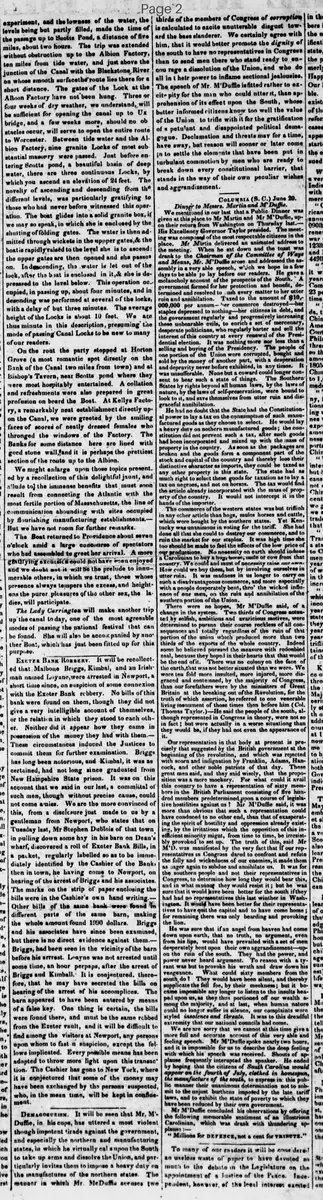
Columbia (S. C.) June 20.
Dinner to Messrs. Martin and McDuffie.
We mentioned in our last that a Public Dinner was given at this place to Mr Martin and Mr McDuffie, upon their return from Washington on Thursday last. His Excellency Governor Taylor presided. The meeting was composed of the most respectable citizens in the place. Mr Martin delivered an animated address to the meeting. When he sat down and the toast was drank to the Chairman of the Committee of Ways and Means, Mr. McDuffie arose and addressed the assembly in a very able speech, which we hope in a few days to be able to lay before our readers. He gave a melancholy account of the prospects of the South. A government formed for her protection and benefit, determined and resolved to push every measure to her utter ruin and annihilation. Taxed to the amount of $10,000,000 per annum-her commerce destroyed-her staples depressed to nothing—her citizens in debt, and the government regularly and progressively increasing these unbearable evils, to enrich a set of mercenary, desperate politicians, who regularly barter and sell the interest of this country at every renewal of the Presidential election. It was nothing more nor less than a selling and buying of the Presidency. The people of one portion of the Union were corrupted, bought and sold by the money of another part, with a desperation and depravity never before exhibited, in any times. It was unsufferable. None but a coward could longer consent to bear such a state of things. The Southern States by rights beyond all human laws, by the laws of nature, by the laws of self-preservation, were bound to look to it, and save themselves from utter ruin and disgraceful annihilation.
He had no doubt that the State had the Constitutional power to lay a tax on the consumption of such manufactured goods as they choose to select. He would lay a heavy duty on northern manufactured goods; the constitution did not prevent such a tax, after such goods had been incorporated and mixed up with the mass of property in the country. As soon as the packages are broken and the goods form a component part of the stock and capital of the country and thereby lose their distinctive character as imports, they could be taxed as any other property in this state. The state had as much right to select these goods for taxation as to lay a tax on negroes, and not on horses. The tax would find the article already incorporated with the mass of property of the country. It would not intercept it in the hands of the importer.
The commerce of the western states was but trifling in any other article than hogs, mules horses and cattle, which were bought by the southern states. Yet Kentucky was unanimous in voting for the tariff. She had done all that she could to destroy our commerce, and to ruin the market for our staples. It was high time she too should be made to feel the effects of the low price of our productions. No necessity on earth should induce a Carolinian to buy a hog, horse, mule or cow from that country. We could and must of necessity raise our own. How could we buy them, but by involving ourselves in utter ruin. It was madness in us longer to carry on such a disadvantageous commerce, and more especially with a people desperately bent, thro' the wicked influence of one man, on the ruin and annihilation of the southern portion of the Union.
There were no hopes, Mr McDuffie said, of a change in the system. Two thirds of Congress actuated by selfish, ambitious and avaricious motives, were determined to pursue their course reckless of all consequences and totally regardless of the ruin of that portion of the union which produced more than two thirds of the exports of the whole country. Indeed some he believed pursued the measure with redoubled zeal, because they hoped in their hearts that that would be the end of it. There was no colony on the face of the earth, that was not better situated than we were. We were ten fold more insulted, more injured, more disgraced and contemned, by the majority of Congress, than our forefathers were by the ministers of Great Britain at the breaking out of the Revolution, for the truth of which assertion, he referred to one venerable living monument of those times then before him (Col. Thomas Taylor.)-He said the people of the south, although represented in Congress in theory, were not so in fact; but were actually in a worse situation than they would be, if they had not even the appearance of it.
Our representation in that body at present is precisely that suggested by the British government at the beginning of the revolution, and which was rejected with scorn and indignation by Franklin, Adams, Hancock, and other noble patriots of that day. These great men said, and they said wisely, that the proposition was a mere mockery. For what could it avail this country to have a representation of sixty members in the British Parliament consisting of five hundred members predetermined upon a course of legislative hostilities against us ? Mr McDuffie said, it was more than obvious that such a representation could have conduced to no other end, than that of exasperating the spirit of hostility and oppression already existing, by the irritations which the opposition of this inefficient minority might, from time to time, be irresistibly provoked to set up. The truth of this, said Mr McD. was manifested by the very fact that if our representatives in Congress dared to confront and refute the folly and wickedness of our enemies, it made them as eager again to subdue and annihilate us. It was for the southern people and not their representatives in Congress, to determine how long they would bear this, and in what manner they would resist it; but he was sure that it would have been better for the south if they had had no representatives this last winter in Washington. It would have been better for their representatives to have quit the capitol and to have come home; for remaining there was only bearding and provoking the lion.
He was sure that if an angel from heaven had come down upon earth, that no truth, no argument, even from his lips, would have prevailed with a set of men desperately bent upon their own aggrandizement-upon the ruin of the south. They had the power, and power never heard argument. To reason with a tyrant was but to provoke his wrath and draw down his vengeance. What could sixty members from the south do ? They would have been silent, and thereby supplicate the fell foe, by their meekness; but it became impossible any longer to listen to the insults heaped upon us, as they thus portioned off our wealth among the majority, and at last, when human nature could no longer suffer in silence, our complaints were styled insolence and threats. It was to this dreadful extremity that our national councils had come.
We are sorry that we cannot at this time give a more full and accurate account of this very able and feeling speech. Mr McDuffie spoke nearly two hours, and it is impossible for us to describe the deep feeling with which his speech was received. Shouts of applause frequently interrupted the speaker. He ended by hoping that the citizens of South Carolina would appear on the fourth of July, clothed in homespun, the manufacture of the south, to express in this public manner their unanimous determination not to submit to the unjust burdens imposed by the late tariff laws, and to exhibit the state of poverty to which they have been reduced by their own government.
Mr McDuffie concluded his observations by offering the following memorable sentiment of an illustrious Carolinian, which was drank with thundering applause:
"Millions for DEFENCE, not a cent for TRIBUTE."
What sub-type of article is it?
What themes does it cover?
What keywords are associated?
What entities or persons were involved?
Where did it happen?
Story Details
Key Persons
Location
Columbia (S. C.)
Event Date
June 20
Story Details
Mr. McDuffie delivers a speech at a public dinner criticizing federal tariffs as ruining the South, accuses Congress of corruption, urges taxation of northern manufactures, boycotting western commerce, and southern self-preservation, possibly through dissolution of the Union.