Thank you for visiting SNEWPapers!
Sign up free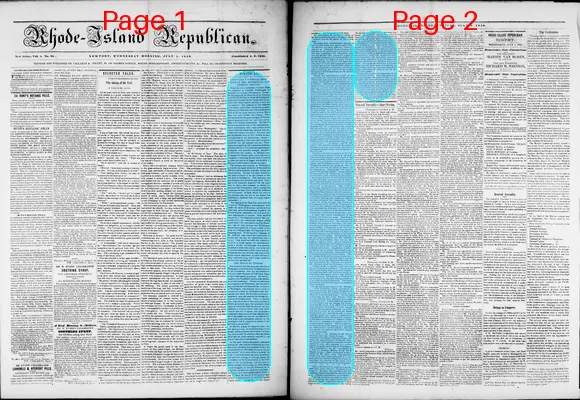
The Rhode Island Republican
Newport, Newport County, Rhode Island
What is this article about?
Historical extract from N.Y. Democratic Address on origins of U.S. Republican and Federal parties, from Washington's 1791 National Bank approval sparking divisions, through Adams' 'Reign of Terror' with Alien/Sedition Acts and military buildup, to Republican victory in 1800 election and reforms under Jefferson.
Merged-components note: Continuation of the article on the origin and history of political parties in the US, spanning multiple components across pages; relabeled from 'story' to 'domestic_news' as it fits political/domestic news better.
Clippings

1 of 2
OCR Quality
Full Text
Extract from the N. Y. Democratic Address.
ORIGIN OF THE REPUBLICAN AND
FEDERAL PARTIES.
When the bill to establish a National Bank
was presented to President Washington, he
hesitated as to giving it his approval. He ask-
ed the opinion of the Secretary of the Treasury
as to the precise time at which the ten days al-
lowed the President by the Constitution to con-
sider a bill, would expire, and kept it until the
last moment. The opinions of the members
of his cabinet were taken, and on that occasion
Jefferson and Hamilton took their stands at the
head of the two great political schools which
have ever since divided the country. Then
was achieved the first great triumph of the aris-
tocratic principles over the true spirit and in-
tents of the Federal Constitution. To that act
are to be attributed most of the embittered po-
litical excitements, and a large portion of the
actual mischiefs which have agitated and dis-
tressed the country ever since. It is true that
the Republican party in 1811, faithful to their
principles and to the Constitution, refused to
renew the charter of that bank, and it wound up
its affairs; but the example was set; Wash-
ington had signed the bill, a precedent had been
obtained, which, in 1816, led to the establishment
of another, with three fold strength, the power
of which over the country, its influence over
Congress, the distress, panic, terror and ruin it
is capable of scattering abroad when its interest
or existence may be in danger, are fearfully il-
lustrated in the events of the last ten years.
The influence and integrity of Washington
prevented any signal exhibition of the practical
effects of the aristocratic principle during his
administration. No man was more devoted to
the cause of liberty, or to the success of the
new form of Government. The hesitancy and
apprehension with which he had given his as-
sent to the Bank bill, rendered him the more
alert to check other attempts to enlarge the
powers of the Government, and to prevent the
consequences from this act which Mr. Jefferson
had anticipated. In these efforts the force of
his character and the fear of his dissent and
displeasure, rendered him, in a great degree,
successful.
The signing of the Bank Bill, and a few oth-
er acts of Washington's administration, done
under the advice of Hamilton and his political
associates, gave the Republican friends of the
President great uneasiness, but lead to no dis-
tinct organization of parties. None doubted
the purity of Washington's motives; few per-
ceivd at first the complicated dangers which
lurked under the principles avowed by Hamil-
ton; and all were desirous that Washington
should leave public life without a shade on his
glory, or a feeling to mar the happiness of his
remaining days. In the eloquent language of
Mr. Jefferson, who viewed the transactions of
the day with the eye of a philosopher and a
patriot, "they would not suffer the temporary
aberration to weigh against the immeasurable
merits of his life; and although they tumbled
his seducers from their places, they preserved
his memory embalmed in their hearts with un-
diminished love and devotion, and there it will
forever remain embalmed, in entire oblivion of
every temporary thing which might cloud the
glories of his splendid life."
THE REIGN OF TERROR.
But no sooner was the name and influence of
Washington withdrawn from the administration
of the Government, than the anti-democratic
principle, under the name of Federalism, began
to show itself openly in practice. It was suc-
ceeded in the Presidential chair by John Adams,
an avowed monarchist. Within two years from
his accession to the Presidency, the calm which
had preceded and accompanied the retirement
of Washington, was changed into a storm of
political excitement by the boldness and reck-
lessness with which the new administration at-
tempted to carry into practice the avowed prin-
ciples of the Federal party. Then, for the first
time, were the people of this country divided by
distinct party lines upon the principles which
ought to control the Administration of our Gov-
ernment—a division which, with many muta-
tions of men and of names, and sometimes a
momentary obscuration of those lines, has exis-
ted to the present day and will continue to ex-
ist as long as our government endures, or the
principle of evil is permitted to operate in the
political or moral world.
At the first session of Congress under the
new administration, the celebrated alien act was
passed, which authorised the President to order
any alien to leave the country, when he should
deem that the public security required it, on
pain of three years imprisonment.
At the same session, the equally celebrated
sedition law was enacted, subjecting to a pen-
alty of not exceeding two thousand dollars and
imprisonment not exceeding two years, any one
who should "write, print, utter or publish," or
cause or aid in the same, any false, scandalous,
and malicious writing or writings against the
government of the United States, or the Pres-
ident of the United States, with the intent to
defame the said Government, or either House
of said Congress, or the said President, or to
bring them or either of them into contempt or
disrepute; or to excite against them or either or
any of them the hatred of the good people
of the United States, or to stir up sedition in the
United States," giving the Federal courts
jurisdiction over the press in such cases.
Acts were passed for raising a standing army and increasing the navy, carrying the expenditures far beyond the means of the Government.
To sustain these establishments a direct tax was laid, and stamp and excise duties imposed, and these not being sufficient, loans were resorted to. Although these measures were defended on the ground that a war with France was fast impending—the Republican party now, for the first time, assuming a regular organization, believed as ultimately appeared, that France had no inclination to make war upon us, and that the chief object of all these measures, some of which they considered unconstitutional, was to break down the State authorities and the independence of the people, for the purpose of enlarging the powers of the General Government and assimilating it to the admired British model.
Around this Administration rallied all the monarchists and aristocrats of the Revolution.
There were men taking an active part in the struggle who fought for Independence but not for Liberty. They desired to establish the Independence of the country not that the PEOPLE MIGHT BE FREE but that THEY might be its rulers. They desired to be the titled nobility of a new monarchy, to be raised above the people and live upon their labor in luxury and ease: an eminence they could never hope to gain so long as the country was tributary to a foreign monarchy, which kept them far from the throne.
They were delighted with the Federal Administration of the elder Adams, perceiving in its measures a tendency towards the end they had from the beginning of resistance to British power, had steadily in view. Those men were joined by most of the old Tories whose sufferings had inspired them with a deadly hatred for the Republican principles and men of the Revolution, and they now sought their revenge upon the one by contributing to the subversion of the other. These combinations backed by the National Bank, the Alien and Sedition Laws, a standing army, the countenance and power of the Administration, and we may add a willing judiciary, were full of hope, insolent and overbearing. For a time, leading Republicans could scarce show themselves in public places or in the streets of the capital, without being hooted at and insulted, and that period in our country's history acquired the appropriate name of "the reign of terror." "No person," says Mr. Jefferson, "who was not a witness to the scenes of that gloomy period, can form any idea of the afflicting persecutions and personal indignities we had to brook."
Startled at the bold usurpations of the Federal Government, and perceiving in the establishment of the principles upon which it was administered the certain loss of all that was valuable in the independence secured by the Revolution, the Republicans of that day, the true Whigs of the Revolution, girded on their armor, and rushed to the rescue of liberty and the Constitution. Seeking only "the greatest good of the greatest number," having adopted the principles of the Declaration of Independence as their guide, and with its great author "sworn upon the altar of God eternal hostility against every form of tyranny over the mind of man," they took the field, resolved ever to throw the barriers which Federal authority was erecting around its usurpations. Men of talents and learning took up the cause of the people with the zeal of apostles and the devotion of martyrs. They filled the newspapers with able and animated discussion, and throwing themselves into the Legislatures of the States, through these organs, in powerful addresses and resolutions, asserted the true doctrines of the Constitution. After a short but severe struggle, the Democratic principles prevailed, and at the Presidential election of 1800, Jefferson and Burr, the Republican candidates for President and Vice President received a majority of the electoral votes.
FEDERAL ELECTION FRAUDS OF 1801.
A scene then ensued characteristic of the Federal anti-democratic party. According to the Constitution as it then was, no person was voted for as Vice President. The electors each voted for two persons as President: the candidate having the highest number of votes was to be President. It happened in this case that Jefferson and Burr had each the same number of votes, so that it devolved upon the House of Representatives, voting by States, to determine who should be President. That both the people and electors intended that Mr. Jefferson should be the President, there was not the slightest reason to doubt; yet, in contempt of a vast majority of people, the Federal party in the House, not being able to elect Burr, and determined that so pure a Republican as Jefferson should not be elected; determined to prevent an election altogether, and provide by law for the administration of the Government. This first attempt of the Federal party to treat an election as if it had not been held, and the means by which their object was thwarted, are thus described by Mr. Jefferson, in a letter to Mr. Madison, dated 19th December, 1800, viz.
…There will be an absolute parity between the two Republican candidates. This has produced great dismay and gloom on the Republican gentlemen here, and exultation among the Federalists, who openly declare they will prevent an election, and will name a President of the Senate pro tem; by, what they say, would only be a stretch of the Constitution. The month of February will therefore present us storms of a new character:
On the 26th he says again to Mr. Madison:
The Federalists appear determined to prevent an election, and to pass a bill giving the Government to Mr. Jay, as Chief Justice, or to Marshall, as Secretary of State. On the 15th of February, he says to Mr. Monroe, "Four days of balloting have produced not a single change of a vote. If they could have been permitted to pass a law for putting the Government into the hands of an officer they would have prevented an election. But we thought it best to declare openly and firmly, one and all, that the day such an act passed, the middle States would arm, and that no such usurpation even of a single day would be submitted to. The first shook them, and they were completely alarmed at the resource for which we declared, to wit, a convention to organize the Government, and to amend it. The very word convention gives them the horrors, as in the present Democratical spirit of America, they fear they should lose some of the favorite morsels of the Constitution.
In a letter to Mr. Madison of the 18th of February, (after the choice) he says: "The minority in the House of Representatives, after seeing the impossibility of electing Mr. Burr, the certainty that legislative usurpation would be resisted by arms, and a resource to a convention to re-organize and amend the Government, held a consultation;" &c. &c.—and finally, in a letter to Governor M'Kean, of the 9th of March, he says: "Had it terminated in the election of Mr. Burr, every Representative would, I am sure, have acquiesced in a moment, because, however it might have been variant from the intention of the voters, yet it would have been agreeable to the Constitution."
But in the event of an usurpation, I was decided with those who were determined not to permit it. Because, that precedent once set, would be artificially reproduced, and end in a dictator. Virginia was bristling up, I believe."
It was the certainty of a resort to arms, and that only, and not any respect for the rights or will of the people, which deterred the Federal party, on that memorable occasion, from treating
the election of President as if it had never happened, and maintained themselves in power by usurpation. They knew the physical power of the states was against them; They feared that a new convention would but extend the practical influence of the Democratic principle; and, after manifesting their contempt for all that is popular in government, they contented themselves with reorganizing the Judiciary and filling it with their creatures, in the vain hope that the life tenure of the judges and their astuteness of construction would form an effectual check to the Democratic influences which were every where taking possession of the Executive and legislative powers of the States as well as the Union. Among the last official acts of the elder Adams, was the appointment of numerous judicial officers to occupy situations which Federalism had created for them in the last moments of its powers.
The Republican party took possession of the reins of power in 1801. The alien and sedition laws were repealed; the newly raised army was disbanded; the taxes and excises were abolished; the new judiciary system was overthrown, notwithstanding the Federal doctrine, resolutely maintained, the life tenure of the judges rendered it inviolable: every thing was put on the most simple and economical footing; the national debt was gradually paid off, and the National Bank was suffered to pass out of existence at the end of its chartered term, notwithstanding the efforts of the Federalists to renew it.
What sub-type of article is it?
What keywords are associated?
What entities or persons were involved?
Domestic News Details
Event Date
1791 1801
Key Persons
Outcome
republican victory in 1800 election; repeal of alien and sedition laws; disbanding of army; abolition of taxes and excises; overthrow of new judiciary; national debt paid off; national bank expired.
Event Details
Extract from N.Y. Democratic Address detailing origin of Republican and Federal parties from Washington's approval of National Bank bill in 1791, leading to party divisions; Washington's administration; Reign of Terror under Adams with Alien and Sedition Acts, standing army, taxes; Federal election fraud attempts in 1801; Republican triumph with Jefferson's election.