Thank you for visiting SNEWPapers!
Sign up free
The Hillsborough Recorder
Hillsboro, Orange County, North Carolina
What is this article about?
In Fayette Circuit Court, Judge Hickey charged the Grand Jury to investigate gambling under Wickliffe's Law from 1832-33. Witnesses including Mayor Harlan Hunt refused to testify, leading to fines and brief imprisonment. The jury was discharged after modified instructions, and seven jurors fined $40 each for contempt after criticizing the court. Event caused excitement in Lexington, KY.
Clipping
OCR Quality
Full Text
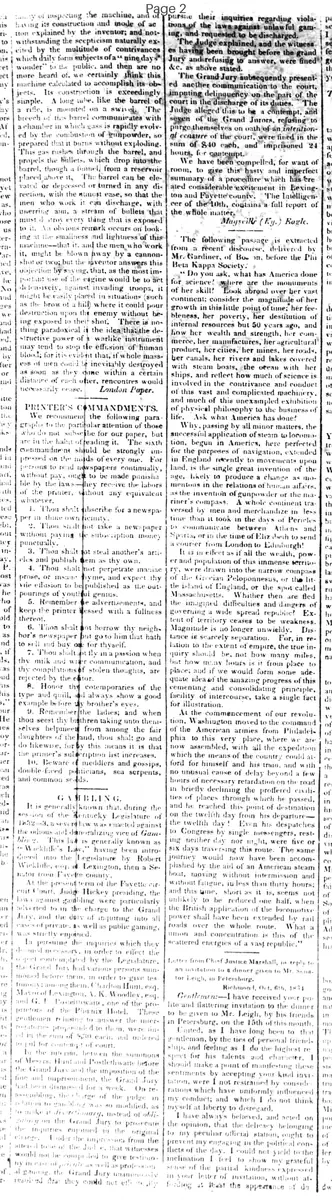
It is generally known that, during the session of the Kentucky Legislature of '32-'3, a severe law was enacted against the odious and demoralizing vice of Gambling. This law is generally known as "Wickliffe's Law," having been introduced into the Legislature by Robert Wickliffe, Esq. of Lexington, then a Senator from Fayette county.
At the present term of the Fayette circuit court, Judge Hickey presiding, the laws against gambling were particularly adverted to in the charge to the Grand Jury, and the duty of inquiring into all cases of private, as well as public gaming, was strictly enjoined.
In pursuing the inquiries which they deemed necessary, in order to effect the object contemplated by the Legislature, the Grand Jury had various persons summoned before them, in order to give testimony among them, Harlan Hunt, Esq., Mayor of Lexington, J. K. Woodley, Esq., and G. J. Postlethwaite, one of the proprietors of the Phœnix Hotel. These gentlemen refused to answer the interrogatories propounded to them, and were in consequence fined, and ordered to give security for their appearance.
In the meantime, between the summons of Messrs. Hunt and Postlethwaite before the Grand Jury and the imposition of the fine and imprisonment, the Grand Jury had been dismissed for a week. On re-assembling, the charge of the judge in relation to gambling was so modified, as to make it discretionary, instead of obligatory on the Grand Jury to prosecute the inquiries enjoined in the original charge. Under the impression from the altered tone of the Judge, that witnesses would not be required to give testimony unless well supported, all gaming, the Grand Jury unanimously resolved that they could not effect it, and requested to be discharged.
The Judge explained, and the witnesses having been brought before the grand Jury and refusing to answer, were fined &c. as above stated.
The Grand Jury subsequently presented another communication to the court, imputing delinquency on the part of the court in the discharge of its duties. The Judge alleged this to be a contempt, and seven of the Grand Jurors, refusing to purge themselves on oath of an intentional censure of the court, were fined in the sum of $40 each, and imprisoned 24 hours, for contempt.
We have been compelled, for want of room, to give this hasty and imperfect summary of a procedure which has created considerable excitement in Lexington and Fayette county. The Intelligencer of the 10th, contains a full report of the whole matter.
Maysville (Ky.) Eagle.
What sub-type of article is it?
What keywords are associated?
What entities or persons were involved?
Where did it happen?
Domestic News Details
Primary Location
Lexington, Fayette County, Kentucky
Event Date
Present Term Of The Fayette Circuit Court
Key Persons
Outcome
witnesses fined and ordered to give security for appearance; seven grand jurors fined $40 each and imprisoned 24 hours for contempt; grand jury discharged
Event Details
Judge Hickey charged Grand Jury to investigate gambling under Wickliffe's Law; witnesses refused to testify and were fined; charge modified to discretionary; jury requested discharge; later communication led to contempt charges against jurors