Thank you for visiting SNEWPapers!
Sign up free
Literary
July 26, 1827
The Wilmingtonian, And Delaware Advertiser
Wilmington, New Castle County, Delaware
What is this article about?
An essay exploring the remarkable phenomenon of new plants emerging from deeply dug earth, questioning if ancient seeds remain viable or if other mechanisms are at play, with examples of clover and vetches appearing on heaths and peat-marshes after applying ashes.
Clipping
OCR Quality
95%
Excellent
Full Text
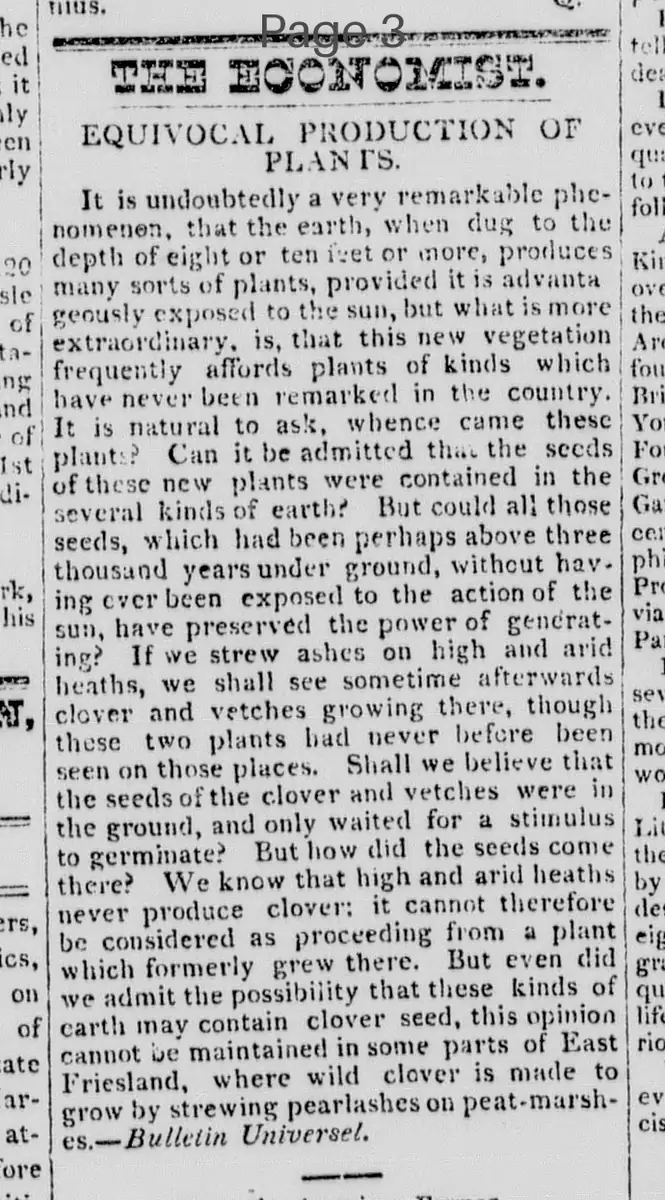
ECONOMIST.
EQUIVOCAL PRODUCTION OF
PLANTS.
It is undoubtedly a very remarkable phenomenon, that the earth, when dug to the
depth of eight or ten feet or more, produces
many sorts of plants, provided it is advantageously
exposed to the sun, but what is more
extraordinary is, that this new vegetation
frequently affords plants of kinds which
have never been remarked in the country.
It is natural to ask, whence came these
plants? Can it be admitted that the seeds
of these new plants were contained in the
several kinds of earth? But could all those
seeds, which had been perhaps above three
thousand years under ground, without having
ever been exposed to the action of the
sun, have preserved the power of generating?
If we strew ashes on high and arid
heaths, we shall see sometime afterwards
clover and vetches growing there, though
these two plants had never before been
seen on those places. Shall we believe that
the seeds of the clover and vetches were in
the ground, and only waited for a stimulus
to germinate? But how did the seeds come
there? We know that high and arid heaths
never produce clover: it cannot therefore
be considered as proceeding from a plant
which formerly grew there. But even did
we admit the possibility that these kinds of
earth may contain clover seed, this opinion
cannot be maintained in some parts of East
Frisland, where wild clover is made to
grow by strewing pearl-ashes on peat-marshes.--Bulletin Universel.
EQUIVOCAL PRODUCTION OF
PLANTS.
It is undoubtedly a very remarkable phenomenon, that the earth, when dug to the
depth of eight or ten feet or more, produces
many sorts of plants, provided it is advantageously
exposed to the sun, but what is more
extraordinary is, that this new vegetation
frequently affords plants of kinds which
have never been remarked in the country.
It is natural to ask, whence came these
plants? Can it be admitted that the seeds
of these new plants were contained in the
several kinds of earth? But could all those
seeds, which had been perhaps above three
thousand years under ground, without having
ever been exposed to the action of the
sun, have preserved the power of generating?
If we strew ashes on high and arid
heaths, we shall see sometime afterwards
clover and vetches growing there, though
these two plants had never before been
seen on those places. Shall we believe that
the seeds of the clover and vetches were in
the ground, and only waited for a stimulus
to germinate? But how did the seeds come
there? We know that high and arid heaths
never produce clover: it cannot therefore
be considered as proceeding from a plant
which formerly grew there. But even did
we admit the possibility that these kinds of
earth may contain clover seed, this opinion
cannot be maintained in some parts of East
Frisland, where wild clover is made to
grow by strewing pearl-ashes on peat-marshes.--Bulletin Universel.
What sub-type of article is it?
Essay
What themes does it cover?
Nature
Agriculture Rural
What keywords are associated?
Plants
Seeds
Earth
Germination
Clover
Vetches
Ashes
Heaths
Peat Marshes
What entities or persons were involved?
Bulletin Universel
Literary Details
Title
Equivocal Production Of Plants
Author
Bulletin Universel
Subject
On The Spontaneous Appearance Of New Plants From Deep Earth And Ashes
Key Lines
It Is Undoubtedly A Very Remarkable Phenomenon, That The Earth, When Dug To The Depth Of Eight Or Ten Feet Or More, Produces Many Sorts Of Plants, Provided It Is Advantageously Exposed To The Sun
If We Strew Ashes On High And Arid Heaths, We Shall See Sometime Afterwards Clover And Vetches Growing There, Though These Two Plants Had Never Before Been Seen On Those Places
This Opinion Cannot Be Maintained In Some Parts Of East Frisland, Where Wild Clover Is Made To Grow By Strewing Pearl Ashes On Peat Marshes