Thank you for visiting SNEWPapers!
Sign up free
Daily National Intelligencer
Washington, District Of Columbia
What is this article about?
Philo-Bobby Breeches defends a prior article by Bobby Breeches criticizing a tailors' petition to Congress for prohibiting imported ready-made clothes, arguing it would unjustly raise prices for consumers to benefit tailors, questions their patriotism, and advocates for consumer rights and free press over such protections.
Clipping
OCR Quality
Full Text
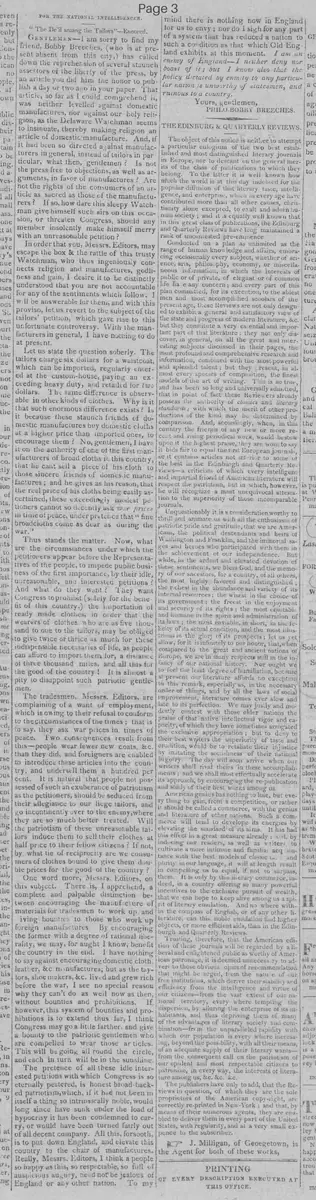
"The Devil among the Tailors"—Encore.
GENTLEMEN—I am sorry to find my friend, Bobby Breeches, (who is at present absent from this city,) has called down the reprehension of several staunch assertors of the liberty of the press, by an article you did him the honor to publish a day or two ago in your paper. That article, so far as I could comprehend it, was neither levelled against domestic manufactures, nor against our holy religion, as the Delaware Watchman seems to insinuate, thereby making religion an article of domestic manufacture. And, if it had been so directed against manufacturers in general, instead of tailors in particular, what then, gentlemen? Is not the press free to objections, as well as arguments, in favor of manufactures? Are not the rights of the consumers of an article as sacred as those of the manufacturers? If so, how dare this sleepy Watchman give himself such airs on this occasion, or threaten Congress, should any member insolently make himself merry with an unreasonable petition?
In order that you, Messrs. Editors, may escape the box & the rattle of this trusty Watchman, who thus ingeniously connects religion and manufactures, godliness and gain, I desire it to be distinctly understood that you are not accountable for any of the sentiments which follow. I will be answerable for them, and with this proviso, let us revert to the subject of the tailors' petition, which gave rise to this unfortunate controversy. With the manufacturers in general, I have nothing to do at present.
Let us state the question soberly. The tailors charge six dollars for a waistcoat, which can be imported, regularly entered at the custom-house, paying an exceeding heavy duty, and retailed for two dollars. The same difference is observable in other kinds of clothes. Why is it that such enormous difference exists? Is it because these staunch friends of domestic manufactures buy domestic cloths at a higher price than imported ones, to encourage them? No, gentlemen, I have it on the authority of one of the first manufacturers of broad cloths in this country, that he can't sell a piece of his cloth to those sincere friends of domestic manufactures; and he gives as his reason, that the real price of his cloths being easily ascertained, these exceedingly modest petitioners cannot so decently ask our prices in time of peace, under pretence that "fine broadcloths come as dear as during the war."
Thus stands the matter. Now, what are the circumstances under which the petitioners appear before the Representatives of the people, to impede public business of the first importance, by their idle, unreasonable, and interested petitions? And what do they want? They want Congress to prohibit (solely for the benefit of this country,) the importation of ready made clothes, in order that the wearers of clothes, who are as five thousand to one to the tailors, may be obliged to give twice or thrice as much for these indispensable necessaries of life, as people can afford to import them for, a distance of three thousand miles, and all this for the good of the country! It is almost a pity to disappoint such patriotic gentlemen.
The tradesmen, Messrs. Editors, are complaining of a want of employment, which is owing to their refusal to conform to the circumstances of the times; that is to say, they ask war prices in times of peace. Two consequences result from this—people wear fewer new coats, &c. than they did, and foreigners are enabled to introduce these articles into the country, and undersell them a hundred per cent. It is natural that people not possessed of such an exuberance of patriotism as the petitioners, should be seduced from their allegiance to our liege tailors, and go incontinently over to the enemy, where they are so much better treated. Will the patriotism of these unreasonable tailors induce them to sell their clothes at half price to their fellow citizens? If not, by what tie of reciprocity are we consumers of clothes bound to give them double prices for the good of the country?
One word more, Messrs. Editors, on this subject. There is, I apprehend, a complete and palpable distinction between encouraging the manufacture of materials for tradesmen to work up and giving bounties to those who work up foreign manufactures. By encouraging the former with a degree of rational liberality, we may, for aught I know, benefit the country in the end. I have nothing to say against encouraging domestic cloth, leather, &c. manufactures; but as the tailors, shoe makers, &c. lived and grew rich before the war, I see no special reason why they can't do as well now as then, without bounties and prohibitions. If, however, this system of bounties and prohibitions is to extend thus far, I think Congress may go a little farther, and give a bounty to the patriotic gentlemen who are compelled to wear those articles. This will be going all round the circle, and each in turn will be in the sunshine.
The pretence of all these idle interested petitions with which Congress is so eternally pestered, is honest broad-backed patriotism, which, if it had not been in itself a thing so intrinsically noble, would long since have sunk under the load of hypocrisy it has been condemned to carry, or would have been turned fairly out of all decent company. All this, forsooth, is to put down England, and elevate this country to the chair of manufactures. Really, Messrs. Editors, I think a people so happy as this, so respectable, so full of auspicious augury, need not be jealous of England or any other nation. To my mind there is nothing now in England for us to envy; nor do I sigh for any part of a system that has reduced a nation to such a condition as that which Old England exhibits at this moment. I am no enemy of England—I neither deny nor boast of it; but I know also that the policy dictated by enmity to any particular nation is unworthy of statesmen, and ruinous to a country.
Yours, gentlemen,
PHILO-BOBBY BREECHES.
What sub-type of article is it?
What themes does it cover?
What keywords are associated?
What entities or persons were involved?
Letter to Editor Details
Author
Philo Bobby Breeches
Recipient
Gentlemen
Main Argument
the tailors' petition to prohibit imported ready-made clothes would force consumers to pay exorbitant prices benefiting tailors at public expense; the press should freely criticize such unreasonable demands, prioritizing consumer rights over manufacturer protections in peacetime.
Notable Details