Thank you for visiting SNEWPapers!
Sign up free
Literary
July 20, 1805
Virginia Argus
Richmond, Virginia
What is this article about?
An essay excerpt from Kilt's Elements of General Knowledge extolling humanity's unique ability to study and admire nature, deriving refined pleasure, instruction, and gratitude to the Creator from its wonders, structures, and designs.
Clipping
OCR Quality
92%
Excellent
Full Text
From Kilt's Elements of General Knowledge
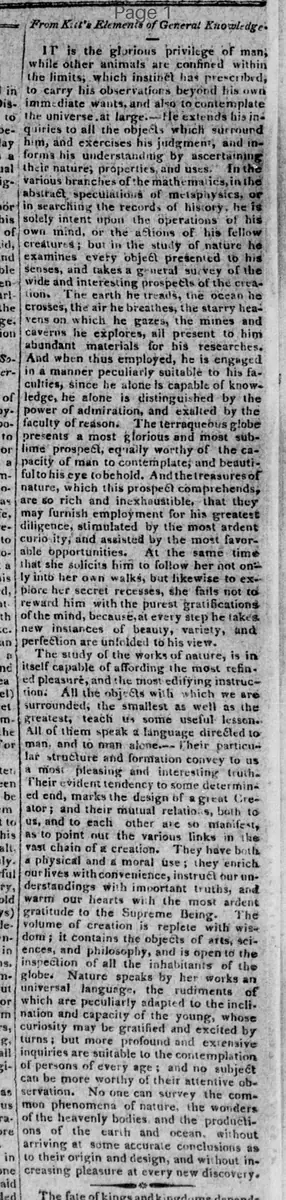
It is the glorious privilege of man; while other animals are confined within the limits; which instinct has prescribed to carry his observations beyond his own immediate wants. and also to contemplate the universe at large.-He extends his inquiries to all the objects which surround him, and exercises his judgment, and informs his understanding by ascertaining. their nature; properties, and uses. In the various branches of the mathematics, in the abstract speculations of metaphysics, or in searching the records of history, he is solely intent upon the operations of his own mind, or the actions of. his fellow creatures; but in the study of nature he examines every object presented to his senses, and takes a general survey of the wide and interesting prospects of the creation. The earth he treads, the ocean he crosses, the air he breathes, the starry heavens on which he gazes, the mines and caverns he explores, all present to.him abundant materials or his researches.
And when thus employed, he is engaged in a manner peculiarly suitable to his faculties, since he alone is capable of knowledge, he alone is distinguished by the power o admiration, and exalted by the faculty of reason. The terraqueous globe presents a most glorious and most sublime prospect; equally worthy of the capacity of man to contemplate; and beautiful to his eye to behold. And the treasures of nature, which this prospect comprehends, are so rich and inexhaustible, that they may furnish employment for his greatest diligence, stimulated by the most ardent curiosity; and assisted by the most favorable opportunities. At the same time that she solicits him to follow her not only into her own walks, but likewise to explore her secret recesses, she fails not to reward him with the purest gratifications of the mind, because, at every step he takes. new instances of beauty, variety, and perfection are unfolded to his view.
The study of the works of nature, is in itself capable of affording the most refined pleasure, and the most edifying instruction: All the objects with which we are surrounded; the smallest as well as the greatest, teach us some useful lesson. All of them speak a language directed to man, and to man alone.-- Their particular structure and formation convey to us a most pleasing and interesting truth.
Their evident tendency to some determined end, marks the design of a great Creator; and their mutual relations, both to us, and to each other are so manifest, as to point out the various links in the vast chain of a creation. They have both a physical and a moral use; they enrich our lives with convenience, instruct our understandings with important truths, and warm our hearts with the most ardent gratitude to the Supreme Being. The volume of creation is replete with wisdom; it contains the objects of arts, sciences, and philosophy, and is open to the inspection of all the inhabitants of the globe. Nature speaks by her works an universal language, the rudiments of which are peculiarly adapted to the inclination and capacity of the young, whose curiosity may be gratified and excited by turns; but more profound and extensive inquiries are suitable to the contemplation of persons of every age; and no subject can be more worthy of their attentive observation. No one can survey the common phenomena of nature, the wonders of the heavenly bodies, and the productions of the earth and ocean, without arriving at some accurate conclusions as to their origin and design, and without increasing pleasure at every new discovery.
It is the glorious privilege of man; while other animals are confined within the limits; which instinct has prescribed to carry his observations beyond his own immediate wants. and also to contemplate the universe at large.-He extends his inquiries to all the objects which surround him, and exercises his judgment, and informs his understanding by ascertaining. their nature; properties, and uses. In the various branches of the mathematics, in the abstract speculations of metaphysics, or in searching the records of history, he is solely intent upon the operations of his own mind, or the actions of. his fellow creatures; but in the study of nature he examines every object presented to his senses, and takes a general survey of the wide and interesting prospects of the creation. The earth he treads, the ocean he crosses, the air he breathes, the starry heavens on which he gazes, the mines and caverns he explores, all present to.him abundant materials or his researches.
And when thus employed, he is engaged in a manner peculiarly suitable to his faculties, since he alone is capable of knowledge, he alone is distinguished by the power o admiration, and exalted by the faculty of reason. The terraqueous globe presents a most glorious and most sublime prospect; equally worthy of the capacity of man to contemplate; and beautiful to his eye to behold. And the treasures of nature, which this prospect comprehends, are so rich and inexhaustible, that they may furnish employment for his greatest diligence, stimulated by the most ardent curiosity; and assisted by the most favorable opportunities. At the same time that she solicits him to follow her not only into her own walks, but likewise to explore her secret recesses, she fails not to reward him with the purest gratifications of the mind, because, at every step he takes. new instances of beauty, variety, and perfection are unfolded to his view.
The study of the works of nature, is in itself capable of affording the most refined pleasure, and the most edifying instruction: All the objects with which we are surrounded; the smallest as well as the greatest, teach us some useful lesson. All of them speak a language directed to man, and to man alone.-- Their particular structure and formation convey to us a most pleasing and interesting truth.
Their evident tendency to some determined end, marks the design of a great Creator; and their mutual relations, both to us, and to each other are so manifest, as to point out the various links in the vast chain of a creation. They have both a physical and a moral use; they enrich our lives with convenience, instruct our understandings with important truths, and warm our hearts with the most ardent gratitude to the Supreme Being. The volume of creation is replete with wisdom; it contains the objects of arts, sciences, and philosophy, and is open to the inspection of all the inhabitants of the globe. Nature speaks by her works an universal language, the rudiments of which are peculiarly adapted to the inclination and capacity of the young, whose curiosity may be gratified and excited by turns; but more profound and extensive inquiries are suitable to the contemplation of persons of every age; and no subject can be more worthy of their attentive observation. No one can survey the common phenomena of nature, the wonders of the heavenly bodies, and the productions of the earth and ocean, without arriving at some accurate conclusions as to their origin and design, and without increasing pleasure at every new discovery.
What sub-type of article is it?
Essay
What themes does it cover?
Nature
Religious
Moral Virtue
What keywords are associated?
Study Of Nature
Human Reason
Divine Creation
Supreme Being
Natural Wonders
Moral Instruction
Philosophical Contemplation
What entities or persons were involved?
From Kilt's Elements Of General Knowledge
Literary Details
Author
From Kilt's Elements Of General Knowledge
Subject
The Study Of Nature And Its Divine Design
Form / Style
Prose Essay On Natural Philosophy And Theology
Key Lines
It Is The Glorious Privilege Of Man; While Other Animals Are Confined Within The Limits; Which Instinct Has Prescribed To Carry His Observations Beyond His Own Immediate Wants.
The Study Of The Works Of Nature, Is In Itself Capable Of Affording The Most Refined Pleasure, And The Most Edifying Instruction:
Their Evident Tendency To Some Determined End, Marks The Design Of A Great Creator;
Nature Speaks By Her Works An Universal Language,