Thank you for visiting SNEWPapers!
Sign up free
Story
August 10, 1883
Sacramento Daily Record Union
Sacramento, Sacramento County, California
What is this article about?
In 1882, the US sold 17 million acres of land, a record, with 8 million in Dakota attracting 59,000 immigrants who settled on small holdings, fostering stable communities. The article argues against land monopolies, which would create aristocracy and dependency, versus small farms promoting homeownership and progress.
Clipping
OCR Quality
98%
Excellent
Full Text
SOME LAND MONOPOLY FIGURES.
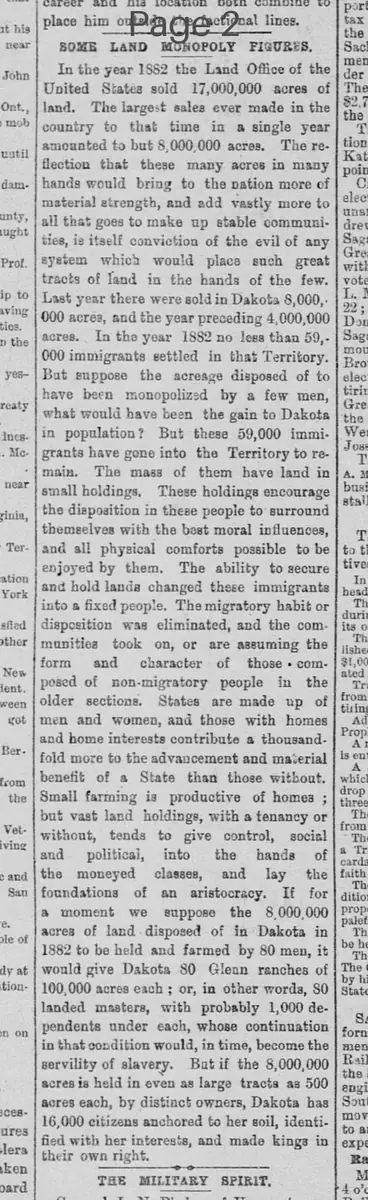
In the year 1882 the Land Office of the United States sold 17,000,000 acres of land. The largest sales ever made in the country to that time in a single year amounted to but 8,000,000 acres. The reflection that these many acres in many hands would bring to the nation more of material strength, and add vastly more to all that goes to make up stable communities, is itself conviction of the evil of any system which would place such great tracts of land in the hands of the few. Last year there were sold in Dakota 8,000,000 acres, and the year preceding 4,000,000 acres. In the year 1882 no less than 59,000 immigrants settled in that Territory. But suppose the acreage disposed of to have been monopolized by a few men, what would have been the gain to Dakota in population? But these 59,000 immigrants have gone into the Territory to remain. The mass of them have land in small holdings. These holdings encourage the disposition in these people to surround themselves with the best moral influences, and all physical comforts possible to be enjoyed by them. The ability to secure and hold lands changed these immigrants into a fixed people. The migratory habit or disposition was eliminated, and the communities took on, or are assuming the form and character of those composed of non-migratory people in the older sections. States are made up of men and women, and those with homes and home interests contribute a thousand fold more to the advancement and material benefit of a State than those without. Small farming is productive of homes; but vast land holdings, with a tenancy or without, tends to give control, social and political, into the hands of the moneyed classes, and lay the foundations of an aristocracy. If for a moment we suppose the 8,000,000 acres of land disposed of in Dakota in 1882 to be held and farmed by 80 men, it would give Dakota 80 Glenn ranches of 100,000 acres each; or, in other words, 80 landed masters, with probably 1,000 dependents under each, whose continuation in that condition would, in time, become the servility of slavery. But if the 8,000,000 acres is held in even as large tracts as 500 acres each, by distinct owners, Dakota has 16,000 citizens anchored to her soil, identified with her interests, and made kings in their own right.
In the year 1882 the Land Office of the United States sold 17,000,000 acres of land. The largest sales ever made in the country to that time in a single year amounted to but 8,000,000 acres. The reflection that these many acres in many hands would bring to the nation more of material strength, and add vastly more to all that goes to make up stable communities, is itself conviction of the evil of any system which would place such great tracts of land in the hands of the few. Last year there were sold in Dakota 8,000,000 acres, and the year preceding 4,000,000 acres. In the year 1882 no less than 59,000 immigrants settled in that Territory. But suppose the acreage disposed of to have been monopolized by a few men, what would have been the gain to Dakota in population? But these 59,000 immigrants have gone into the Territory to remain. The mass of them have land in small holdings. These holdings encourage the disposition in these people to surround themselves with the best moral influences, and all physical comforts possible to be enjoyed by them. The ability to secure and hold lands changed these immigrants into a fixed people. The migratory habit or disposition was eliminated, and the communities took on, or are assuming the form and character of those composed of non-migratory people in the older sections. States are made up of men and women, and those with homes and home interests contribute a thousand fold more to the advancement and material benefit of a State than those without. Small farming is productive of homes; but vast land holdings, with a tenancy or without, tends to give control, social and political, into the hands of the moneyed classes, and lay the foundations of an aristocracy. If for a moment we suppose the 8,000,000 acres of land disposed of in Dakota in 1882 to be held and farmed by 80 men, it would give Dakota 80 Glenn ranches of 100,000 acres each; or, in other words, 80 landed masters, with probably 1,000 dependents under each, whose continuation in that condition would, in time, become the servility of slavery. But if the 8,000,000 acres is held in even as large tracts as 500 acres each, by distinct owners, Dakota has 16,000 citizens anchored to her soil, identified with her interests, and made kings in their own right.
What sub-type of article is it?
Historical Event
Curiosity
What themes does it cover?
Justice
Social Manners
Moral Virtue
What keywords are associated?
Land Sales
Monopoly
Immigration
Dakota
Small Holdings
Aristocracy
Where did it happen?
United States, Dakota Territory
Story Details
Location
United States, Dakota Territory
Event Date
1882
Story Details
The article presents figures on US land sales in 1882, emphasizing benefits of distribution to many immigrants in small holdings in Dakota for stable communities, versus harms of monopoly leading to aristocracy and dependency.