Thank you for visiting SNEWPapers!
Sign up free
Literary
October 11, 1797
Gazette Of The United States, & Philadelphia Daily Advertiser
Philadelphia, Philadelphia County, Pennsylvania
What is this article about?
Translated excerpt from Cosin Jacques' 'An Elector of Paris,' a dialogue defining a Royalist as a Frenchman regretting the revolutionary chaos over the ancient regime's abuses, arguing monarchy suppresses factions better than republic, promoting civic virtue.
Clipping
OCR Quality
95%
Excellent
Full Text
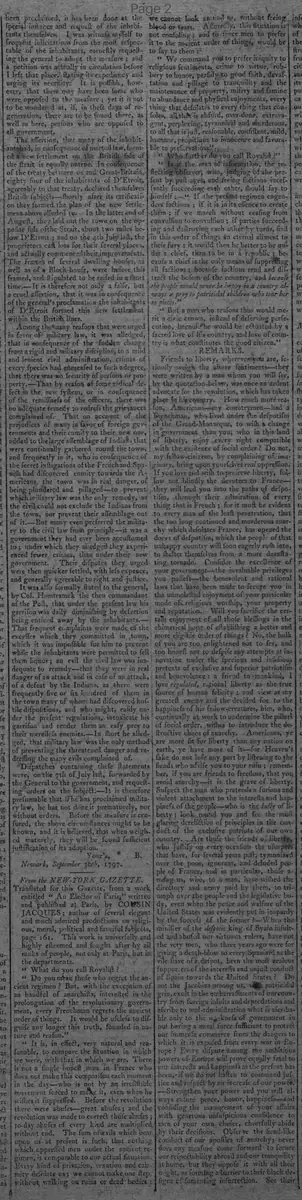
From the NEW-YORK GAZETTE.
Translated for this Gazette, from a work entitled "An Elector of Paris" written and published at Paris, by COSIN JACQUES; author of several elegant and much admired productions on religious, moral, political and fanciful subjects, page 161. This work is universally and highly esteemed and sought after by all ranks of people, not only at Paris, but in the departments.
"What do you call Royalist?
"Do you mean those who regret the ancient regimen? But, with the exception of an handful of anarchists, interested in the prolongation of the revolutionary government, every Frenchman regrets the ancient order of things. It would be useless to disguise any longer this truth, founded in nature and reason."
"It is, in effect, very natural and reasonable, to compare the situation in which we were, with that in which we are. There is not a single honest man in France who does not make this comparison each moment in the day-who is not by an irresistible movement forced to make it, even when he wishes it suppressed. Before the revolution there were abuses-great abuses; and the revolution was made to correct those abuses; to-day abuses of every kind are multiplied without end. The sum of evils which bear upon us at present is such, that nothing which oppressed men under the ancient regimen, is comparable to our actual situation. Every kind of privation, vexation and calamity desolate us; we cannot make one step without walking on ruins or dead bodies; we cannot look around us, without seeing blood or tears. Assuredly, this situation is not consoling: and to force men to prefer it to the ancient order of things, would be to say to them:
"We command you to prefer iniquity to religious sentiments, crime to virtue, robbery to honor, perfidy to good faith, devastation and pillage to tranquility and the maintenance of property, misery and famine to abundance and physical enjoyments, every thing that desolates to every thing that consoles, all that is absurd, over-done, extravagant, perplexing, tyrannical and murderous, to all that is just, reasonable, consistent, mild, humane, propitious to innocence and favorable to preservation."
"Who further do you call Royalist?"
"Is it the man of information, the reflecting observer, who, judging of the present by past ages, and seeing factions incessantly succeeding each other, should say to himself: -'If the present regimen engenders factions; if it is in its essence to create them; if we march without ceasing from convulsion to convulsion; if parties succeeding and destroying each other by turns, find in this order of things an eternal aliment to their fury; it would then be better to be under a chief, than to be in a republic; because a chief is the only means of suppressing all factions; because factions rend and distract the bosom of the country, and because the people would never be happy in a country always a prey to patricidal children who tear her to pieces.'"
But a man who reasons thus would merit a civic crown, instead of deserving persecution, because he would be actuated by a sacred love of his country, and love of country is what constitutes the good citizen.
Translated for this Gazette, from a work entitled "An Elector of Paris" written and published at Paris, by COSIN JACQUES; author of several elegant and much admired productions on religious, moral, political and fanciful subjects, page 161. This work is universally and highly esteemed and sought after by all ranks of people, not only at Paris, but in the departments.
"What do you call Royalist?
"Do you mean those who regret the ancient regimen? But, with the exception of an handful of anarchists, interested in the prolongation of the revolutionary government, every Frenchman regrets the ancient order of things. It would be useless to disguise any longer this truth, founded in nature and reason."
"It is, in effect, very natural and reasonable, to compare the situation in which we were, with that in which we are. There is not a single honest man in France who does not make this comparison each moment in the day-who is not by an irresistible movement forced to make it, even when he wishes it suppressed. Before the revolution there were abuses-great abuses; and the revolution was made to correct those abuses; to-day abuses of every kind are multiplied without end. The sum of evils which bear upon us at present is such, that nothing which oppressed men under the ancient regimen, is comparable to our actual situation. Every kind of privation, vexation and calamity desolate us; we cannot make one step without walking on ruins or dead bodies; we cannot look around us, without seeing blood or tears. Assuredly, this situation is not consoling: and to force men to prefer it to the ancient order of things, would be to say to them:
"We command you to prefer iniquity to religious sentiments, crime to virtue, robbery to honor, perfidy to good faith, devastation and pillage to tranquility and the maintenance of property, misery and famine to abundance and physical enjoyments, every thing that desolates to every thing that consoles, all that is absurd, over-done, extravagant, perplexing, tyrannical and murderous, to all that is just, reasonable, consistent, mild, humane, propitious to innocence and favorable to preservation."
"Who further do you call Royalist?"
"Is it the man of information, the reflecting observer, who, judging of the present by past ages, and seeing factions incessantly succeeding each other, should say to himself: -'If the present regimen engenders factions; if it is in its essence to create them; if we march without ceasing from convulsion to convulsion; if parties succeeding and destroying each other by turns, find in this order of things an eternal aliment to their fury; it would then be better to be under a chief, than to be in a republic; because a chief is the only means of suppressing all factions; because factions rend and distract the bosom of the country, and because the people would never be happy in a country always a prey to patricidal children who tear her to pieces.'"
But a man who reasons thus would merit a civic crown, instead of deserving persecution, because he would be actuated by a sacred love of his country, and love of country is what constitutes the good citizen.
What sub-type of article is it?
Dialogue
Essay
What themes does it cover?
Political
Liberty Freedom
What keywords are associated?
Royalist
French Revolution
Ancient Regime
Factions
Monarchy
Republic
Civic Virtue
What entities or persons were involved?
Cosin Jacques
Literary Details
Author
Cosin Jacques
Subject
Defining A Royalist In The Context Of The French Revolution
Form / Style
Prose Dialogue On Political Reflection
Key Lines
What Do You Call Royalist?
Every Frenchman Regrets The Ancient Order Of Things.
It Would Then Be Better To Be Under A Chief, Than To Be In A Republic;
Love Of Country Is What Constitutes The Good Citizen.