Thank you for visiting SNEWPapers!
Sign up free
The New Hampshire Gazette
Portsmouth, Rockingham County, New Hampshire
What is this article about?
An anonymous author in the Republican Watchtower defends Thomas Jefferson against charges in a letter by Thomas Turner of Virginia, published in a Federalist newspaper. Turner accuses Jefferson of abandoning his post as Governor during British invasions in 1781 and aiding the seditious writer James Callender. The defender refutes these as misrepresentations, portraying Jefferson's actions as patriotic and dutiful.
Clipping
OCR Quality
Full Text
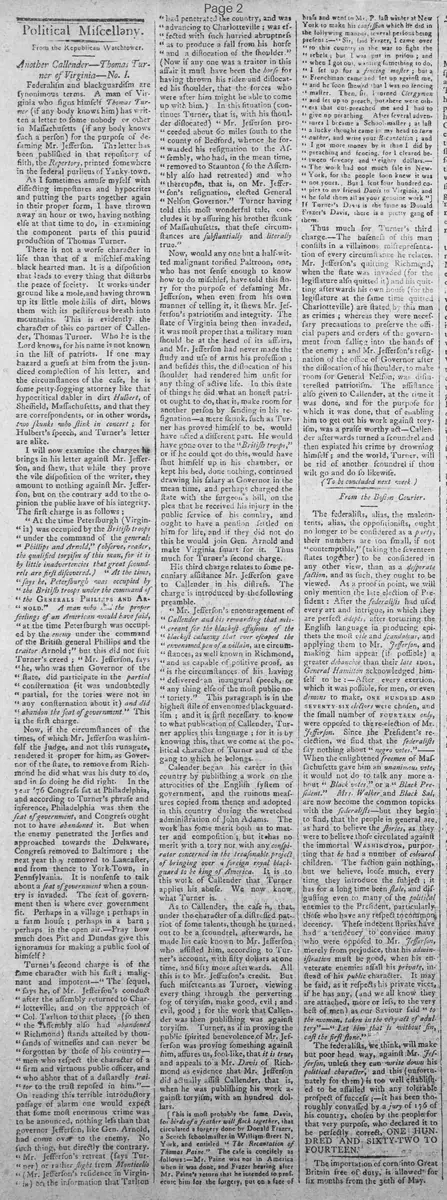
From the Republican Watchtower.
Another Callender—Thomas Turner of Virginia—No. I.
Federalism and blackguardism are synonymous terms. A man of Virginia who signs himself Thomas Turner (if any body knows him) has written a letter to some nobody or other in Massachusetts (if any body knows such a person) for the purpose of defaming Mr. Jefferson. The letter has been published in that repository of filth, the Repertory, printed somewhere in the federal purlieus of Yankee-town.
As I sometimes amuse myself with detecting impostures and hypocrites and putting the parts together again in their proper form, I have thrown away an hour or two, having nothing else at that time to do, in examining the component parts of this putrid production of Thomas Turner.
There is not a worse character in life than that of a mischief-making black-hearted man. It is a disposition that leads to every thing that disturbs the peace of society. It works under ground like a mole, and having thrown up its little mole hills of dirt, blows them with its pestiferous breath into mountains. This is evidently the character of this co-partner of Callender, Thomas Turner. Who he is the Lord knows, for his name is not known in the list of patriots. If one may hazard a guess at him from the jaundiced complexion of his letter, and the circumstances of the case, he is some petty-fogging attorney like that hypocritical dabbler in dirt Hulbert, of Sheffield, Massachusetts, and that they are correspondents, or in other words, two skunks who stink in concert; for Hulbert's speech, and Turner's letter are alike.
I will now examine the charges he brings in his letter against Mr. Jefferson, and show, that while they prove the vile disposition of the writer, they amount to nothing against Mr. Jefferson, but on the contrary add to the opinion the public have of his integrity.
The first charge is as follows:
"At the time Petersburg (Virginia) was occupied by the British troops under the command of the generals Phillips and Arnold," (observe, reader, the qualified toryism of this man, for it is by little inadvertencies that great scoundrels are first discovered.) "At the time, says he, Petersburg was occupied by the British troops under the command of the Generals Phillips and Arnold."
A man who is the proper feelings of an American would have said, "at the time Petersburg was occupied by the enemy under the command of the British general Phillips and the traitor Arnold;" but this did not suit Turner's creed; "Mr. Jefferson, says he, who was then Governor of the state, did participate in the partial consternation (it was undoubtedly partial, for the tories were not in any consternation about it) and did abandon the seat of government." This is the first charge.
Now, if the circumstances of the times, of which Mr. Jefferson was himself the Judge, and not this runagate, rendered it proper for him, as Governor of the state, to remove from Richmond he did what was his duty to do, and in so doing he did right. In the year '76 Congress sat at Philadelphia, and according to Turner's phrase and inference, Philadelphia was then the seat of government, and Congress ought not to have abandoned it. But when the enemy penetrated the Jerseys and approached towards the Delaware, Congress removed to Baltimore; the next year they removed to Lancaster, and from thence to York-Town, in Pennsylvania. It is nonsense to talk about a seat of government when a country is invaded. The seat of government then is wherever government sits. Perhaps in a village; perhaps in a farm house; perhaps in a barn; perhaps in the open air.—Pray how much does Pitt and Dundas give this ignoramus for making a public fool of himself?
Turner's second charge is of the same character with his first; malignant and impotent—“The sequel, says he, of Mr. Jefferson's conduct after the assembly returned to Charlottesville, and on the approach of Col. Tarleton to that place, (so then the Assembly also had abandoned Richmond) stands attested by thousands of witnesses and can never be forgotten by those of his countrymen— men who respect the character of a firm and virtuous public officer, and who abhor that of a dastardly traitor to the trust reposed in him."
On reading this terrible introductory passage of alarm one would expect that some most enormous crime was to be announced, nothing less than that governor Jefferson, like Gen. Arnold, had come over to the enemy. No such thing, but directly the contrary.
"Mr. Jefferson's retreat (says Turner) or rather flight from Monticello (Mr. Jefferson's residence in Virginia) on the information that Tarleton had penetrated the country, and was advancing to Charlottesville; was effected with such hurried abruptness as to produce a fall from his horse and a dislocation of the shoulder."
(Now if any one was a traitor in this affair it must have been the horse for having thrown his rider and dislocated his shoulder, that the forces who were after him might be able to come up with him.) In this situation (continues Turner, that is, with his shoulder dislocated) Mr. Jefferson proceeded about 60 miles south to the county of Bedford, whence he forwarded his resignation to the Assembly, who had, in the mean time, removed to Staunton so the Assembly also had retreated) and who thereupon, that is, on Mr. Jefferson's resignation, elected General Nelson Governor." Turner having told this most wonderful tale, concludes it by assuring his brother skunk of Massachusetts, that these circumstances are substantially and literally true."
Now, would any one but a half-witted malignant torified Paltoon, one, who has not sense enough to know how to do mischief, have told this story for the purpose of defaming Mr. Jefferson, when even from his own manner of telling it, it shows Mr. Jefferson's patriotism and integrity. The State of Virginia being then invaded, it was most proper that a military man should be at the head of its affairs, and Mr. Jefferson had never made the study and use of arms his profession: and besides this, the dislocation of his shoulder had rendered him unfit for any thing of active life. In this state of things he did what an honest patriot ought to do, that is, make room for another person by sending in his resignation—a mere skunk, such as Turner has proved himself to be, would have acted a different part. He would have gone over to the "British troops," or if he could not do this, would have shut himself up in his chamber, or kept his bed, done nothing, continued drawing his salary as Governor in the mean time, and perhaps charged the state with the surgeon's bill, on the plea that he received his injury in the public service of his country, and ought to have a pension settled on him for life, and if they did not do this he would join Gen. Arnold and make Virginia smart for it. Thus much for Turner's second charge.
His third charge relates to some pecuniary assistance Mr. Jefferson gave to Callender in his distress. The charge is introduced by the following preamble.
"Mr. Jefferson's encouragement of Callender and his rewarding that miscreant for the blackest effusions of the blackest calumny that ever escaped the envenomed pen of a villain, are circumstances, as well known in Richmond, and as capable of positive proof, as is the circumstance of his having delivered an inaugural speech, or any thing else of the most public notoriety." This paragraph is in the highest style of envenomed blackguardism: and it is first necessary to know to what publication of Callender, Turner applies this language; for it is by knowing this, that we come at the political character of Turner and of the gang to which he belongs.
Callender began his career in this country by publishing a work on the atrocities of the English system of government, and the ruinous measures copied from thence and adopted in this country during the wretched administration of John Adams. The work has some merit both as to matter and composition; but it has no merit with a tory nor with any conspirator concerned in the treasonable project of bringing over a foreign royal blackguard to be king of America. It is to this work of Callender that Turner applies his abuse. We now know what Turner is.
As to Callender, the case is, that, under the character of a distressed patriot of some talents, though he turned out to be a scoundrel, afterwards, he made his case known to Mr. Jefferson who aided him, according to Turner's account, with fifty dollars at one time, and fifty more afterwards. All this is to Mr. Jefferson's credit. But such miscreants as Turner, viewing every thing through the perverting fog of toryism, make good, evil; and evil, good; for the work that Callender was then publishing was against toryism. Turner, as if in proving the public spirited benevolence of Mr. Jefferson was proving something against him, assures us, fool-like, that it is true, and appeals to a Mr. Davis of Richmond as evidence that Mr. Jefferson did actually assist Callender, that is, when he was publishing his work against toryism, with an hundred dollars.
This is most probably the same Davis, for birds of a feather will flock together, that circulated a forgery done by Donald Frazer, a Scotch schoolmaster in William-street N. York, and entitled "The Recantation of Thomas Paine." The case is concisely as follows:-Mr. Paine was not in America when it was done, and Frazer hearing after Mr. Paine's return that he intended to prosecute him for the forgery, put on a face of brass and went to Mr. P. last winter at New York to make his confession which he did in the following manner, several persons being present: "Sir, said Frazer, I came over to this country in the war to fight the rebels; but I was put in prison; and when I got out, wanting something to do, I set up for a fencing master; but a Frenchman came and set up against me, and he soon showed that I was no fencing master. Then, in, I turned Clergyman and set up to preach, but there were others that out-preached me and I had to give up preaching. After several adventures I became a School-master; at last a lucky thought came in my head to turn author, and write your Recantation; and I got more money by it than I did by preaching and fencing, for I cleared between seventy and eighty dollars. The work had not much sale in New-York, for the people soon knew it was not yours. But I sent four hundred copies to my friend Davis in Virginia, and he sold them all as your genuine work."
If Turner's Davis is the same as Donald Frazer's Davis, there is a pretty gang of them.
Thus much for Turner's third charge.—The baseness of this man consists in a villainous misrepresentation of every circumstance he relates. Mr. Jefferson's quitting Richmond, when the state was invaded (for the legislature also quitted it) and his quitting afterwards his own house (for the legislature at the same time quitted Charlottesville) are stated, by this man as crimes; whereas they were necessary precautions to preserve the official papers and orders of the government from falling into the hands of the enemy; and Mr. Jefferson's resignation of the office of Governor after the dislocation of his shoulder, to make room for General Nelson, was disinterested patriotism. The assistance also given to Callender, at the time it was done, and for the purpose for which it was done, that of enabling him to get out his work against toryism, was a praiseworthy act—Callender afterwards turned a scoundrel and then expiated his crime by drowning himself; and the world, Turner, will be rid of another scoundrel if thou wilt go and do so likewise.
To be concluded next week.
What sub-type of article is it?
What themes does it cover?
What keywords are associated?
What entities or persons were involved?
Where did it happen?
Story Details
Key Persons
Location
Virginia
Event Date
1781
Story Details
Thomas Turner accuses Thomas Jefferson of cowardice for fleeing Richmond and Charlottesville during British invasions led by Phillips, Arnold, and Tarleton, injuring himself in escape, and resigning as Governor; he also claims Jefferson improperly aided the writer Callender. The author defends these as prudent actions during wartime invasion and benevolent support for anti-Federalist publication, exposing Turner's Tory bias and misrepresentations.