Thank you for visiting SNEWPapers!
Sign up free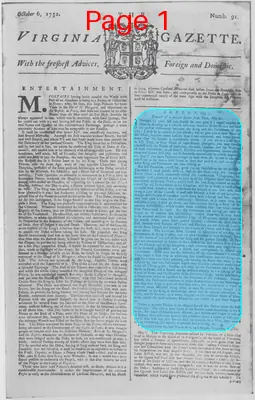
The Virginia Gazette
Richmond, Williamsburg, Richmond County, Virginia
What is this article about?
Extract from a Paris letter dated May 10 details the ongoing religious and political dispute between the French King and Paris Parliament over the 1713 papal Bull Unigenitus, which mandates acceptance of certain doctrines on grace and election, leading to refusals of sacraments to dissenters and parliamentary remonstrances against court policies.
Clipping
OCR Quality
Full Text
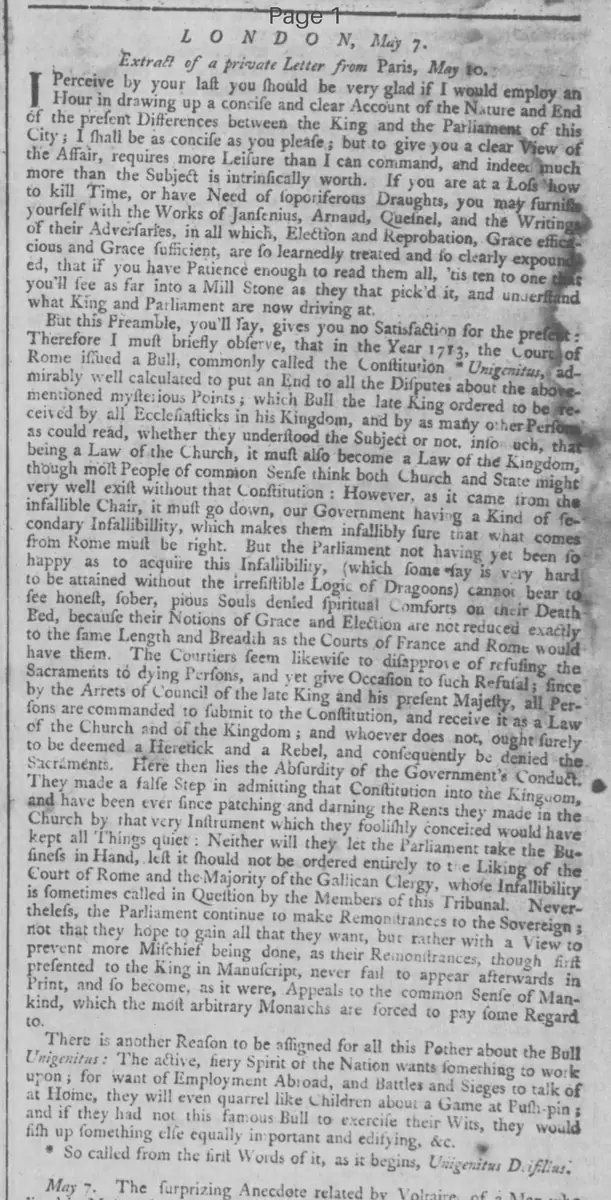
Extract of a private Letter from Paris, May 10.
Perceive by your last you should be very glad if I would employ an Hour in drawing up a concise and clear Account of the Nature and End of the present Differences between the King and the Parliament of this City; I shall be as concise as you please; but to give you a clear View of the Affair, requires more Leisure than I can command, and indeed much more than the Subject is intrinsically worth. If you are at a Loss how to kill Time, or have Need of soporiferous Draughts, you may furnish yourself with the Works of Jansenius, Arnaud, Quesnel, and the Writings of their Adversaries, in all which, Election and Reprobation, Grace efficacious and Grace sufficient, are so learnedly treated and so clearly expounded, that if you have Patience enough to read them all, 'tis ten to one you'll see as far into a Mill Stone as they that pick'd it, and understand what King and Parliament are now driving at.
But this Preamble, you'll say, gives you no Satisfaction for the present: Therefore I must briefly observe, that in the Year 1713, the Court of Rome issued a Bull, commonly called the Constitution Unigenitus, admirably well calculated to put an End to all the Disputes about the above-mentioned mysterious Points; which Bull the late King ordered to be received by all Ecclesiastics in his Kingdom, and by as many other Persons as could read, whether they understood the Subject or not. In so much, that being a Law of the Church, it must also become a Law of the Kingdom, though most People of common Sense think both Church and State might very well exist without that Constitution: However, as it came from the infallible Chair, it must go down, our Government having a Kind of secondary Infallibility, which makes them infallibly sure that what comes from Rome must be right. But the Parliament not having yet been so happy as to acquire this Infallibility, (which some say is very hard to be attained without the irresistible Logic of Dragoons) cannot bear to see honest, sober, pious Souls denied spiritual Comforts on their Death Bed, because their Notions of Grace and Election are not reduced exactly to the same Length and Breadth as the Courts of France and Rome would have them. The Courtiers seem likewise to disapprove of refusing the Sacraments to dying Persons, and yet give Occasion to such Refusal; since by the Arrets of Council of the late King and his present Majesty, all Persons are commanded to submit to the Constitution, and receive it as a Law of the Church and of the Kingdom; and whoever does not, ought surely to be deemed a Heretick and a Rebel, and consequently be denied the Sacraments. Here then lies the Absurdity of the Government's Conduct.
They made a false Step in admitting that Constitution into the Kingdom, and have been ever since patching and darning the Rents they made in the Church by that very Instrument which they foolishly conceived would have kept all Things quiet: Neither will they let the Parliament take the Business in Hand, lest it should not be ordered entirely to the Liking of the Court of Rome and the Majority of the Gallican Clergy, whose Infallibility is sometimes called in Question by the Members of this Tribunal. Nevertheless, the Parliament continue to make Remonstrances to the Sovereign; not that they hope to gain all that they want, but rather with a View to prevent more Mischief being done, as their Remonstrances, though first presented to the King in Manuscript, never fail to appear afterwards in Print, and so become, as it were, Appeals to the common Sense of Mankind, which the most arbitrary Monarchs are forced to pay some Regard to.
There is another Reason to be assigned for all this Pother about the Bull Unigenitus: The active, fiery Spirit of the Nation wants something to work upon; for want of Employment Abroad, and Battles and Sieges to talk of at Home, they will even quarrel like Children about a Game at Push-pin; and if they had not this famous Bull to exercise their Wits, they would fish up something else equally important and edifying, &c.
So called from the first Words of it, as it begins, Unigenitus Dei Filius.
What sub-type of article is it?
What keywords are associated?
What entities or persons were involved?
Where did it happen?
Foreign News Details
Primary Location
Paris
Event Date
May 10
Key Persons
Outcome
ongoing disputes with parliamentary remonstrances published to appeal to public sense; no resolution, potential for further mischief prevented
Event Details
The letter explains the disputes arising from the 1713 Bull Unigenitus, enforced by the King as law, leading to denial of sacraments to dissenters over Jansenist doctrines; Parliament opposes this, making remonstrances to the King to challenge the policy and highlight government absurdity.