Thank you for visiting SNEWPapers!
Sign up free
Story
June 3, 1916
The Broad Ax
Salt Lake City, Salt Lake County County, Utah
What is this article about?
In 1886, David Cook at Speeds Cement mills near New Albany, Indiana, implemented early work start at 6 a.m. to utilize winter daylight, allowing a 10-hour day year-round, predating European daylight saving by 30 years.
Clipping
OCR Quality
95%
Excellent
Full Text
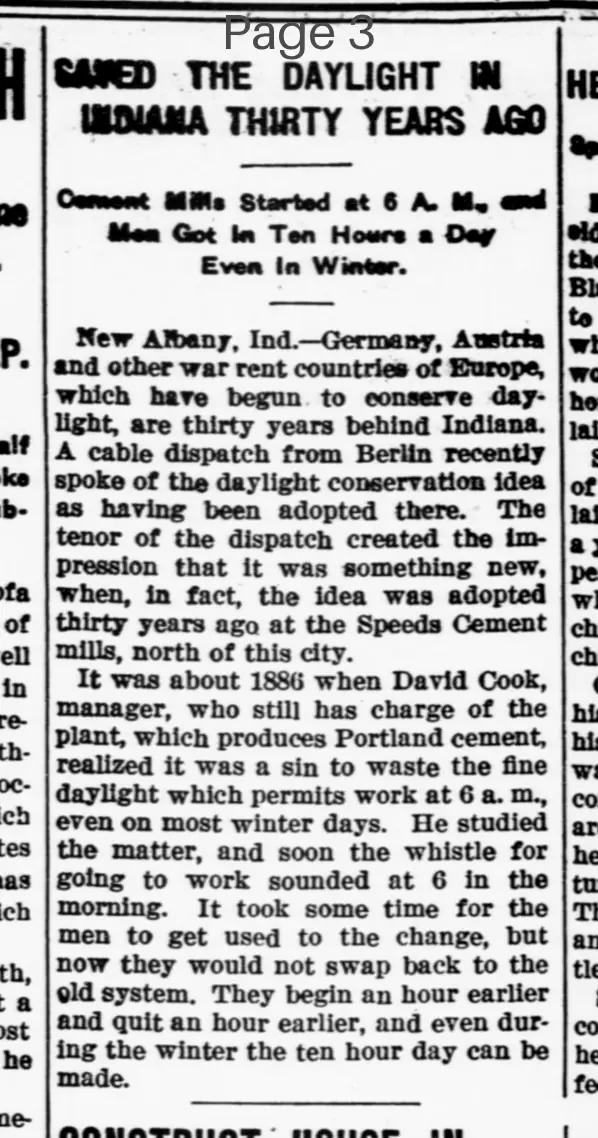
INDIANA THIRTY YEARS AGO
Content Mills Started at 6 A. M., so Men Got In Ten Hours a Day Even In Winter.
New Albany, Ind.—Germany, Austria and other war-torn countries of Europe which have begun to conserve daylight, are thirty years behind Indiana.
A cable dispatch from Berlin recently spoke of the daylight conservation idea as having been adopted there. The tenor of the dispatch created the impression that it was something new, when, in fact, the idea was adopted thirty years ago at the Speeds Cement mills, north of this city.
It was about 1886 when David Cook, manager, who still has charge of the plant, which produces Portland cement, realized it was a sin to waste the fine daylight which permits work at 6 a. m., even on most winter days. He studied the matter, and soon the whistle for going to work sounded at 6 in the morning. It took some time for the men to get used to the change, but now they would not swap back to the old system. They begin an hour earlier and quit an hour earlier, and even during the winter the ten hour day can be made.
Content Mills Started at 6 A. M., so Men Got In Ten Hours a Day Even In Winter.
New Albany, Ind.—Germany, Austria and other war-torn countries of Europe which have begun to conserve daylight, are thirty years behind Indiana.
A cable dispatch from Berlin recently spoke of the daylight conservation idea as having been adopted there. The tenor of the dispatch created the impression that it was something new, when, in fact, the idea was adopted thirty years ago at the Speeds Cement mills, north of this city.
It was about 1886 when David Cook, manager, who still has charge of the plant, which produces Portland cement, realized it was a sin to waste the fine daylight which permits work at 6 a. m., even on most winter days. He studied the matter, and soon the whistle for going to work sounded at 6 in the morning. It took some time for the men to get used to the change, but now they would not swap back to the old system. They begin an hour earlier and quit an hour earlier, and even during the winter the ten hour day can be made.
What sub-type of article is it?
Historical Event
Curiosity
What themes does it cover?
Triumph
What keywords are associated?
Daylight Conservation
Work Hours
Cement Mills
Indiana History
Early Adoption
What entities or persons were involved?
David Cook
Where did it happen?
Speeds Cement Mills, North Of New Albany, Ind.
Story Details
Key Persons
David Cook
Location
Speeds Cement Mills, North Of New Albany, Ind.
Event Date
About 1886
Story Details
David Cook implemented 6 a.m. start at Speeds Cement mills to conserve daylight, enabling 10-hour workdays even in winter; workers adapted and preferred the system.