Thank you for visiting SNEWPapers!
Sign up free
Virginia Argus
Richmond, Virginia
What is this article about?
An anonymous Virginia legislator argues in a letter that the state legislature can constitutionally reduce judges' salaries if they exceed adequate compensation, citing historical precedents and contrasting with the U.S. Constitution. He supports maintaining or adjusting salaries to ensure judicial independence and adequacy given workload and costs in Richmond.
Merged-components note: Extract of a letter on constitutionality of reducing judges' salaries; merged as continuation; relabeled to letter_to_editor as it is presented as such.
Clippings
1 of 2
OCR Quality
Full Text
REDUCING THE SALARIES
OF JUDGES.
Extract of a letter from a gentleman in
the Country, formerly a member of
the Legislature of Virginia, to his
friend in Richmond.
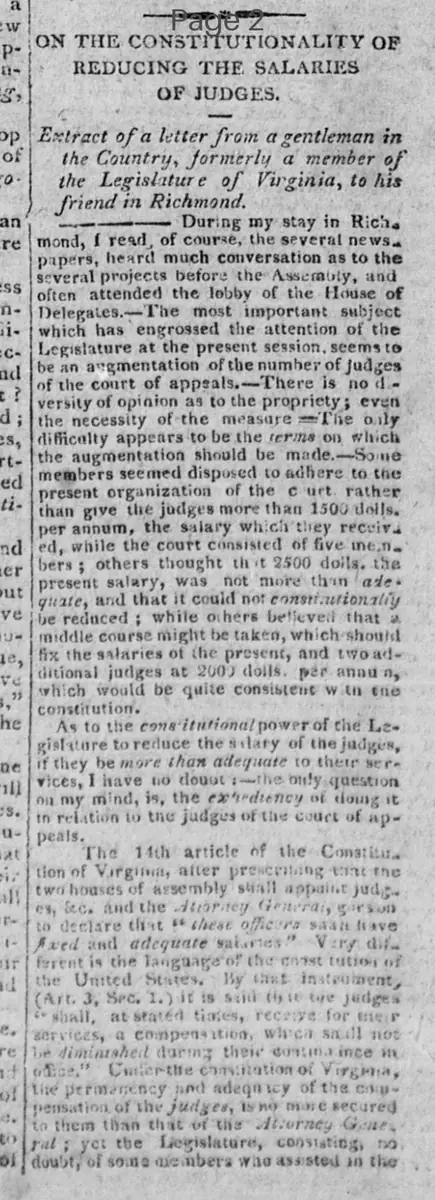
During my stay in Richmond, I read, of course, the several newspapers, heard much conversation as to the several projects before the Assembly, and often attended the lobby of the House of Delegates.--The most important subject which has engrossed the attention of the Legislature at the present session, seems to be an augmentation of the number of judges of the court of appeals.--There is no diversity of opinion as to the propriety; even the necessity of the measure =The only difficulty appears to be the terms on which the augmentation should be made.--Some members seemed disposed to adhere to the present organization of the court. rather than give the judges more than 1500 dolls. per annum, the salary which they received, while the court consisted of five members; others thought that 2500 dolls. the present salary, was not more than adequate, and that it could not constitutionally be reduced; while others believed that a middle course might be taken, which should fix the salaries of the present, and two additional judges at 2000 dolls. per annum, which would be quite consistent with the constitution.
As to the constitutional power of the Legislature to reduce the salary of the judges, if they be more than adequate to their services, I have no doubt :-the only question on my mind, is, the expediency of doing it in relation to the judges of the court of appeals.
The 4th article of the Constitution of Virginia, after providing that the two houses of assembly shall appoint judges, &c. and the Attorney General, goes on to declare that " these officers shall have fixed and adequate salaries" Very different is the language of the constitution of the United States. By cant instrument, (Art. 3, Sec. 1.) it is said that the judges shall, at stated times, receive for their services, a compensation, which shall not be diminished during their continuance in office." Contrast the conviction of Virginia, The permanency and adequacy of the compensation of the judges, is no more secured to them than that of the Attorney General; yet the Legislature, consisting, to. formation of the constitution, have been in the constant habit of varying the salaries of the Judges and Attorney General, as it appeared to fall short of, or exceed an adequate compensation. Thus, in the October session, 1781, after reciting that "the provision made for the officers of government by an act of assembly, passed in May preceding, had been found inadequate to their services, as well on account of the quantum as the depreciation between each quarterly payment," the legislature increased the salaries of the different officers of government, and made their pay equal to specie. (See laws of Virginia, Edit. 1785, pa. 150.) In 1785, only four years afterwards, the legislature, by an act, the preamble of which recites that "the salaries allowed by law to the officers of civil government had been found to exceed a proper and adequate compensation for their services," reduced the salaries of most of the officers of government, including the Attorney General. (See acts of 1785, ch 16.) In 1771, at the organization of the general court, the salary of the judges was five hundred pounds per annum. (See Laws of Virginia, edit. 1785, pa. 73, sect. 73.) It was afterwards reduced to three hundred pounds; (See acts of 1785, ch. 16. Rev. Code, vol. 1, ch. 58, p. 56.) After the establishment of the district courts, the judges were allowed, in addition to their stated salary, of one thousand dollars per annum, their travelling expenses; which were commuted for the present salary of fifteen hundred dollars per annum.
Having shown the practice of the government to have been to vary the salaries of the judges from time to time, as they either exceeded an adequate compensation, or were not equal to their services, let us see whether there be any thing in principle which is hostile to it. The constitution of Virginia provides that the salary of the judges shall be fixed and adequate; not that it shall not be diminished. Now, "it is apparent to the understanding of every man, that the constitution is not satisfied, unless those salaries be not only fixed, that is, certain but adequate also. A salary may be permanent, but not adequate. Suppose the judges have a fixed salary, and either from the depreciation of the value of money, or an increase of business, it should be inadequate to their services, would not the legislature be bound, in duty to the judges, to increase it? On the other hand, if from an appreciation of the value of money, or a diminution of business, the salary of the judges should be more than adequate, would not the legislature, be bound, in duty to the people, to reduce it? Let us suppose that, in consequence of the great pressure of business before the court of appeals, the legislature should require the judges to sit 200 days in the year, and should fix upon any given sum as an adequate compensation for such services; but in order to promote an earlier decision of causes by that court, they shall determine to take away the right of arbitrary appeals, and increase the sum for which a writ of error or supersedeas shall lie, thus decreasing the business, and not making it necessary for the judges to sit more than 100 days, would it be said that a salary which was adequate when the court were compelled to sit 200 days shall necessarily be continued, when the judges are only employed half that time?
But I have heard it said, you may increase the salary of the judges as much as you please, but you cannot diminish it, without affecting their independence. If by the term independence, you mean a man's pecuniary circumstances, no word in the English language can convey a more indeterminate idea. It is from a man's wants, either real or imaginary, that the same sum of money will make him independent or otherwise. A frugal man content with the necessaries of life, will be more independent, on a salary of 2500 dollars a year, than a man who indulges himself in luxury would be on a salary of 5000 dollars. But the argument is founded on the supposition that the independence of a judge can only be affected by diminishing his salary, and thereby inducing him to court the favor of the legislature. Has it ever occurred to gentlemen, that when we depart from the constitutional ground of a fixed salary, the argument applies as strongly to an increase as a diminution? If, in the one case, a judge would be deterred from doing his duty for fear the legislature might diminish his salary, might he not in the other be induced to court their favor, under a hope that it would be increased? Let it be distinctly understood that I put these cases merely hypothetical. I have no idea that any judge would be influenced by such unworthy motives. But as arguments have been deduced from a view of one side of the picture, I thought it but fair to exhibit the other.
As to the expediency of allowing the judges of the court of appeals a salary of 2500 dollars a year, I have as little doubt, as I have of the constitutionality of increasing or diminishing their salaries as a change of circumstances may require. In the present state of the docket of that court, it would require the utmost exertions of the judges, sitting every day in the year, to get through it. They will, no doubt, feel the necessity of meeting in vacation and of possessing themselves fully of the records in as many cases as can possibly be decided at the succeeding term. By pursuing this course, they will require no arguments upon points, on which any of the judges may entertain a doubt; and thus a great proportion of time which is consumed at every term, will be saved. To a person acquainted with the expenses incident to a residence in Richmond, where the judges will be compelled to remain, the sum of 2500 dollars, will appear barely a competency. It is far, very far, short of the income of many members of the bar; and I believe there are very few who move in the most polished circles, who do not expend more than double that sum. I am no friend to the encouragement of extravagance; but am clearly of opinion that a judge should not only have a competency while he is performing the duties of his office, but should be enabled to lay up something for old age; and should not be compelled, for the mere sake of getting his bread, to continue in a highly responsible office, when nature and his declining faculties admonish him to retire.
What sub-type of article is it?
What themes does it cover?
What keywords are associated?
What entities or persons were involved?
Letter to Editor Details
Author
A Gentleman In The Country, Formerly A Member Of The Legislature Of Virginia
Recipient
His Friend In Richmond
Main Argument
the virginia legislature has the constitutional power to reduce judges' salaries if they exceed adequate compensation, as the state constitution requires fixed and adequate salaries but not immutability, unlike the u.s. constitution; historical precedents support adjustments based on circumstances, and current salaries should reflect workload and living costs in richmond.
Notable Details