Thank you for visiting SNEWPapers!
Sign up free
Story
May 11, 1889
Wood River Times
Hailey, Blaine County, Alturas County, Idaho
What is this article about?
An editorial from the N.Y. Engineering and Mining Journal advocating for the metric system's adoption in U.S. commercial transactions, criticizing the confusing English weights and measures with examples from mining and trade, and citing 1887 global adoption statistics showing 61% of civilized world population using it.
Clipping
OCR Quality
98%
Excellent
Full Text
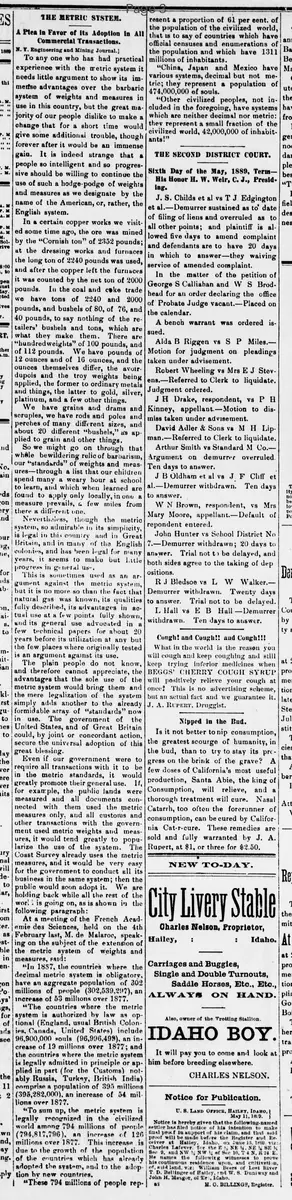
THE METRIC SYSTEM.
A Plea In Favor of its Adoption in All Commercial Transactions.
N. Y. Engineering and Mining Journal.
To any one who has had practical experience with the metric system it needs little argument to show its immense advantages over the barbaric system of weights and measures in use in this country, but the great majority of our people dislike to make a change that for a short time would give some additional trouble, though forever after it would be an immense gain. It is indeed strange that a people so intelligent and so progressive should be willing to continue the use of such a hodge-podge of weights and measures as we designate by the name of the American, or, rather, the English system.
In a certain copper works we visited some time ago, the ore was mined by the "Cornish ton" of 2352 pounds; at the dressing works and furnaces the long ton of 2240 pounds was used, and after the copper left the furnaces it was counted by the net ton of 2000 pounds. In the coal and coke trade we have tons of 2240 and 2000 pounds, and bushels of 80, of 76, and 40 pounds, to say nothing of the retailers' bushels and tons, which are what they make them. There are "hundredweights" of 100 pounds, and of 112 pounds. We have pounds of 12 ounces and of 16 ounces, and the ounces themselves differ, the avoirdupois and the troy weights being applied, the former to ordinary metals and things, the latter to gold, silver, platinum, and a few other things. We have grains and drams and scruples, we have rods and poles and perches of many different sizes, and about 20 different "bushels," as applied to grain and other things.
So we might go on through that whole bewildering relic of barbarism, our "standards" of weights and measures-through a list that our children spend many a weary hour at school to learn, and which when learned are found to apply only locally, in one place a measure prevails, a few miles from there a different one.
Nevertheless, though the metric system, so admirable in its simplicity, is legal in this country and in Great Britain, and in many of the English colonies, and has been legal for many years, it seems to make but little progress in general use.
This is sometimes used as an argument against the metric system, but it is no more so than the fact that natural gas was known, its qualities fully described, its advantages in actual use at a few points fully shown and its general use advocated in a few technical papers for about 20 years before its utilization at any but the few places where originally tested is an argument against its use.
The plain people do not know, and therefore cannot appreciate, the advantages that the sole use of the metric system would bring them and the mere legalization of the system simply adds another to the already formidable array of "standards" now in use. The government of the United States, and of Great Britain could, by joint or concordant action, secure the universal adoption of this great blessing.
Even if our government were to require all transactions with it to be in the metric standards, it would greatly promote their general use. If, for example, the public lands were measured and all documents connected with them used the metric measures only, and all customs and other transactions with the government used metric weights and measures, it would tend greatly to popularize the use of the system. The Coast Survey already uses the metric measures, and it would be very easy for the government to conduct all its business in the same system; then the public would soon adopt it. We are holding back while all the rest of the world is going on, as is shown in the following paragraph:
At a meeting of the French Academie des Sciences, held on the 4th February last, M. de Malaroc, speaking on the subject of the extension of the metric system of weights and measures, said:
"In 1887, the countries where the decimal metric system is obligatory, have an aggregate population of 302 millions of people (302,539,297), an increase of 53 millions over 1877.
"The countries where the metric system is authorized by law as optional (England, usual British Colonies, Canada, United States) include 96,900,000 souls (96,996,499), an increase of 19 millions over 1877; and the countries where the metric system is legally admitted in principle or applied in part (for the Customs) notably Russia, Turkey, British India) comprise a population of 395 millions (395,282,000), an increase of 54 millions over 1877.
"To sum up, the metric system is legally recognized in the civilized world among 794 millions of people (794,817,796), an increase of 126 millions over 1877. This increase is due to the growth of the population of the countries which has already adopted the system, and to the adoption by new countries.
"These 794 millions of people represent a proportion of 61 per cent. of the population of the civilized world, that is to say of countries which have official censuses and enumerations of the population and which have 1311 millions of inhabitants.
"China, Japan and Mexico have various systems, decimal but not metric; they represent a population of 474,000,000 of souls.
"Other civilized peoples, not included in the foregoing, have systems which are neither decimal nor metric: they represent a small fraction of the civilized world, 42,000,000 of inhabitants!"
A Plea In Favor of its Adoption in All Commercial Transactions.
N. Y. Engineering and Mining Journal.
To any one who has had practical experience with the metric system it needs little argument to show its immense advantages over the barbaric system of weights and measures in use in this country, but the great majority of our people dislike to make a change that for a short time would give some additional trouble, though forever after it would be an immense gain. It is indeed strange that a people so intelligent and so progressive should be willing to continue the use of such a hodge-podge of weights and measures as we designate by the name of the American, or, rather, the English system.
In a certain copper works we visited some time ago, the ore was mined by the "Cornish ton" of 2352 pounds; at the dressing works and furnaces the long ton of 2240 pounds was used, and after the copper left the furnaces it was counted by the net ton of 2000 pounds. In the coal and coke trade we have tons of 2240 and 2000 pounds, and bushels of 80, of 76, and 40 pounds, to say nothing of the retailers' bushels and tons, which are what they make them. There are "hundredweights" of 100 pounds, and of 112 pounds. We have pounds of 12 ounces and of 16 ounces, and the ounces themselves differ, the avoirdupois and the troy weights being applied, the former to ordinary metals and things, the latter to gold, silver, platinum, and a few other things. We have grains and drams and scruples, we have rods and poles and perches of many different sizes, and about 20 different "bushels," as applied to grain and other things.
So we might go on through that whole bewildering relic of barbarism, our "standards" of weights and measures-through a list that our children spend many a weary hour at school to learn, and which when learned are found to apply only locally, in one place a measure prevails, a few miles from there a different one.
Nevertheless, though the metric system, so admirable in its simplicity, is legal in this country and in Great Britain, and in many of the English colonies, and has been legal for many years, it seems to make but little progress in general use.
This is sometimes used as an argument against the metric system, but it is no more so than the fact that natural gas was known, its qualities fully described, its advantages in actual use at a few points fully shown and its general use advocated in a few technical papers for about 20 years before its utilization at any but the few places where originally tested is an argument against its use.
The plain people do not know, and therefore cannot appreciate, the advantages that the sole use of the metric system would bring them and the mere legalization of the system simply adds another to the already formidable array of "standards" now in use. The government of the United States, and of Great Britain could, by joint or concordant action, secure the universal adoption of this great blessing.
Even if our government were to require all transactions with it to be in the metric standards, it would greatly promote their general use. If, for example, the public lands were measured and all documents connected with them used the metric measures only, and all customs and other transactions with the government used metric weights and measures, it would tend greatly to popularize the use of the system. The Coast Survey already uses the metric measures, and it would be very easy for the government to conduct all its business in the same system; then the public would soon adopt it. We are holding back while all the rest of the world is going on, as is shown in the following paragraph:
At a meeting of the French Academie des Sciences, held on the 4th February last, M. de Malaroc, speaking on the subject of the extension of the metric system of weights and measures, said:
"In 1887, the countries where the decimal metric system is obligatory, have an aggregate population of 302 millions of people (302,539,297), an increase of 53 millions over 1877.
"The countries where the metric system is authorized by law as optional (England, usual British Colonies, Canada, United States) include 96,900,000 souls (96,996,499), an increase of 19 millions over 1877; and the countries where the metric system is legally admitted in principle or applied in part (for the Customs) notably Russia, Turkey, British India) comprise a population of 395 millions (395,282,000), an increase of 54 millions over 1877.
"To sum up, the metric system is legally recognized in the civilized world among 794 millions of people (794,817,796), an increase of 126 millions over 1877. This increase is due to the growth of the population of the countries which has already adopted the system, and to the adoption by new countries.
"These 794 millions of people represent a proportion of 61 per cent. of the population of the civilized world, that is to say of countries which have official censuses and enumerations of the population and which have 1311 millions of inhabitants.
"China, Japan and Mexico have various systems, decimal but not metric; they represent a population of 474,000,000 of souls.
"Other civilized peoples, not included in the foregoing, have systems which are neither decimal nor metric: they represent a small fraction of the civilized world, 42,000,000 of inhabitants!"
What sub-type of article is it?
Curiosity
What themes does it cover?
Moral Virtue
What keywords are associated?
Metric System
Weights And Measures
English System
Adoption
Commercial Transactions
Global Statistics
What entities or persons were involved?
M. De Malaroc
Where did it happen?
United States, Great Britain, France
Story Details
Key Persons
M. De Malaroc
Location
United States, Great Britain, France
Event Date
1887
Story Details
Advocacy for metric system adoption, illustrating English system's confusions in mining and trade, suggesting government mandates, and quoting 1887 statistics on global use among 794 million people.