Thank you for visiting SNEWPapers!
Sign up free
Editorial
February 14, 1794
Gazette Of The United States & Evening Advertiser
Philadelphia, Philadelphia County, Pennsylvania
What is this article about?
An editorial arguing for the suability of states in courts, emphasizing equality of rights for natural and artificial persons under republican government. It critiques exemptions from legal compulsion as despotic and praises the U.S. Supreme Court's decision affirming states' liability to individuals.
Clipping
OCR Quality
98%
Excellent
Full Text
From the American Minerva
SUABILITY OF STATES.
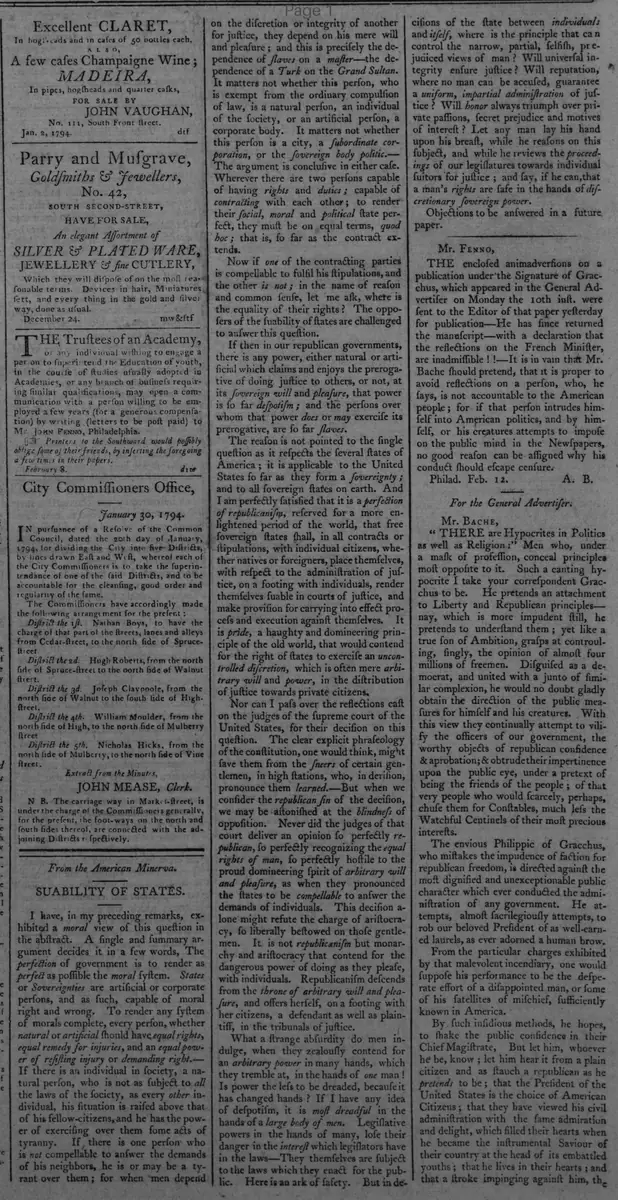
I have, in my preceding remarks, exhibited a moral view of this question in the abstract. A single and summary argument decides it in a few words, The perfection of government is to render as perfect as possible the moral system. States or Sovereignties are artificial or corporate persons, and as such, capable of moral right and wrong. To render any system of morals complete, every person, whether natural or artificial should have equal rights, equal remedy for injuries, and an equal power of resisting injury or demanding right.—If there is an individual in society, a natural person, who is not as subject to all the laws of the society, as every other individual, his situation is raised above that of his fellow-citizens, and he has the power of exercising over them some acts of tyranny. If there is one person who is not compellable to answer the demands of his neighbors, he is or may be a tyrant over them; for when men depend on the discretion or integrity of another for justice, they depend on his mere will and pleasure; and this is precisely the dependence of slaves on a master—the dependence of a Turk on the Grand Sultan. It matters not whether this person, who is exempt from the ordinary compulsion of law, is a natural person, an individual of the society, or an artificial person, a corporate body. It matters not whether this person is a city, a subordinate corporation, or the sovereign body politic.—The argument is conclusive in either case. Wherever there are two persons capable of having rights and duties; capable of contracting with each other; to render their social, moral and political state perfect, they must be on equal terms, good hoc; that is, so far as the contract extends. Now if one of the contracting parties is compellable to fulfil his stipulations, and the other is not ; in the name of reason and common sense, let me ask, where is the equality of their rights? The opposers of the suability of states are challenged to answer this question. If then in our republican governments, there is any power, either natural or artificial which claims and enjoys the prerogative of doing justice to others, or not, at its sovereign will and pleasure, that power is so far despotism; and the persons over whom that power does or may exercise its prerogative, are so far slaves. The reason is not pointed to the single question as it respects the several states of America ; it is applicable to the United States so far as they form a sovereignty ; and to all sovereign states on earth. And I am perfectly satisfied that it is a perfection of republicanism, reserved for a more enlightened period of the world, that free sovereign states shall, in all contracts or stipulations, with individual citizens, whether natives or foreigners, place themselves, with respect to the administration of justice, on a footing with individuals, render themselves suable in courts of justice, and make provision for carrying into effect processes and execution against themselves. It is pride, a haughty and domineering principle of the old world, that would contend for the right of states to exercise an uncontrolled discretion, which is often mere arbitrary will and power, in the distribution of justice towards private citizens. Nor can I pass over the reflections cast on the judges of the supreme court of the United States, for their decision on this question. The clear explicit phraseology of the constitution, one would think, might save them from the sneers of certain gentlemen, in high stations, who, in derision, pronounce them learned.—But when we consider the republicanism of the decision, we may be astonished at the blindness of opposition. Never did the judges of that court deliver an opinion so perfectly republican, so perfectly recognizing the equal rights of man, so perfectly hostile to the proud domineering spirit of arbitrary will and pleasure, as when they pronounced the states to be compellable to answer the demands of individuals. This decision alone might refute the charge of aristocracy, so liberally bestowed on those gentlemen. It is not republicanism but monarchy and aristocracy that contend for the dangerous power of doing as they please, with individuals. Republicanism descends from the throne of arbitrary will and pleasure, and offers herself, on a footing with her citizens, a defendant as well as plaintiff, in the tribunals of justice. What a strange absurdity do men indulge, when they zealously contend for an arbitrary power in many hands, which they tremble at, in the hands of one man ! Is power the less to be dreaded, because it has changed hands ? If I have any idea of despotism, it is most dreadful in the hands of a large body of men. Legislative powers in the hands of many, lose their danger in the interest which legislators have in the laws—They themselves are subject to the laws which they enact for the public. Here is an ark of safety. But in decisions of the state between individuals and itself, where is the principle that can control the narrow, partial, selfish, prejudiced views of man ? Will universal integrity ensure justice? Will reputation, where no man can be accused, guarantee a uniform, impartial administration of justice ? Will honor always triumph over private passions, secret prejudice and motives of interest ? Let any man lay his hand upon his breast, while he reasons on this subject, and while he reviews the proceedings of our legislatures towards individual suitors for justice ; and say, if he can, that a man's rights are safe in the hands of discretionary sovereign power.
Objections to be answered in a future paper.
SUABILITY OF STATES.
I have, in my preceding remarks, exhibited a moral view of this question in the abstract. A single and summary argument decides it in a few words, The perfection of government is to render as perfect as possible the moral system. States or Sovereignties are artificial or corporate persons, and as such, capable of moral right and wrong. To render any system of morals complete, every person, whether natural or artificial should have equal rights, equal remedy for injuries, and an equal power of resisting injury or demanding right.—If there is an individual in society, a natural person, who is not as subject to all the laws of the society, as every other individual, his situation is raised above that of his fellow-citizens, and he has the power of exercising over them some acts of tyranny. If there is one person who is not compellable to answer the demands of his neighbors, he is or may be a tyrant over them; for when men depend on the discretion or integrity of another for justice, they depend on his mere will and pleasure; and this is precisely the dependence of slaves on a master—the dependence of a Turk on the Grand Sultan. It matters not whether this person, who is exempt from the ordinary compulsion of law, is a natural person, an individual of the society, or an artificial person, a corporate body. It matters not whether this person is a city, a subordinate corporation, or the sovereign body politic.—The argument is conclusive in either case. Wherever there are two persons capable of having rights and duties; capable of contracting with each other; to render their social, moral and political state perfect, they must be on equal terms, good hoc; that is, so far as the contract extends. Now if one of the contracting parties is compellable to fulfil his stipulations, and the other is not ; in the name of reason and common sense, let me ask, where is the equality of their rights? The opposers of the suability of states are challenged to answer this question. If then in our republican governments, there is any power, either natural or artificial which claims and enjoys the prerogative of doing justice to others, or not, at its sovereign will and pleasure, that power is so far despotism; and the persons over whom that power does or may exercise its prerogative, are so far slaves. The reason is not pointed to the single question as it respects the several states of America ; it is applicable to the United States so far as they form a sovereignty ; and to all sovereign states on earth. And I am perfectly satisfied that it is a perfection of republicanism, reserved for a more enlightened period of the world, that free sovereign states shall, in all contracts or stipulations, with individual citizens, whether natives or foreigners, place themselves, with respect to the administration of justice, on a footing with individuals, render themselves suable in courts of justice, and make provision for carrying into effect processes and execution against themselves. It is pride, a haughty and domineering principle of the old world, that would contend for the right of states to exercise an uncontrolled discretion, which is often mere arbitrary will and power, in the distribution of justice towards private citizens. Nor can I pass over the reflections cast on the judges of the supreme court of the United States, for their decision on this question. The clear explicit phraseology of the constitution, one would think, might save them from the sneers of certain gentlemen, in high stations, who, in derision, pronounce them learned.—But when we consider the republicanism of the decision, we may be astonished at the blindness of opposition. Never did the judges of that court deliver an opinion so perfectly republican, so perfectly recognizing the equal rights of man, so perfectly hostile to the proud domineering spirit of arbitrary will and pleasure, as when they pronounced the states to be compellable to answer the demands of individuals. This decision alone might refute the charge of aristocracy, so liberally bestowed on those gentlemen. It is not republicanism but monarchy and aristocracy that contend for the dangerous power of doing as they please, with individuals. Republicanism descends from the throne of arbitrary will and pleasure, and offers herself, on a footing with her citizens, a defendant as well as plaintiff, in the tribunals of justice. What a strange absurdity do men indulge, when they zealously contend for an arbitrary power in many hands, which they tremble at, in the hands of one man ! Is power the less to be dreaded, because it has changed hands ? If I have any idea of despotism, it is most dreadful in the hands of a large body of men. Legislative powers in the hands of many, lose their danger in the interest which legislators have in the laws—They themselves are subject to the laws which they enact for the public. Here is an ark of safety. But in decisions of the state between individuals and itself, where is the principle that can control the narrow, partial, selfish, prejudiced views of man ? Will universal integrity ensure justice? Will reputation, where no man can be accused, guarantee a uniform, impartial administration of justice ? Will honor always triumph over private passions, secret prejudice and motives of interest ? Let any man lay his hand upon his breast, while he reasons on this subject, and while he reviews the proceedings of our legislatures towards individual suitors for justice ; and say, if he can, that a man's rights are safe in the hands of discretionary sovereign power.
Objections to be answered in a future paper.
What sub-type of article is it?
Constitutional
Legal Reform
What keywords are associated?
Suability Of States
Sovereign Immunity
Equal Rights
Republicanism
Despotism
Supreme Court Decision
Constitutional Equality
Judicial Remedy
What entities or persons were involved?
Supreme Court Of The United States
States
United States
Individual Citizens
Editorial Details
Primary Topic
Suability Of States
Stance / Tone
Strongly Pro Suability, Republican Advocacy Against Despotism
Key Figures
Supreme Court Of The United States
States
United States
Individual Citizens
Key Arguments
Perfection Of Government Requires Equal Rights And Remedies For Natural And Artificial Persons
Exemption From Legal Compulsion Creates Tyranny And Slavery Like Dependence
Contracting Parties Must Be Equally Compellable For Equality Of Rights
Sovereign Immunity Is Despotic, Applicable To All States Including U.S.
Supreme Court's Decision Is Perfectly Republican, Recognizing Equal Rights
Critique Of Opposition As Blind To Republican Principles
Despotism More Dreadful In Many Hands Than One
Legislatures' Self Interest Ensures Fairness In Laws, But Not In State Vs. Individual Disputes
Discretionary Sovereign Power Endangers Individual Rights