Thank you for visiting SNEWPapers!
Sign up free
Virginia Argus
Richmond, Virginia
What is this article about?
In the U.S. House of Representatives on February 19, 1802, Mr. Bayard continued his defense of Federalist policies during debate on a Senate bill to repeal acts organizing U.S. courts. He justified assumption of state debts, internal taxes, army for Indian defense, and navy against Algerines, countering accusations of corruption and unnecessary expense.
Clipping
OCR Quality
Full Text
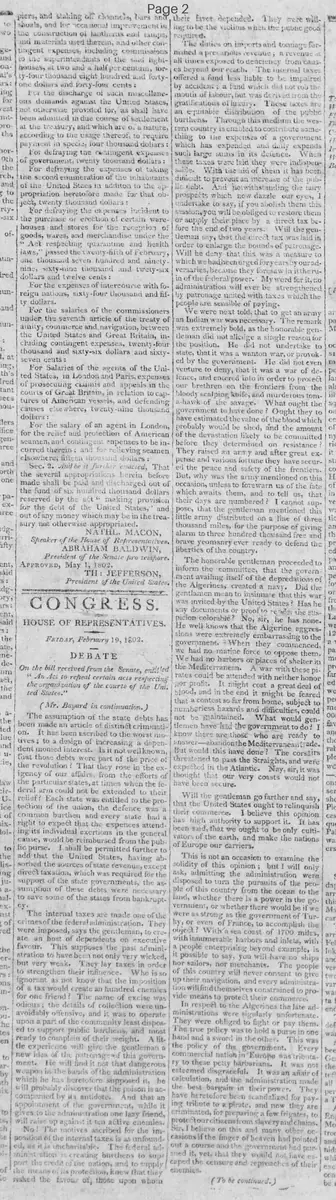
HOUSE OF REPRESENTATIVES.
Friday, February 19, 1802.
DEBATE
On the bill received from the Senate, entitled "An Act to repeal certain acts respecting the organization of the courts of the United States."
(Mr. Bayard in continuation.)
The assumption of the state debts has been made an article of distinct crimination. It has been ascribed to the worst motives; to a design of increasing a dependent monied interest. Is it not well known, that those debts were part of the price of the revolution? That they rose in the exigency of our affairs, from the efforts of the particular states, at times when the federal arm could not be extended to their relief? Each state was entitled to the protection of the union, the defence was a common burthen and every state had a right to expect that the expenses attending its individual exertions in the general cause, would be reimbursed from the public purse. I shall be permitted further to add that the United States, having absorbed the sources of state revenue, except direct taxation, which was required for the support of the state governments, the assumption of these debts were necessary to save some of the states from bankruptcy.
The internal taxes are made one of the crimes of the federal administration. They were imposed, says the gentleman, to create an host of dependents on executive favour. This supposes the past administration to have been not only very wicked, but very weak. They lay taxes in order to strengthen their influence. Who is so ignorant as not know that the imposition of a tax would create an hundred enemies for one friend? The name of excise was odious; the details of collection were unavoidably offensive, and it was to operate upon a part of the community least disposed to support public burthens, and most ready to complain of their weight. A little experience will give the gentleman a new idea of the patronage of this government. He will find it not that dangerous weapon in the hands of the administration which he has heretofore supposed it, he will probably discover that the poison is accompanied by its antidote. And that an appointment of the government, while it gives to the administration one lazy friend, will raise up against it ten active enemies.
No! The motives ascribed for the imposition of the internal taxes is as unfounded, as it is uncharitable. The federal administration knew that upon their success in the collection of these taxes their favour depended. They were willing to be the victims when the public good required.
The duties on imports and tonnage furnished a precarious revenue, a revenue at all times exposed to deficiency from causes beyond our reach. The internal taxes offered a fund less liable to be impaired by accident; a fund which did not rob the mouth of labour, but was derived from the gratifications of luxury. These taxes are an equitable distribution of the public burthens. Through this medium the western country is enabled to contribute something to the expenses of a government which has expended and daily expends such large sums in its defence. When these taxes were laid they were indispensable. With the aid of them it has been difficult to prevent an increase of the public debt. And notwithstanding the fairy prospects which now dazzle our eyes, I undertake to say, if you abolish them this session, you will be obliged to restore them or supply their place by a direct tax before the end of two years. Will the gentleman say, that the direct tax was laid in order to enlarge the bounds of patronage. Will he deny that this was a measure to which we had been urged for years by our adversaries, because they foresaw in it the ruin of the federal power. My word for it, no administration will ever be strengthened by patronage united with taxes which the people are sensible of paying:
We were next told, that to get an army an Indian war was necessary. The remark was extremely bold, as the honorable gentleman did not allege a single reason for the position. He did not undertake to state, that it was a wanton war, or provoked by the government. He did not even venture to deny, that it was a war of defence, and entered into in order to protect our brethren on the frontiers from the bloody scalping, knife, and murderous toma-hawk of the savage. What ought the government to have done? Ought they to have estimated the value of the blood which probably would be shed, and the amount of the devastation likely to be committed before they determined on resistance? They raised an army and after great expense and various fortune they have secured the peace and safety of the frontiers. But, why was the army mentioned on this occasion, unless to forewarn us of the fate which awaits them, and to tell us, that their days are numbered? I cannot suppose, that the gentleman mentioned this little army distributed on a line of three thousand miles, for the purpose of giving alarm to three hundred thousand free and brave yeomanry ever ready to defend the liberties of the country.
The honorable gentleman proceeded to inform the committee, that the government availing itself of the depredations of the Algerines created a navy. Did the gentleman mean to insinuate that this war was invited by the United States? Has he any documents or proof to render the suspicion colorable? No, sir, he has none. He well knows that the Algerine aggressions were extremely embarrassing to the government. When they commenced, we had no marine force to oppose them. We had no harbors or places of shelter in the Mediterranean. A war with these pirates could be attended with neither honor nor profit. It might cost a great deal of blood, and in the end it might be feared that a contest so far from home, subject to numberless hazards and difficulties, could not be maintained. What would gentlemen have had the government to do? I know there are those who are ready to answer—abandon the Mediterranean trade. But would this have done? The corsairs threatened to pass the Straights, and were expected in the Atlantic. Nay, sir, it was thought that our very coasts would not have been secure.
Will the gentleman go farther and say, that the United States ought to relinquish their commerce. I believe this opinion has high authority to support it. It has been said, that we ought to be only cultivators of the earth, and make the nations of Europe our Carriers.
This is not an occasion to examine the solidity of this opinion; but I will only ask, admitting the administration were disposed to turn the pursuits of the people of this country from the ocean to the land, whether there is a power in the government, or whether there would be if we were as strong as the government of Turkey, or even of France, to accomplish the object? With a sea coast of 1700 miles, with innumerable harbors and inlets, with a people enterprising beyond example, is it possible to say, you will have no ships nor sailors, nor merchants. The people of this country will never consent to give up their navigation, and every administration will find themselves constrained to provide means to protect their commerce.
In respect to the Algerines the late administrations were singularly unfortunate. They were obliged to fight or pay them. The true policy was to hold a purse in one hand and a sword in the other. This was the policy of the government. Every commercial nation in Europe was tributary to these petty barbarians. It was not esteemed disgraceful. It was an affair of calculation, and the administration made the best bargain in their power. They have heretofore been scandalized for paying tribute to a pirate, and now they are criminated, for preparing a few frigates, to protect our citizens from slavery and chains.
Sir, I believe on this and many other occasions if the finger of heaven had pointed out a course and the government had pursued it, yet, that they would not have escaped the censure and reproaches of their enemies.
(To be continued.)
What sub-type of article is it?
What keywords are associated?
What entities or persons were involved?
Where did it happen?
Domestic News Details
Primary Location
United States
Event Date
February 19, 1802
Key Persons
Event Details
Mr. Bayard continued debate on Senate bill to repeal acts organizing U.S. courts, defending Federalist policies including state debt assumption, internal taxes, army for Indian defense, and navy against Algerines against accusations of corruption and unnecessary expense.