Thank you for visiting SNEWPapers!
Sign up free
The Massachusetts Spy, And Worcester County Advertiser
Worcester, Worcester County, Massachusetts
What is this article about?
Detailed analysis of France's political situation: three parties (ultras, ministerial, liberals) vie for power; independent House of Peers rejects primogeniture; royal family (Louis XVIII, Charles X, etc.) lacks popular affection; rising priestly influence and Jesuit fears countered by liberal press and public opinion.
Clipping
OCR Quality
Full Text
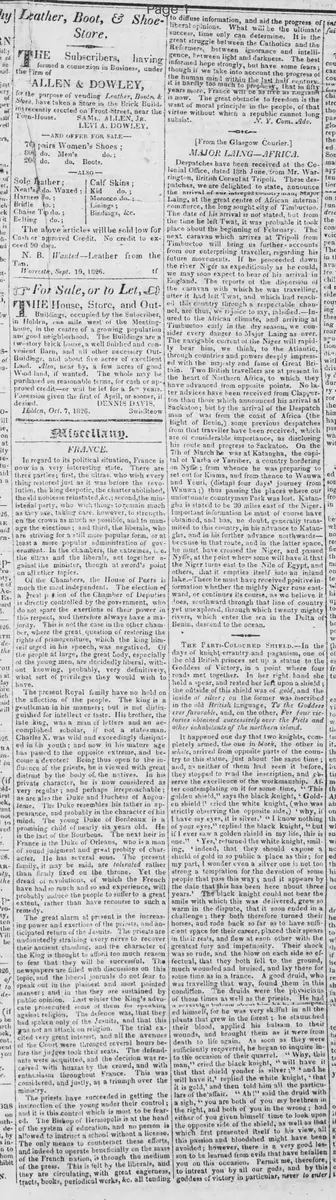
Of the Chambers, the House of Peers is much the most independent. The election of a President of the Chamber of Deputies is directly controlled by the government, who do not spare the exertions of their power in this respect, and therefore always have a majority. This is not the case in the other chamber, where the great question of restoring the rights of primogeniture, which the king himself urged in his speech, was negatived. Of the people at large, the great body, especially of the young men, are decidedly liberal, without knowing, probably, very definitively, what sort of privileges they would wish to have.
The present Royal family have no hold on the affection of the people. The king is a gentleman in his manners; but is not distinguished for intellect or taste. His brother, the late king, was a man of letters and an accomplished scholar, if not a statesman.
Charles X. was wild and exceedingly dissipated in his youth; and now in his mature age has passed to the opposite extreme, and become a devotee: Being thus open to the influence of the priests, he is viewed with great distrust by the body of the natives. In his private character, he is now considered as very regular; and perhaps irreproachable: as are also the Duke and Duchess of Angouleme. The Duke resembles his father in appearance, and probably in the character of his mind. The young Duke of Bordeaux is a promising child of nearly six years old. He is the last of the Bourbons. The next heir in France is the Duke of Orleans, who is a man of sound judgment and great probity of character. He has several sons. The present family, it may be said, are tolerated rather than firmly fixed on the throne. Yet the dread of revolutions, of which the French have had so much and so sad experience, will probably induce the people to suffer to a great extent, rather than have recourse to such a remedy.
The great alarm at present is the increasing power and exertions of the priests, and anticipated return of the Jesuits. The priests are undoubtedly straining every nerve to recover their ancient standing, and the character of the King is thought to afford too much reason to fear that they will be successful. The newspapers are filled with discussions on this topic, and the liberal journals do not fear to speak out in the plainest and most pointed manner; and in this they are sustained by public opinion. Last winter the King's advocate prosecuted some of them for speaking against religion. The defence was, that they had spoken only of the Jesuits, and that this was not an attack on religion. The trial excited very great interest, and all the avenues of the Court were thronged several hours before the judges took their seats. The defendants were acquitted, and the decision was received with huzzas by the crowd, and with enthusiasm throughout France. This was considered, and justly, as a triumph over the ministry.
The priests have succeeded in getting the instruction of the young under their control; and it is this control which is most to be feared. The Bishop of Hermopolis is at the head of the system of education, and no person is allowed to instruct a school without a license.
The only means to counteract these efforts, and indeed to operate beneficially on the mass of the French nation, is through the medium of the press. This is felt by the liberals, and they are circulating, with great eagerness, tracts, books, periodical works, &c. all tending to diffuse information, and aid the progress of liberal opinions. What will be the ultimate success, time only can determine. It is the great struggle between the Catholics and the Reformers, between ignorance and intelligence, between light and darkness. The best informed hope strongly, but have some fears; though if we take into account the progress of the human mind within the last half century, it is hardly too much to prophesy, that in fifty years more, France will be as free as England is now. The great obstacle to freedom is the want of moral principle in the people, of that virtue without which a republic cannot long subsist.
N. Y. Com. Adv.
What sub-type of article is it?
What keywords are associated?
What entities or persons were involved?
Where did it happen?
Foreign News Details
Primary Location
France
Key Persons
Outcome
house of peers negatived restoration of primogeniture rights; defendants in jesuit trial acquitted, seen as triumph over ministry; priests control youth education; liberals circulate publications to counter priestly influence.
Event Details
France's political landscape features three parties: ultras seeking pre-revolution restoration, ministerial maintaining status quo with strengthened crown, and liberals pushing for more popular government. Extremes unite against the minister in chambers. House of Peers independent, rejecting primogeniture; Deputies controlled by government. Public, especially youth, liberal-leaning. Royal family (Louis XVIII, Charles X as devotee influenced by priests, etc.) lacks affection; tolerated amid revolution fears. Alarm over priests' and Jesuits' rising power, countered by liberal press; recent trial acquittal boosted liberals. Priests control education under Bishop of Hermopolis. Liberals use press to spread information in struggle for reform.