Thank you for visiting SNEWPapers!
Sign up free
Richmond Enquirer
Richmond, Richmond County, Virginia
What is this article about?
Commentary on expected changes to U.S. militia law post-war, criticizing Governor Strong's potential resistance, and reporting a Senate bill introduced in Boston on March 12 authorizing the President to call forth militia directly if governors refuse, with provisions for pay and treating refusers as deserters.
Clipping
OCR Quality
Full Text
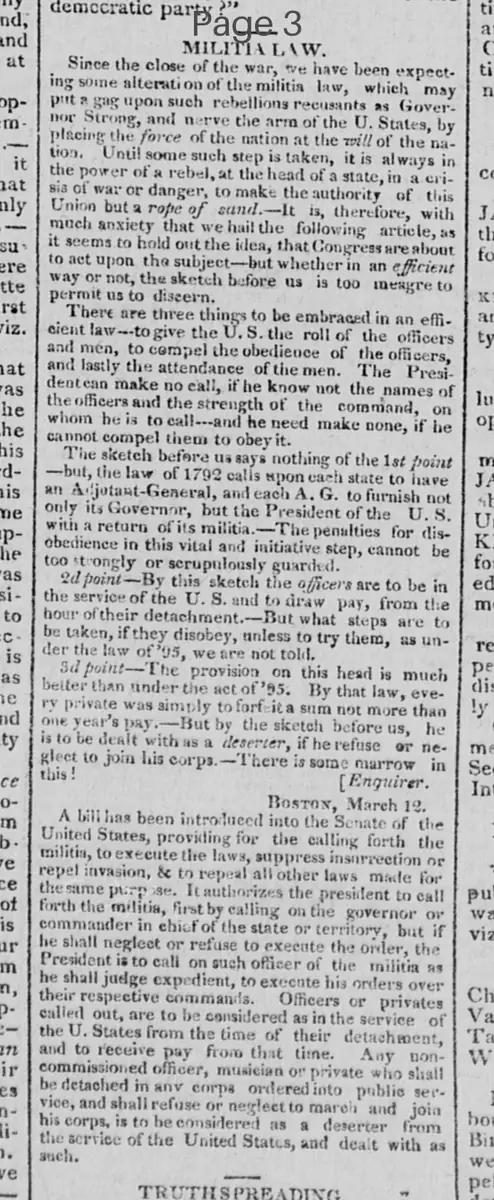
Since the close of the war, we have been expecting some alteration of the militia law, which may put a gag upon such rebellious recusants as Governor Strong, and nerve the arm of the U. States, by placing the force of the nation at the will of the nation. Until some such step is taken, it is always in the power of a rebel, at the head of a state, in a crisis of war or danger, to make the authority of this Union but a rope of sand.—It is, therefore, with much anxiety that we hail the following article, as it seems to hold out the idea, that Congress are about to act upon the subject—but whether in an efficient way or not, the sketch before us is too meagre to permit us to discern.
There are three things to be embraced in an efficient law—to give the U.S. the roll of the officers and men, to compel the obedience of the officers, and lastly the attendance of the men. The President can make no call, if he know not the names of the officers and the strength of the command, on whom he is to call—and he need make none, if he cannot compel them to obey it.
The sketch before us says nothing of the 1st point—but, the law of 1792 calls upon each state to have an Adjutant-General, and each A. G. to furnish not only its Governor, but the President of the U. S. with a return of its militia.—The penalties for disobedience in this vital and initiative step, cannot be too strongly or scrupulously guarded.
2d point—By this sketch the officers are to be in the service of the U. S. and to draw pay, from the hour of their detachment.—But what steps are to be taken, if they disobey, unless to try them, as under the law of '95, we are not told.
3d point—The provision on this head is much better than under the act of '95. By that law, every private was simply to forfeit a sum not more than one year's pay.—But by the sketch before us, he is to be dealt with as a deserter, if he refuse or neglect to join his corps.—There is some marrow in this!
[Enquirer.]
Boston, March 12.
A bill has been introduced into the Senate of the United States, providing for the calling forth the militia, to execute the laws, suppress insurrection or repel invasion, & to repeal all other laws made for the same purpose. It authorizes the president to call forth the militia, first by calling on the governor or commander in chief of the state or territory, but if he shall neglect or refuse to execute the order, the President is to call on such officer of the militia as he shall judge expedient, to execute his orders over their respective commands. Officers or privates called out, are to be considered as in the service of the U. States from the time of their detachment, and to receive pay from that time. Any non-commissioned officer, musician or private who shall be detached in any corps ordered into public service, and shall refuse or neglect to march and join his corps, is to be considered as a deserter from the service of the United States, and dealt with as such.
What sub-type of article is it?
What keywords are associated?
What entities or persons were involved?
Where did it happen?
Domestic News Details
Primary Location
Boston
Event Date
March 12
Key Persons
Event Details
Editorial commentary on the need for militia law reforms post-war to ensure federal control, referencing past laws of 1792 and 1795, and reporting a Senate bill authorizing the President to call militia directly if governors refuse, with officers and privates in U.S. service from detachment and receiving pay, and refusers treated as deserters.