Thank you for visiting SNEWPapers!
Sign up free
Sacramento Daily Record Union
Sacramento, Sacramento County, California
What is this article about?
Testimony resumed in the embezzlement trial of Thomas H. Reynolds in Superior Court, Department One, with witnesses including General Thomas J. Clunie, Thomas F. Eagan, Chas. F. Reed, Alex. Badlam, and Reynolds himself detailing office practices, a 'tag-book' recording Burns' defalcations, loans to Burns, and denying personal embezzlement.
Merged-components note: These three components form a continuous article on the Reynolds embezzlement case, with sequential reading orders and flowing text content.
Clipping
OCR Quality
Full Text
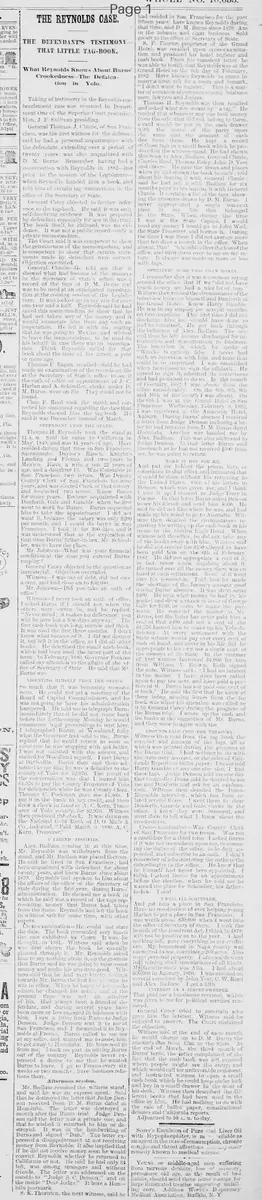
THE DEFENDANTS TESTIMONY-
THAT LITTLE TAG-BOOK.
What Reynolds Knows About Burns'
Crookedness-The Defalcation in
Yolo.
Taking of testimony in the Reynolds embezzlement case was resumed in Department One of the Superior Court yesterday Hon. J. F. Sullivan presiding
General Thomas J. Clunie, of San Francisco, was the first witness for the defense said he had a personal acquaintance with the defendant, extending over a period of twenty years: was also acquainted with D M. Burns. Remember having had a conversation with Reynolds in 1882-just prior to the session of the Legislature- when Reynolds handed him a book, and told him of certain tag transactions in the office of the Secretary of State.
General Carey objected to further reference to the tag-book. He said it was only self-deceiving evidence It was prepared by defendant especially for use in this trial The book itself, he claimed, was no evidence. It was not a public record-only a private memorandum.
The Court said it was competent to show the genuineness of the memorandum, and is competent to show that certain statements made by defendant were correct Objection overruled.
General Clunie-He told me that it showed what had become of the moneys in the Secretary of State's office, was a record of the tags of D M. Burns and was to be used at an anticipated investigation at the coming session of the Legislature. It was locked up in my safe for over one year and a half. Reynolds said he had saved this memorandum to show that he had not taken any of the money, and it would exonerate him from any such an imputation. He left it with me, stating that he was going to Mexico, and wished to leave the memorandum, to be used in his behalf in case there was an investigation. Think Reynolds called for that book about the time of his arrest -a year or more ago
Thomas F. Eagan recalled-Said he had made an examination of the records on file at the Secretary of State's office to see if the oath of office or appointment of J. G. Harlan and A. Schindler, clerks under D. M. Burns, were on file They could not be found.
Chas. F. Reed took the stand, and corrected his statement regarding the date that Reynolds showed him the tag book. He said it was December instead of March
DEFENDANT
Thomas H. Reynolds took the stand at 11 A. M. Said he came to California in May, 1879, and was 44 years of age, Have resided during that time in San Francisco, Sacramento, Delor's Ranch, Knight's Landing and Fresno, and two years in Mexico. Have a wife, a son 22 years of age, and a daughter 13. Was Constable in San Francisco two terms. Was Deputy County Clerk of San Francisco for nine years, and was elected clerk of that county, and re-elected two terms. Knew Burns for many years. Became acquainted with Danforth, Gale and Gamble when he first went to work for Burns. Burns requested him to take the appointment. I did not want it, because the salary was only $200 per month, and I could do better in San Francisco. I took it for 100 days and it was understood that at the expiration of that time Burns' father-in-law, Mr Schindler, was to have the place.
Mr. Johnson-What was your financial condition at the time you entered Burns employ?
General Carey objected to the question as immaterial. Objection overruled
Witness-I was out of debt, did not owe a cent, and had close on to $50,000
Mr. Johnson-Did you take an oath of office?
Witness-I never took an oath of office. I asked Burns, if I should not, when the others were sworn in, and he replied, "Never mind, it makes no difference: you will be here but a few days anyway." The first cash-book was long, narrow and thick It was used the first three months. I don't know what became of it. I did not destroy it, but left it in the office, as I did all other books. He described the small cash-book, which had been used the latter part of the term. In February, 1880, Governor Perkins called my attention to the affairs of the office of Secretary of State He said that Mr. Burns was
ABSENTING HIMSELF FROM THE OFFICE
So much that it was becoming monotonous. He could not get a meeting of the Board of Capitol Commissioners, and he was not going to have his administration hampered. He told me to telegraph Burns immediately that if he did not come back before the forthcoming Monday he would commence legal proceedings to oust him. I telegraphed Burns, at Woodland, fully what the Governor had said to me. Burns replied that he would return as soon as some one he was stopping with got better. I was not satisfied with the answer, and started for Woodland myself. I met Burns at Davisville. Burns then and there admitted to me that he was a defaulter to the county of Yolo for $2,976. The result of the conversation was that I loaned him $1,570 to pay the County Treasurer of Yolo for deficiencies while he was County Clerk.
Thomas C. Rockman gave me $1,400. I put it in the bank to my credit, and then drew a check in favor of A. C. Kern, Treasurer of Yolo county, for $2,976. Witness then produced the check. It was drawn on the National Gold Bank of D. O Mills & Co., indorsed. Paid March 3, 1880, A. C Kern. Treasurer.
A FRIEND TESTIFIES.
Alex. Badlam, coming in at this time, Mr. Reynolds was withdrawn from the stand, and Mr. Badlam was placed thereon. He said he lived in San Francisco: had been acquainted with defendant for about twenty years, and knew Burns since about 1879. Reynolds had spoken to him about the affairs of the office of the Secretary of State during the first year, during Burns administration. He showed me a book in which he said was a record of the tags representing money that Burns had taken from the State. Reynolds had left the book in witness' safe for some time, with other papers.
Cross-examination-He could not state the date. The book resembled very much the one exhibited in Court. It was, he thought, in 1881. Witness said when he was first shown the book he casually glanced through it. Mr. Reynolds asked him to say nothing about it, on the grounds that Burns said he was going to raise some money and make his accounts good. Witness said that he had very kindly feelings towards Mr. Burns the first few months he was in office. When he heard of his crookedness he changed his mind, and at the present time was not an admirer of his. Had always been a friend of defendant, and during several years have been more or less engaged in business with him. I saw a letter from Burns to Judge Denson, Judge Denson sent it to me at San Francisco, and I forwarded it to Reynolds at Fresno. Burns called to see me at my office, and wanted me to assist him to get away to Honolulu. He borrowed $5 from me. I took no part in getting Burns out of the country. Reynolds never expressed a desire to me that he wanted Burns to leave. I go to Fresno every six weeks or two months: have business relations there.
Afternoon Session.
Mr. Badlam resumed the witness stand, and said he was an express agent. Said that he destroyed the letter that Judge Denson received from D. M. Burns dated at Honolulu. The letter was destroyed a month after the Burns trial. Judge Denson said the letter was a private one, and that he wished it returned to him or destroyed. It was in the handwriting of Burns and signed "Dan." The letter expressed a disappointment at not receiving money from Reynolds. It also implied that if he did not receive money soon he would convict Reynolds whether he returned to California or not. He said he had only $4 left, was among strangers and without friends. The letter was addressed on the outside to " Judge S. C. Denson," and on the inside "Dear Judge." It bore a Honolulu postmark.
S. F. Thorne, proprietor of the Grand Hotel, was recalled upon cross-examination, and produced his hotel register and cash book From his transient ledger he was able to testify that Reynolds was at the Grand Hotel on the 6th day of February, 1882. Have known Reynolds to come in many a time, ask for a room and remark, "I don't want to register." This is a matter of common occurrence among business men, lawyers and Judges.
Thomas H. Reynolds was then recalled and asked what was meant by " a tag." He replied that whenever any one took money from the safe that did not belong to them, a card would be put in the cash drawer with the name of the party upon the same and the amount of cash due from them. He kept a record of those tags in a small book which he produced on the witness stand He had shown this book to Alex Badlam General Clunie, Charles Reed, Thomas Foley, John D Yost and others He gave the times and places when he had shown the book to each : told about his leaving it with General Clunie: said he had left it with Badlam for six months prior to his leaving it with General Clunie It contain a list of the tags, showing the amounts drawn by D M. Burns I never appropriated a single ten-cent piece in my life that belonged to the State When, during the time I was at the State Capitol, I would need any money I would go to John Weil the State Treasurer and borrow it. During the time I was there I did not average more than ten days a month in the office. When absent, Danforth should collect the fees of the office and then turn over to me on my return It always was made me more or less with tags
SOMETIMES MORE TAGS THAN MONEY
I remember that it was a common saying around the office that if we "did not have much money we had a nice lot of tags Witness then related the circumstance of the interview between himself and Danforth at the Grand Hotel Know Harry Gamble He was in my employ for several months on two occasions The first time I did not discharge him, but should have done so had he remained. He got back through the influence of Alex Badlam. The second time he left, he was discharged for intoxication and non-attention to business The interview in which he spoke of "Wrecks' is entirely false. I never had such an interview with him, and none that could be so construed. I was astonished when he refused to sign the affidavit. He agreed to sign it, admitted its correctness and had promised to do so. In the month of February, 1882 I was absent from the office considerably. On the 6th 7th, 8th and 10th of the month I was absent. On the 6th I was at the Grand Hotel in San Francisco Wednesday, February 8, 1882. I was registered at the American Hotel, Auburn During Burns' absence I received a letter from Judge Denson inclosing a letter he had received from D. M. Burns dated Honolulu Another was handed me by Alex Badlam. This was also addressed to Judge Denson. In that letter Burns said inasmuch as he had not received $500 from me, he was going to return
MAKE IT HOT FOR ME.
And put me behind the prison bars, or something to that effect, and intimated that it could be done without his returning to the United States one of his letters to Denson, which was given me, and I think I tore it up, I showed to Judge Terry in Fresno. In that letter Burns asked Denson to see his friends and send him $500 He said he did not like where he was, and had made up his mind to go to Australia. Witness then detailed the circumstances regarding his writing up the cash-book in his room in the Golden Eagle Hotel When witness left the office, he did not take any the books away with him Witness said he did not receive the $100 alleged to have been paid him on the 6th of February 1882. He did not appropriate a cent of it, in fact never knew anything about it He turned over all the money there was on hand at each settlement. None of it went into his possession. Told how he made the shortage of the January account good during Burns absence. It was short some $100. He took what money he had in his pocket and drew a check in favor of George Gale for $100, in order to make the payment. He reported the matter to Mr Burns, but the latter has never paid him a cent. of that $100 and not a cent of the $1,576 loaned him to make up his Yolo deficiency. At every settlement with the State witness would pay over every cent of cash on hand, and never in his life did he appropriate to his own use a single cent of the moneys of the State In the summer of 1881 witness borrowed $1,000 for him from William A Brown. Both signed the note. Witness said " I had no interest in the matter. I have since been called upon to pay the note, and have paid a portion of it. Burns has not paid one cent of it back." He said the first that he knew of there being missing leaves from the fee book was when his attention was called to it by General Carey during the progress of the Burns trial I wrote up the cash and fee books at the suggestion of Mr. Burns, and they were to agree with the
AMOUNTS PAID INTO THE TREASURY.
Witness then read from the tag book the number and amount of the tags, all of which was printed during the progress of the Burns trial I had nothing to do with the stationery account, or the sales of California Reports or ballot paper. I never told Harry Gamble or any one else that I had these tags. Judge Denson told me one day that Controller Dunn said he desired to see me and Danforth and ask for an explanation. Witness then detailed the Dunn Reynolds interview, which has been related several times. I went there to clear Danforth, Gamble and Gale, clerks in the office. I knew they were innocent, and went there to tell what I knew about the crookedness
Cross-examination-Was County Clerk of San Francisco for two terms. Was not a candidate for a third term. I asked Burns if it was not incumbent upon me, in assuming the duties of the office, to be duly appointed, and subscribe to an oath. I don't remember of administering the oaths to the subordinates in the office. He knew that he himself had never been appointed. I think I asked Burns for an appointment before the election, when he told me he wanted the place for Schindler, his father-in-law. I said
I WILL FIX SCHINDLER.
And got him a place in San Francisco Have no recollection of ever helping young Harlan to get a place in San Francisco. I was worth about $30,000 when I went into the office of Secretary of State. I took the benefit of the Insolvent Act, I think in 1878, will not be positive as to the year. I had nothing left, gave everything to my creditors. My homestead in Napa county was exempted to me containing 200 acres. Also some personal property. I afterwards went into mining stock speculations of all kinds My favorite stock was Alta. I had about $5,000 in January, 1880. I was assisted on several occasions by John Yost, C. W. Reed and Alex. Badlam, I got a fifth
INTEREST IN A STREET SWEEPER
That paid me a handsome revenue, which was given to me for political services rendered
General Carey tried to ascertain who gave him the interest. Witness said he objected to answer. The Court sustained the objection
Witness said at the end of each month he would charge up to D. M. Burns the amounts due from him to the State. At the end of March, the third month of Burns' term, the latter complained of the fact that the cash book was left exposed where people might see the entry, and which would call for unfavorable comment, and instructed witness to open a small cash book which he could keep under lock and key in a small drawer in the front of his desk. Witness then described the different books that had been used in the office by him. He had nothing to do with the sale of ballot paper, constitutional debates and California reports.
Adjourned to 10 A. M. to-day.
Scott's Emulsion of Pure Cod Liver Oil with Hypophosphites, is as reliable as an agent in the cure of consumption, chronic coughs and throat affections . any other remedy known to medical science.
Young or middle-aged men suffering from nervous debility, loss of memory, premature old age. as the result of bad habits, should send three letter stamps for large illustrated treatise suggesting unfailing cure. Address World's Dispensary Medical Association. Buffalo, N. Y.
What sub-type of article is it?
What keywords are associated?
What entities or persons were involved?
Where did it happen?
Domestic News Details
Primary Location
Sacramento, California
Event Date
Yesterday
Key Persons
Outcome
ongoing trial testimony; reynolds denies embezzlement, details burns' defalcations including $2,976 yolo deficiency paid by reynolds; no verdict.
Event Details
Testimony in Reynolds' embezzlement case resumed with witnesses describing a 'tag-book' recording Burns' unauthorized withdrawals from Secretary of State's office funds; Reynolds testifies about his employment, lack of oath, loans to Burns, office practices, and denial of taking state money.