Thank you for visiting SNEWPapers!
Sign up free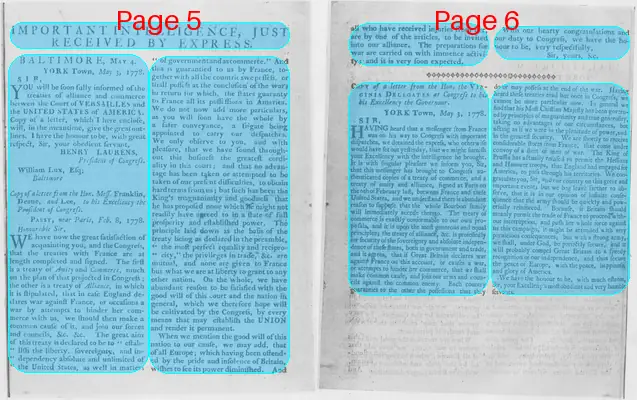
The Virginia Gazette
Richmond, Williamsburg, Richmond County, Virginia
What is this article about?
Reports from York Town and Baltimore detail the signing of treaties of amity, commerce, and alliance between France and the United States on February 6, 1778, guaranteeing American independence and mutual possessions, with expectations of Bourbon family accession and European support against Britain.
Merged-components note: Sequential reading order across pages and shared subject matter on the French treaties and alliance make these parts of the same foreign news component.
Clippings
1 of 2
OCR Quality
Full Text
BALTIMORE, May 4.
YORK Town, May 3, 1778.
SIR,
You will be soon fully informed of the treaties of alliance and commerce between the Court of Versailles and the UNITED STATES of AMERICA.
Copy of a letter, which I here enclose, will, in the meantime, give the great outlines. I have the honour to be, with great respect, Sir, your obedient servant,
HENRY LAURENS.
President of Congress.
William Lux, Esq;
Baltimore
Copy of a letter from the Hon. Messrs. Franklin, Deane, and Lee, to his Excellency the President of Congress.
Passy, near Paris, Feb. 8, 1778.
Honourable Sir,
We have now the great satisfaction of acquainting you, and the Congress, that the treaties with France are at length completed and signed.
The first is a treaty of Amity and Commerce, much on the plan of that projected in Congress; the other is a treaty of Alliance, in which it is stipulated, that in case England declares war against France, or occasions a war by attempts to hinder her commerce with us, we should then make a common cause of it, and join our forces and councils, &c. &c.
The great aim of this treaty is declared to be to establish the liberty, sovereignty, and independence absolute and unlimited of the United States, as well in matters of government as commerce. And this is guaranteed to us by France, together with all the countries we possess, or shall possess at the conclusion of the war; in return for which, the states guarantee to France all its possessions in America.
We do not now add more particulars, as you will soon have the whole by a safer conveyance, a frigate being appointed to carry our despatches.
We only observe to you, and with pleasure, that we have found throughout this business the greatest cordiality in this court; and that no advantage has been taken or attempted to be taken of our present difficulties, to obtain hard terms from us; but such has been the King's magnanimity and goodness, that he has proposed none which we might not readily have agreed to in a state of full prosperity and established power. The principle laid down as the basis of the treaty being, as declared in the preamble, the most perfect equality and reciprocity, the privileges in trade, &c. are mutual, and none are given to France but what we are at liberty to grant to any other nation.
On the whole, we have abundant reason to be satisfied with the good will of this court and the nation in general, which we therefore hope will be cultivated by the Congress, by every means that may establish the UNION and render it permanent.
When we mention the good will of this nation to our cause, we may add, that of all Europe; which having been offended by the pride and insolence of Britain, wishes to see its power diminished, And
all who have received injuries from her, are by one of the articles, to be invited into our alliance. The preparations for war are carried on with immense activity; and it is very soon expected.
With our hearty congratulations and our duty to Congress, we have the honour to be, very respectfully, Sir, yours, &c.
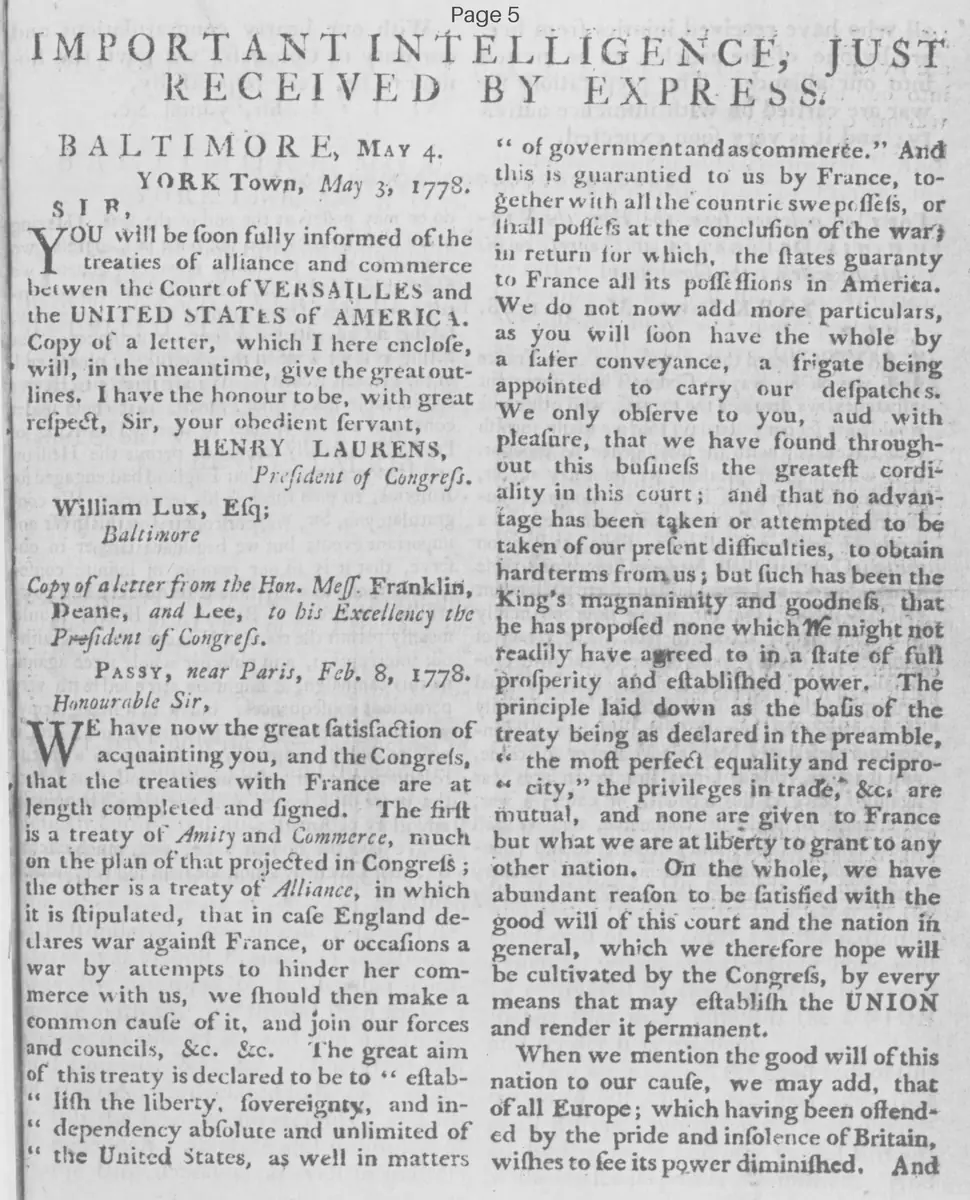
Copy of a letter from the Hon. the Virginia Delegates at Congress to his Excellency the Governour.
YORK Town, May 3, 1778.
SIR,
Having heard that a messenger from France was on his way to Congress with important dispatches, we detained the express, who otherwise would have set out yesterday, that we might furnish your Excellency with the intelligence he brought.
It is with singular pleasure we inform you, Sir, that this messenger has brought to Congress authenticated copies of a treaty of commerce, and a treaty of amity and alliance, signed at Paris on the 6th of February last, between France and these United States, and we understand there is abundant reason to suppose that the whole Bourbon family will immediately accede thereto.
The treaty of commerce is exactly conformable to our own proposals, and it is upon the most generous and equal principles; the treaty of alliance, &c. is professedly for security of the sovereignty and absolute independence of these states, both in government and trade, and it agrees, that if Great Britain declares war against France on this account, or causes a war, or attempts to hinder her commerce, that we shall make common cause, and join our arms and councils against the common enemy. Each country guarantees to the other the possessions that they do or may possess at the end of the war.
Having heard these treaties read but once in Congress, we cannot be more particular now. In general we find that his Most Christian Majesty has been governed by principles of magnanimity and true generosity, taking no advantages of our circumstances, but acting as if we were in the plenitude of power, and in the greatest security.
We are shortly to receive considerable stores from France, that come under convoy of a fleet of men of war. The King of Prussia has actually refused to permit the Hessians and Hanover troops, that England had engaged for America, to pass through his territories.
We congratulate you, Sir, and our country on this great and important event; but we beg leave farther to observe, that it is in our opinion of infinite consequence that the army should be quickly and powerfully reinforced.
Because, if Britain should meanly permit the trade of France to proceed without interruption, and push her whole force against us this campaign, it might be attended with very pernicious consequences; but with a strong army, we shall, under God, be perfectly secure, and it will probably compel Great Britain to a speedy recognition of our independence, and thus secure the peace of Europe, with the peace, happiness, and glory of America.
We have the honour to be, with much esteem, Sir, your Excellency's most obedient and very humble servants.
What sub-type of article is it?
What keywords are associated?
What entities or persons were involved?
Where did it happen?
Foreign News Details
Primary Location
Paris
Event Date
February 6, 1778
Key Persons
Outcome
treaties guarantee liberty, sovereignty, and independence of the united states; mutual guarantees of possessions in america; invitation for other injured nations to join alliance; preparations for war in france; king of prussia refuses passage to hessian and hanover troops.
Event Details
Letters from Henry Laurens and delegates Franklin, Deane, and Lee inform Congress of the completed treaties of amity, commerce, and alliance with France, signed at Passy near Paris on February 8, 1778 (noted as February 6 in another letter). The treaties establish equality and reciprocity, with France supporting U.S. independence if Britain declares war or hinders commerce. Virginia delegates report the same, noting generous terms from the French King and upcoming stores under convoy.