Thank you for visiting SNEWPapers!
Sign up free
Editorial
February 5, 1802
The National Intelligencer And Washington Advertiser
Washington, District Of Columbia
What is this article about?
The editorial praises the Senate's passage of the Judiciary Bill repealing the 1801 Act by a one-vote margin on February 3, 1802, as a triumph of republican principles, economy, and limited federal power. It notes the near two-to-one House majority and anticipates broader support.
Clipping
OCR Quality
95%
Excellent
Full Text
WASHINGTON CITY.
FRIDAY, FEBRUARY 5, 1802.
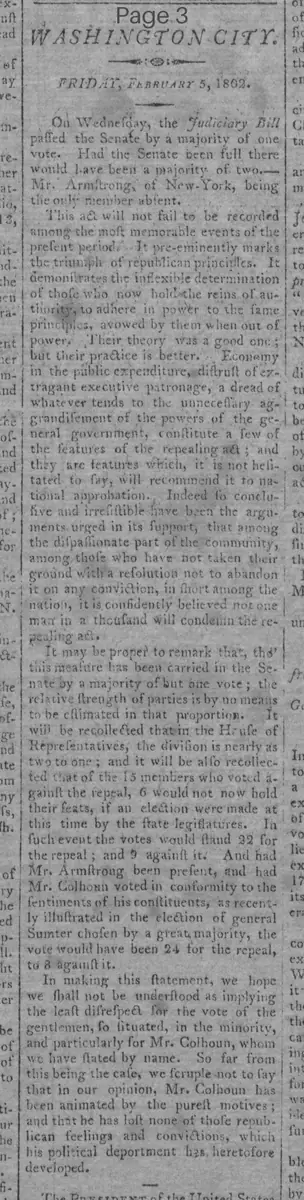
On Wednesday, the Judiciary Bill passed the Senate by a majority of one vote. Had the Senate been full there would have been a majority of two.—Mr. Armstrong, of New-York, being the only member absent.
This act will not fail to be recorded among the most memorable events of the present period. It pre-eminently marks the triumph of republican principles. It demonstrates the inflexible determination of those who now hold the reins of authority, to adhere in power to the same principles, avowed by them when out of power. Their theory was a good one; but their practice is better. Economy in the public expenditure, distrust of extravagant executive patronage, a dread of whatever tends to the unnecessary aggrandizement of the powers of the general government, constitute a few of the features of the repealing act; and they are features which, it is not hesitated to say, will recommend it to national approbation. Indeed so conclusive and irresistible have been the arguments urged in its support, that among the dispassionate part of the community, among those who have not taken their ground with a resolution not to abandon it on any conviction, in short among the nation, it is confidently believed not one man in a thousand will condemn the repealing act.
It may be proper to remark that, though this measure has been carried in the Senate by a majority of but one vote; the relative strength of parties is by no means to be estimated in that proportion. It will be recollected that in the House of Representatives, the division is nearly as two to one; and it will be also recollected that of the 15 members who voted against the repeal, 6 would not now hold their seats, if an election were made at this time by the state legislatures. In such event the votes would stand 23 for the repeal; and 9 against it. And had Mr. Armstrong been present, and had Mr. Calhoun voted in conformity to the sentiments of his constituents, as recently illustrated in the election of general Sumter chosen by a great majority, the vote would have been 24 for the repeal, to 8 against it.
In making this statement, we hope we shall not be understood as implying the least disrespect for the vote of the gentlemen, so situated, in the minority, and particularly for Mr. Calhoun, whom we have stated by name. So far from this being the case, we scruple not to say that in our opinion, Mr. Calhoun has been animated by the purest motives; and that he has lost none of those republican feelings and convictions, which his political deportment has heretofore developed.
FRIDAY, FEBRUARY 5, 1802.
On Wednesday, the Judiciary Bill passed the Senate by a majority of one vote. Had the Senate been full there would have been a majority of two.—Mr. Armstrong, of New-York, being the only member absent.
This act will not fail to be recorded among the most memorable events of the present period. It pre-eminently marks the triumph of republican principles. It demonstrates the inflexible determination of those who now hold the reins of authority, to adhere in power to the same principles, avowed by them when out of power. Their theory was a good one; but their practice is better. Economy in the public expenditure, distrust of extravagant executive patronage, a dread of whatever tends to the unnecessary aggrandizement of the powers of the general government, constitute a few of the features of the repealing act; and they are features which, it is not hesitated to say, will recommend it to national approbation. Indeed so conclusive and irresistible have been the arguments urged in its support, that among the dispassionate part of the community, among those who have not taken their ground with a resolution not to abandon it on any conviction, in short among the nation, it is confidently believed not one man in a thousand will condemn the repealing act.
It may be proper to remark that, though this measure has been carried in the Senate by a majority of but one vote; the relative strength of parties is by no means to be estimated in that proportion. It will be recollected that in the House of Representatives, the division is nearly as two to one; and it will be also recollected that of the 15 members who voted against the repeal, 6 would not now hold their seats, if an election were made at this time by the state legislatures. In such event the votes would stand 23 for the repeal; and 9 against it. And had Mr. Armstrong been present, and had Mr. Calhoun voted in conformity to the sentiments of his constituents, as recently illustrated in the election of general Sumter chosen by a great majority, the vote would have been 24 for the repeal, to 8 against it.
In making this statement, we hope we shall not be understood as implying the least disrespect for the vote of the gentlemen, so situated, in the minority, and particularly for Mr. Calhoun, whom we have stated by name. So far from this being the case, we scruple not to say that in our opinion, Mr. Calhoun has been animated by the purest motives; and that he has lost none of those republican feelings and convictions, which his political deportment has heretofore developed.
What sub-type of article is it?
Constitutional
Partisan Politics
Legal Reform
What keywords are associated?
Judiciary Repeal
Republican Principles
Senate Vote
Federal Powers
Party Strength
Economy In Government
What entities or persons were involved?
Senate
Mr. Armstrong Of New York
Mr. Calhoun
House Of Representatives
General Sumter
Editorial Details
Primary Topic
Repeal Of The Judiciary Act Of 1801
Stance / Tone
Strongly Supportive Of Republican Principles And Repeal
Key Figures
Senate
Mr. Armstrong Of New York
Mr. Calhoun
House Of Representatives
General Sumter
Key Arguments
Triumph Of Republican Principles In Power
Economy In Public Expenditure
Distrust Of Extravagant Executive Patronage
Opposition To Aggrandizement Of Federal Powers
Broad National Approbation Expected
House Division Nearly Two To One For Repeal
Anticipated Stronger Senate Majority With Full Attendance And Elections