Thank you for visiting SNEWPapers!
Sign up free
Story
January 22, 1846
The Hillsborough Recorder
Hillsboro, Orange County, North Carolina
What is this article about?
A farmer reports an experiment on three acres of corn where ashes outperformed gypsum by producing nearly 25% more yield, sounder corn, and more fodder. Recommends saving house ashes. Quotes a Massachusetts farmer on ashes' lasting benefits on clayey loam since 1835, improving clover and other crops.
Clipping
OCR Quality
98%
Excellent
Full Text
ASHES.
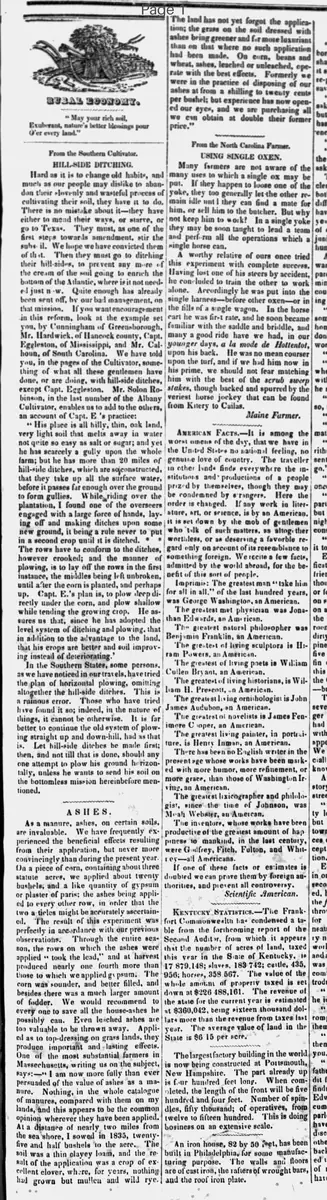
As a manure, ashes, on certain soils, are invaluable. We have frequently experienced the beneficial effects resulting from their application, but never more convincingly than during the present year. On a piece of corn, containing about three statute acres, we applied about twenty bushels, and a like quantity of gypsum or plaster of paris; the ashes being applied to every other row, in order that the two articles might be accurately ascertained. The result of this experiment was perfectly in accordance with our previous observations. Through the entire season, the rows on which the ashes were applied "took the lead," and at harvest produced nearly one fourth more than those to which we applied gypsum. The corn was sounder, and better filled, and besides there was a much larger amount of fodder. We would recommend to every one to save all the house-ashes he possibly can. Even leached ashes are too valuable to be thrown away. Applied as a top-dressing on grass lands, they produce important and lasting effects. One of the most substantial farmers in Massachusetts, writing us on the subject, says: "I am now more fully than ever persuaded of the value of ashes as a manure. Nothing, in the whole catalogue of manures, compared with them on my lands, and this appears to be the common opinion wherever they have been applied. At a distance of nearly two miles from the sea shore, I sowed in 1835, twenty-five and a half bushels to the acre. The soil was a thin clayey loam, and the result of the application was a crop of excellent clover, where, for years, nothing had grown but mullein and wild rye. The land has not yet forgot the application; the grass on the soil dressed with ashes grows greener and far more luxuriant than on that where no such application had been made. On corn, beans and wheat, ashes, leached or unleached, operate with the best effects. Formerly we were in the practice of disposing of our ashes at from a shilling to twenty cents per bushel; but experience has now opened our eyes, and we are purchasing all we can obtain at double their former price."
As a manure, ashes, on certain soils, are invaluable. We have frequently experienced the beneficial effects resulting from their application, but never more convincingly than during the present year. On a piece of corn, containing about three statute acres, we applied about twenty bushels, and a like quantity of gypsum or plaster of paris; the ashes being applied to every other row, in order that the two articles might be accurately ascertained. The result of this experiment was perfectly in accordance with our previous observations. Through the entire season, the rows on which the ashes were applied "took the lead," and at harvest produced nearly one fourth more than those to which we applied gypsum. The corn was sounder, and better filled, and besides there was a much larger amount of fodder. We would recommend to every one to save all the house-ashes he possibly can. Even leached ashes are too valuable to be thrown away. Applied as a top-dressing on grass lands, they produce important and lasting effects. One of the most substantial farmers in Massachusetts, writing us on the subject, says: "I am now more fully than ever persuaded of the value of ashes as a manure. Nothing, in the whole catalogue of manures, compared with them on my lands, and this appears to be the common opinion wherever they have been applied. At a distance of nearly two miles from the sea shore, I sowed in 1835, twenty-five and a half bushels to the acre. The soil was a thin clayey loam, and the result of the application was a crop of excellent clover, where, for years, nothing had grown but mullein and wild rye. The land has not yet forgot the application; the grass on the soil dressed with ashes grows greener and far more luxuriant than on that where no such application had been made. On corn, beans and wheat, ashes, leached or unleached, operate with the best effects. Formerly we were in the practice of disposing of our ashes at from a shilling to twenty cents per bushel; but experience has now opened our eyes, and we are purchasing all we can obtain at double their former price."
What sub-type of article is it?
Curiosity
Personal Triumph
What themes does it cover?
Triumph
Recovery
What keywords are associated?
Ashes Manure
Corn Experiment
Gypsum Comparison
Soil Improvement
Clover Crop
Farming Advice
What entities or persons were involved?
Unnamed Massachusetts Farmer
Where did it happen?
Massachusetts
Story Details
Key Persons
Unnamed Massachusetts Farmer
Location
Massachusetts
Event Date
1835
Story Details
Experiment on corn shows ashes yield 25% more than gypsum; Massachusetts farmer reports lasting soil improvement from 1835 ashes application, turning poor land productive for clover, grass, corn, beans, wheat.