Thank you for visiting SNEWPapers!
Sign up free
Story
December 26, 1913
The Washburn Leader
Washburn, Mclean County, North Dakota
What is this article about?
In Jamestown, N.D., a family of beavers constructed a three-foot dam across the Jim River near the asylum bridge, admired by visitors for its skill. The area was once a top trapping site known as Jacques River.
Clipping
OCR Quality
95%
Excellent
Full Text
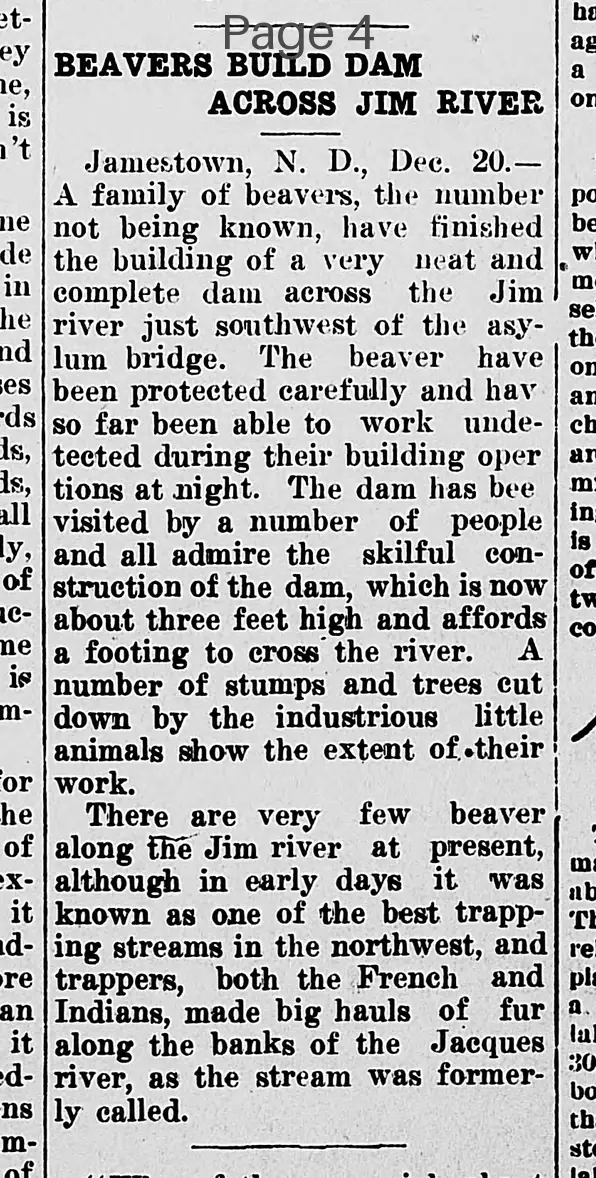
BEAVERS BUILD DAM
ACROSS JIM RIVER
Jamestown, N. D., Dec. 20.-
A family of beavers, the number
not being known, have finished
the building of a very neat and
complete dam across the Jim
river just southwest of the asy-
lum bridge. The beavers have
been protected carefully and have
so far been able to work unde-
tected during their building oper-
ations at night. The dam has been
visited by a number of people
and all admire the skilful con-
struction of the dam, which is now
about three feet high and affords
a footing to cross the river. A
number of stumps and trees cut
down by the industrious little
animals show the extent of their
work.
There are
very
few
beavers
along the Jim river at present,
although in early days it was
known as one of the best trapp-
ing streams in the northwest, and
trappers, both the French and
Indians, made big hauls of fur
along the banks of the Jacques
river, as the stream was former-
ly called.
ACROSS JIM RIVER
Jamestown, N. D., Dec. 20.-
A family of beavers, the number
not being known, have finished
the building of a very neat and
complete dam across the Jim
river just southwest of the asy-
lum bridge. The beavers have
been protected carefully and have
so far been able to work unde-
tected during their building oper-
ations at night. The dam has been
visited by a number of people
and all admire the skilful con-
struction of the dam, which is now
about three feet high and affords
a footing to cross the river. A
number of stumps and trees cut
down by the industrious little
animals show the extent of their
work.
There are
very
few
beavers
along the Jim river at present,
although in early days it was
known as one of the best trapp-
ing streams in the northwest, and
trappers, both the French and
Indians, made big hauls of fur
along the banks of the Jacques
river, as the stream was former-
ly called.
What sub-type of article is it?
Animal Story
Curiosity
What themes does it cover?
Nature
What keywords are associated?
Beaver Dam
Jim River
Jamestown
Trapping History
Jacques River
Where did it happen?
Jim River Just Southwest Of The Asylum Bridge, Near Jamestown, N. D.
Story Details
Location
Jim River Just Southwest Of The Asylum Bridge, Near Jamestown, N. D.
Event Date
Dec. 20.
Story Details
A family of beavers built a neat and complete dam across the Jim river, about three feet high, allowing crossing. People admire the construction and see stumps and trees cut by the beavers. Historically, the river, formerly called Jacques river, was a prime trapping stream for French and Indians.