Thank you for visiting SNEWPapers!
Sign up free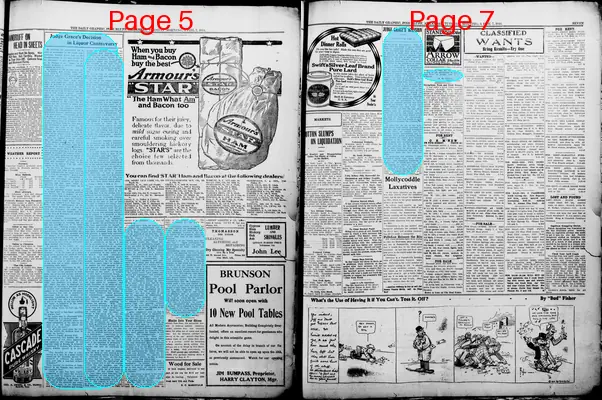
Pine Bluff Daily Graphic
Pine Bluff, Jefferson County, Arkansas
What is this article about?
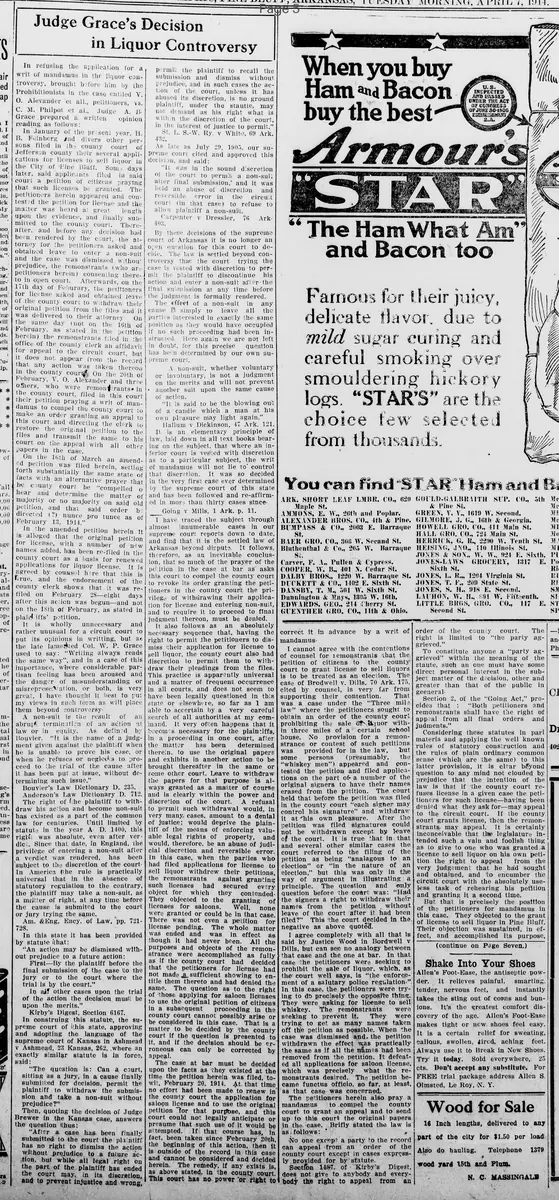
In 1914, Judge A.B. Grace of Arkansas denies a writ of mandamus sought by prohibitionists against a county court's dismissal without prejudice of liquor license applications in Pine Bluff, ruling that the court had discretion to allow the non-suit and withdrawal of petitions, leaving no grounds for appeal.
Merged-components note: Continuation of Judge Grace's decision in liquor controversy from page 5 to page 7
Clippings
1 of 2
OCR Quality
Full Text
In refusing the application for a writ of mandamus in the liquor controversy, brought before him by the Prohibitionists in the case entitled V. O. Alexander et al., petitioners, vs. C. M. Philpot et al., Judge A. B. Grace prepared a written opinion reading as follows:
In January of the present year, H. B. Feinberg and divers other persons filed in the county court of Jefferson county their several applications for licenses to sell liquor in the City of Pine Bluff. Some days later, said applicants filed in said court a petition of citizens praying that such licenses be granted. The petitioners herein appeared and contested the petition for license and the matter was heard at great length upon the evidence, and finally submitted to the county court. Thereafter, and before any decision had been rendered by the court, the attorney for the petitioners asked and obtained leave to enter a non-suit and the case was dismissed without prejudice, the remonstrants (who are petitioners herein) consenting thereto in open court. Afterwards, on the 17th day of February, the petitioners for license asked and obtained leave of the county court to withdraw their original petition from the files and it was delivered to their attorney. On the same day (not on the 16th of February, as stated in the petition herein) the remonstrants filed in the office of the county clerk an affidavit for appeal to the circuit court, but it does not appear from the record that any action was taken thereon in the county court. On the 20th of February, V. O. Alexander and three others, who were remonstrants in the county court, filed in this court their petition praying a writ of mandamus to compel the county court to make an order granting an appeal to this court and directing the clerk to restore the original petition to the files and transmit the same to this court on the appeal with all other papers in the case.
On the 16th of March an amended petition was filed herein, setting forth substantially the same state of facts with an alternative prayer that the county court be "compelled to hear and determine the matter of majority or no majority on said old petition, and that said order be directed nunc pro tunc as of February 13, 1914."
In the amended petition herein it is alleged that the original petition for license, with a number of new names added, has been re-filed in the county court as a basis for renewed applications for liquor license. It is agreed by counsel here that this is true, and the endorsement of the county clerk shows that it was re-filed on February 28—eight days after this action was begun—and not on the 15th of February, as stated in plaintiffs' petition.
It is wholly unnecessary and rather unusual for a circuit court to put its opinions in writing, but as the late lamented Col. W. P. Grace used to say: "Writing always reads the same way", and in a case of this importance, where considerable partisan feeling has been aroused and the danger of misunderstanding or misrepresentation, or both, is very great, I have thought it best to put my views in such form as will place them beyond controversy.
A non-suit is the result of an abrupt termination of an action at law or in equity. As defined by Bouvier. "It is the name of a judgment given against the plaintiff when he is unable to prove his case, or when he refuses or neglects to proceed to the trial of the cause after it has been put at issue, without determining such issue."
Bouvier's Law Dictionary p. 235. Anderson's Law Dictionary p. 712.
The right of the plaintiff to withdraw his action and become non-suit has existed as a part of the common law for centuries. Until limited by statute in the year A. D. 1400, this right was absolute, even after verdict. Since that date, in England, the privilege of entering a non-suit after a verdict was rendered, has been subject to the discretion of the court. In America the rule is practically universal that in the absence of statutory regulation to the contrary, the plaintiff may take a non-suit, as a matter of right, at any time before the cause is submitted to the court or jury trying the same.
Am. & Eng. Ency. of Law, pp. 721-728.
In this state it has been provided by statute that:
"An action may be dismissed without prejudice to a future action: First—By the plaintiff before the final submission of the case to the jury or to the court where the trial is by the court."
In all other cases upon the trial of the action the decision must be upon the merits."
Kirby's Digest. Section 6167.
In construing this statute, the supreme court of this state, approving and adopting the language of the supreme court of Kansas in Ashmead v. Ashmead, 23 Kansas, 262, where an exactly similar statute is in force, said:
"The question is: Can a court, sitting as a jury, in a cause finally submitted for decision, permit the plaintiff to withdraw the submission and take a non-suit without prejudice?"
Then, quoting the decision of Judge Brewer in the Kansas case, answers the question thus:
"After a case has been finally submitted to the court the plaintiff has no right to dismiss the action without prejudice to a future action, but while all legal right on the part of the plaintiff has ended the court may, in its discretion, and to prevent injustice and wrong, permit the plaintiff to recall the submission and dismiss without prejudice, and in such cases the action of the court, unless it has abused its discretion, is no ground of reversal. The plaintiff, under the statute, may not demand as his right what is within the discretion of the court, in the interest of justice to permit."
St. L. S.-W. Ry. v. White, 69 Ark. 432.
As late as July 29, 1905, our supreme court cited and approved this decision, and said:
"It was in the sound discretion of the court to permit a non-suit after final submission." and it was held an abuse of discretion and reversible error in the circuit court (in that case) to refuse to allow plaintiff a non-suit.
Carpenter v. Dressler, 76 Ark. 403.
By these decisions of the supreme court of Arkansas it is no longer an open question for this court to decide. The law is settled beyond controversy that the court trying the case is vested with discretion to permit the plaintiff to discontinue his action and enter a non-suit after the final submission at any time before the judgment is formally rendered.
The effect of a non-suit in any cause is simply to leave all the parties interested in exactly the same position as they would have occupied if no such proceeding had been instituted. Here again we are not left in doubt, for this precise question has been determined by our own supreme court.
A non-suit, whether voluntary or involuntary, is not a judgment on the merits and will not prevent another suit upon the same cause of action.
"It is said to be the blowing out of a candle which a man at his own pleasure may light again."
Hallum v. Dickinson, 47 Ark. 121.
It is an elementary principle of law, laid down in all text books bearing on the subject, that where an inferior court is vested with discretion as to a particular subject, the writ of mandamus will not lie to control that discretion. It was so decided in the very first case ever determined by the supreme court of this state and has been followed and re-affirmed in more than thirty cases since.
Going v. Mills, 1 Ark. p. 11.
I have traced the subject through almost innumerable cases in our supreme court reports down to date, and find that it is the settled law of Arkansas beyond dispute. It follows, therefore, as an inevitable conclusion, that so much of the prayer of the petition in the case at bar as asks this court to compel the county court to revoke its order granting the petitioners in the county court the privilege of withdrawing their application for license and entering non-suit, and to require it to proceed to final judgment thereon, must be denied.
It also follows as an absolutely necessary sequence that, having the right to permit the petitioners to dismiss their application for license to sell liquor, the county court also had discretion to permit them to withdraw their pleadings from the files. This practice is apparently universal and a matter of frequent occurrence in all courts, and does not seem to have been legally questioned in this state or elsewhere, so far as I am able to ascertain by a very careful search of all authorities at my command. It very often happens that it becomes necessary for the plaintiffs, in a proceeding in one court, after the matter has been determined therein, to use the original papers and exhibits in another action to be brought thereafter in the same or some other court. Leave to withdraw the papers for that purpose is always granted as a matter of course and is clearly within the power and discretion of the court. A refusal to permit such withdrawal would, in very many cases, amount to a denial of justice; would deprive the plaintiff of the means of enforcing valuable legal rights of property, and would, therefore, be an abuse of judicial discretion and reversible error.
In this case, when the parties who had filed applications for license to sell liquor withdrew their petitions, the remonstrants against granting such licenses had secured every object for which they contended. They objected to the granting of licenses for saloons. Well, none were granted or could be in that case. There was not even a petition for license pending. The whole matter was ended and was in effect as though it had never been. All the purposes and objects of the remonstrance were accomplished as fully as if the county court had decided that the petitioners for license had not made a sufficient showing to entitle them thereto and had denied the same. The question as to the right of those applying for saloon licenses to use the original petition of citizens in a subsequent proceeding in the county court cannot possibly arise or be considered in this case. That is a matter to be decided by the county court if the question is presented to it, and if the decision should be erroneous can only be corrected by appeal.
The case at bar must be decided upon the facts as they existed at the time the petition herein was filed, to-wit, February 20, 1914. At that time no effort had been made to renew in the county court the application for saloon license and to use the original petition for that purpose, and this court could not legally anticipate or presume that such use of it would be attempted. If that course has, in fact, been taken since February 20th, the beginning of this action, then it is outside of the record in this case and cannot be considered and decided herein. The remedy, if any exists is, as above stated, in the county court. This court has no power or right to correct it in advance by a writ of mandamus.
I cannot agree with the contentions of counsel for remonstrants that the petition of citizens to the county court to grant license to sell liquors is to be treated as an election. The case of Brodwell v. Dills, 70 Ark. 175, cited by counsel, is very far from supporting their contention. That was a case under the "Three mile law" where the petitioners sought to obtain an order of the county court prohibiting the sale of liquor within three miles of a certain school house. No provision for a remonstrance or contest of such petitions was provided for in the law, but some persons (presumably, the "whiskey men") appeared and contested the petition and filed applications on the part of a number of the original signers to have their names erased from the petition. The court held that before the petition was filed in the county court "each signer may control his signature" and withdraw it at his own pleasure. After the petition was filed signatures could not be withdrawn except by leave of the court. It is true that in that and several other similar cases the court referred to the filing of the petition as being "analogous to an election" or "in the nature of an election," but this was only in the way of argument in illustrating a principle. The question and only question before the court was: "Had the signers a right to withdraw their names from the petition without leave of the court after it had been filed?" This the court decided in the negative as above quoted.
I agree completely with all that is said by Justice Wood in Bordwell v. Dills, but can see no analogy between that case and the one at bar. In that case the petitioners were seeking to prohibit the sale of liquor, which, as the court well says, is "the enforcement of a salutary police regulation." In this case, the petitioners were trying to do precisely the opposite thing. They were asking for license to sell whiskey. The remonstrants were seeking to prevent it. They were trying to get as many names taken off the petition as possible. When the case was dismissed and the petition withdrawn the effect was practically the same as if all the names had been removed from the petition. It defeated all applications for saloon license, which was precisely what the remonstrants desired. The petition became functus officio, so far, at least, as that case was concerned.
The petitioners herein also pray a mandamus to compel the county court to grant an appeal and to send up to this court the original papers in the case. Briefly stated the law is as follows:
No one except a party to the record can appeal from an order of the county court except in cases expressly provided for by statute.
Section 1447, of Kirby's Digest, does not give to anybody and everybody the right to appeal from an order of the county court.
The right is limited to "the party aggrieved."
To constitute anyone a "party aggrieved" within the meaning of the statute, such an one must have some direct personal interest in the subject matter of the decision, other and greater than that of the public in general.
Section 2, of the "Going Act," provides that : "Both petitioners and remonstrants shall have the right of appeal from all final orders and judgments."
Considering these statutes in pari materia and applying the well known rules of statutory construction and the rules of plain ordinary common sense (which are the same) to this latter provision, it is clear beyond question to any mind not clouded by prejudice that the intention of the law is that if the county court refuses license in a given case the petitioners for such license—having been denied what they ask for—may appeal to the circuit court. If the county court grants license, then the remonstrants may appeal. It is certainly inconceivable that the legislature intended such a vain and foolish thing as to give to one who was granted a license to sell liquor on his own petition the right to appeal from the very judgement that he had sought and obtained, and to encumber the circuit court with the absolutely useless task of rehearing his petition and granting it a second time.
But that is precisely the position of the petitioners for mandamus in this case. They objected to the grant of license to sell liquor in Pine Bluff. Their objection was sustained, in effect, and accomplished its purpose,
JUDGE GRACE'S DECISION
(Continued from Page 5.)
and no license was granted. What is there then for them to appeal from? Nothing, absolutely nothing, unless it be considered that their prayer for an appeal is made only as a blind to conceal an ulterior purpose, not disclosed, and this is most earnestly denied by their counsel here. My conclusion, therefore, is that as there is nothing in the judgment or action of the county court prejudicial to any right claimed by the petitioners in this case, they are not and cannot be "aggrieved" thereby; there is nothing to appeal from and no right of appeal exists. It follows, as of course, that there is no shadow of a right to the writ of mandamus.
It may be added here that it is not expressly alleged in the petition that the county court refused to grant the remonstrants an appeal, and that fact does not appear anywhere in the record. It is expressly denied on oath by the county judge that any appeal from his decision in granting the non-suit and permitting the attorney for the petitioners to withdraw the original petition was ever prayed and denied. It is true that an affidavit was filed with the county clerk, but this, like any other motion, must be presented to the court for action, and either refused or granted by the court before it can be made the basis of controversy. This was not done and would, of itself, be sufficient grounds for refusing the writ.
In cases like the one at bar opinions based upon selfish interests on the one side or emotional sentiment on the other, are usually and frequently equally unreasoning and intolerant. With public sentiment, however divided, the courts have nothing whatever to do. The official presiding as judge may entertain pronounced views on one or the other side of any question, but the court, as such, must close its eyes and ears to all such influences and give its judgment upon the law and that alone.
In preparing this opinion, I have consumed much time, many duties, in fact, and consulted hundreds of authorities. It would serve no useful purpose to quote at length or even cite them here. It is sufficient to say that to my mind they are conclusive in supporting the legal positions I have herein assumed.
My judgment is, that the writ of mandamus is not authorized in this case and must be denied, and it is so ordered.
A. B. GRACE,
Circuit Judge.
What sub-type of article is it?
What themes does it cover?
What keywords are associated?
What entities or persons were involved?
Where did it happen?
Story Details
Key Persons
Location
Jefferson County, City Of Pine Bluff, Arkansas
Event Date
1914
Story Details
Judge Grace denies mandamus to compel county court to reverse non-suit in liquor license applications, citing discretion in allowing dismissal and no grounds for appeal by remonstrants whose objections were effectively sustained.