Thank you for visiting SNEWPapers!
Sign up free
Literary
July 5, 1820
The Hillsborough Recorder
Hillsboro, Orange County, North Carolina
What is this article about?
An excerpt from Voltaire's 'Zadig' titled 'The Blind of One Eye,' introduced with praise for Voltaire's moral and religious-friendly writings. The satirical tale follows Zadig's misfortunes in love and marriage in ancient Babylon, highlighting human folly, particularly in women and philosophy.
Merged-components note: Introductory review excerpt leading into the Voltaire story 'The Blind of One Eye', forming a single literary piece.
Clipping
OCR Quality
88%
Good
Full Text
From the Metropolitan.
Voltaire's writings have only to be read to be admired, and when we consider the corrupt age in which he flourished, by the situation-practices of that professing religion, it is no wonder that the talents of such a man should be wielded forth with all the energies in high he was master. The works of the great Shakespeare of the French nation, so far as those have come before us, we must honestly declare to be not only compatible with sound morals, but absolutely friendly to true and genuine religion. Below will be found an extract from his miscellaneous works a keen, but at the same time a philanthropist! satire, pervades every line at ".
Our fair readers will please to recollect that he is speaking of French ladies: but if we dared to express an opinion about our own fair, it would be, that two out of three in fashionable life, (women in Babylon.)
and four out of five of our young and beautiful widows would cut off the dead husband's noses as quick as my lady Azora.
Women have a little sympathies for living men, and but little regard for dead ones; who can pretend to blame them? The violent grief of men hath as speedy an end as that of widows.
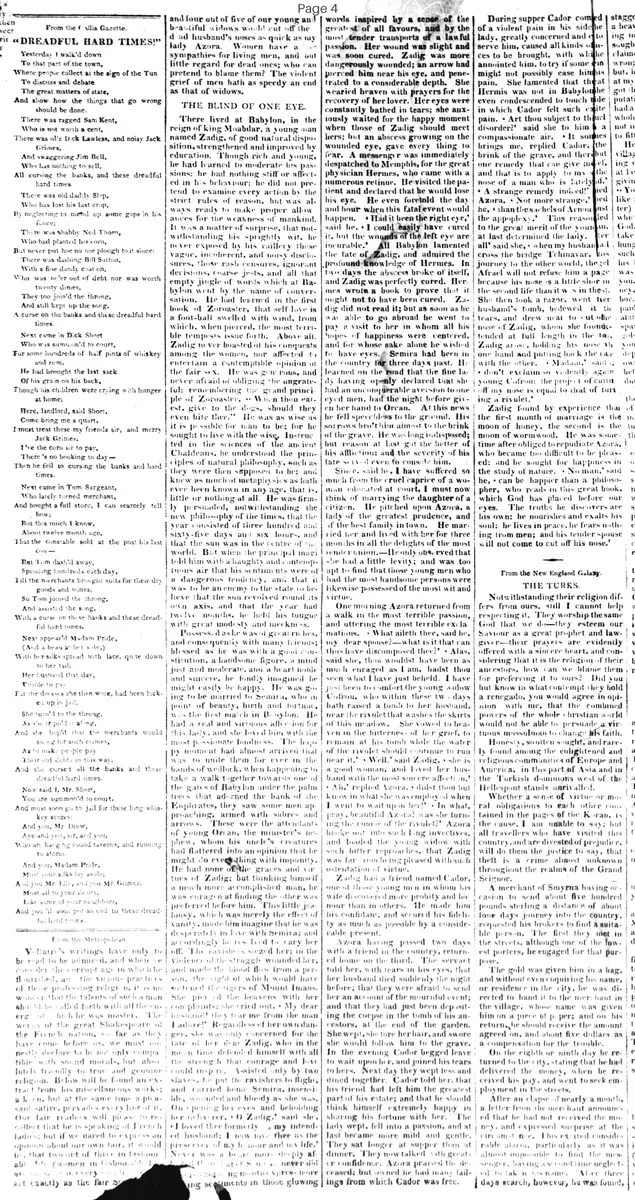
THE BLIND OF ONE EYE.
There lived at Babylon, in the reign of king Moabdar, a young man named Zadig, of good natural disposition, strengthened and improved by education. Though rich and young, he had learned to moderate his passions: he had nothing stiff or affected in his behaviour: he did not pretend to examine every action by the strict rules of reason, but was always ready to make proper allowances for the weakness of mankind. It was a matter of surprise, that notwithstanding his sprightly wit, he never exposed by his raillery those vague, incoherent, and noisy disclosures, those rash censures, ignorant decisions, coarse jests, and all that empty jingle of words which at Babylon went by the name of conversation. He had learned in the first book of Zoroaster, that self love is a foot-ball swelled with wind, from which, when pierced, the most terrible tempests issue forth. Above all, Zadig never boasted of his conquests among the women, nor affected to entertain a contemptible opinion of the fair sex. He was generous, and never afraid of obliging the ungrateful: remembering the grand principle of Zoroaster, "When thou eatest, give to the dogs, should they even bite thee." He was as wise as it is possible for man to be; for he sought to live with the wise. Instructed in the sciences of the ancient Chaldeans, he understood the principles of natural philosophy, such as they were then supposed to be; and knew as much of metaphysics as hath ever been known in any age, that is, little or nothing at all. He was firmly persuaded, notwithstanding the new philosophy of the times, that the year consisted of three hundred and sixty-five days and six hours, and that the sun was in the centre of the world. But when the principal magi told him with a haughty and contemptuous air that sentiments were of a dangerous tendency, and that it was to be an enemy to the state to believe that the sun revolved round its own axis, and that the year had twelve months, he held his tongue with great modesty and meekness. Possessed as he was of great riches, and consequently with many friends; blessed as he was with a good constitution, a handsome figure, a mind just and moderate, and a heart noble and sincere, he fondly imagined he might easily be happy. He was going to be married to Semira, who in point of beauty, birth and fortune, was the first match in Babylon. He had a real and virtuous affection for this lady, and she loved him with the most passionate fondness. The happy moment had almost arrived that was to unite them for ever in the bands of wedlock, when happening to take a walk together towards one of the gates of Babylon under the palm trees that adorned the bank of the Euphrates, they saw some men approaching, armed with sabres and arrows. These were the attendants of young Orcan, the minister's nephew, whom his uncle's creatures had flattered into an opinion that he might do everything with impunity. He had none of the graces and virtues of Zadig: but thinking himself a much more accomplished man, he was enraged at finding the other was preferred before him. This little jealousy, which was merely the effect of vanity, made him imagine that he was desperately in love with Semira: and accordingly he resolved to carry her off. The ravishers seized her: in the violence of the struggle wounded her, and made the blood flow from a person, the sight of which would have softened the tigers of Mount Imaus. She pierced the heavens with her complaints: she cried out, "My dear husband! they tear me from the man I adore!" Regardless of her own danger, she was only concerned for the fate of her dear Zadig, who in the meantime defended himself with all the strength that courage and love could inspire. Assisted only by two slaves, he put the ravishers to flight, and carried home Semira, insensible, wounded and bloody as she was. On opening her eyes and beholding her dear lover: "O Zadig!" said she, "I loved thee formerly as my intended husband: I now love thee as the preserver of my honor and my life." Never was a heart more deeply affected than that of Semira, never did imagination express more warm sentiments in those glowing words inspired by a sense of the greatest of all favours, and by the most tender transports of a lawful passion. Her wound was slight and was soon cured. Zadig was more dangerously wounded; an arrow had pierced him near his eye, and penetrated to a considerable depth. She wearied heaven with prayers for the recovery of her lover. Her eyes were constantly bathed in tears; she anxiously waited for the happy moment when those of Zadig should meet hers; but an abscess growing on the wounded eye, gave everything to fear. A messenger was immediately despatched to Memphis, for the great physician Hermes, who came with a numerous retinue. He visited the patient and declared that he would lose his eye. He even foretold the day and hour when this fatal event would happen. "Had it been the right eye," said he, "I could easily have cured it, but the wounds of the left eye are incurable." All Babylon lamented the fate of Zadig, and admired the profound knowledge of Hermes. In two days the abscess broke of itself, and Zadig was perfectly cured. Hermes wrote a book to prove that it ought not to have been cured. Zadig did not read it; but as soon as he was able to go abroad he went to pay a visit to her in whom all his hopes of happiness were centered, and for whose sake alone he wished to have eyes. Semira had been in the country for three days past. He learned on the road that the fair lady having openly declared that she had an unconquerable aversion to one eyed men, had the night before given her hand to Orcan. At this news he fell speechless to the ground. His sorrows brought him almost to the brink of the grave. He was long indisposed: but reason at last got the better of his affliction: and the severity of his fate served even to console him. "Since," said he, "I have suffered so much from the cruel caprice of a woman educated at court, I must now think of marrying the daughter of a citizen." He pitched upon Azora, a lady of the greatest prudence, and of the best family in town. He married her and lived with her for three months in all the delights of the most tender union. He only observed that she had a little levity; and was too apt to find that those young men who had the most handsome persons were likewise possessed of the most wit and virtue.
One morning Azora returned from a walk in the most terrible passion, and uttering the most terrible exclamations. "What aileth thee, said he, my dear spouse?--what is it that can thus have discomposed thee?" "Alas," said she, "thou wouldst have been as much enraged as I am, hadst thou seen what I have just beheld. I have just been to comfort the young widow Cofrou, who within these two days hath raised a tomb to her husband, near the rivulet that washes the skirts of this meadow. She vowed to heaven in the bitterness of her grief, to remain at his tomb while the water of the rivulet should continue to run near it." "Well," said Zadig, "she is a good woman, and loved her husband with the most sincere affection." "Ah," replied Azora, "didst thou but know in what she was employed when I went to wait upon her!" "In what, pray, beautiful Azora? was she turning the course of the rivulet?" Azora brake out into such long invectives, and loaded the young widow with such bitter reproaches, that Zadig was far from being pleased with such ostentation of virtue.
Zadig had a friend named Cador, one of the young men in whom his wife discovered more probity and honour than in others. He made him his confidant, and secured his fidelity as much as possible by a considerable present.
Azora having passed two days with a friend in the country, returned home on the third. The servant told her, with tears in his eyes, that her husband died suddenly the night before; that they were afraid to send her an account of the mournful event; and that they had just been depositing the corpse in the tomb of his ancestors, at the end of the garden. She wept, she tore her hair, and swore she would follow him to the grave. In the evening Cador begged leave to wait upon her, and joined his tears to hers. Next day they wept less and dined together. Cador told her, that his friend had left him the greatest part of his estate: and that he should think himself extremely happy in sharing his fortune with her. The lady wept, fell into a passion, and at last became more mild and gentle. They sat longer at supper than at dinner. They now talked with greater confidence. Azora praised the deceased: but owned he had many failings from which Cador was free.
During supper Cador complained of a violent pain in his side the lady, greatly concerned and desirous to serve him, caused all kinds of remedies to be brought, with which she anointed him, to try if some poultice might not possibly ease him of his pain. She lamented that the great Hermes was not in Babylon he even condescended to touch the part in which Cador felt such exquisite pain. "Art thou subject to this frequent disorder?" said she to him with a compassionate air. "It sometimes brings me, replied Cador, to the brink of the grave, and there is but one remedy that can give me relief, and that is to apply to my side the nose of a man who is lately dead."
"A strange remedy indeed!" said Azora. "Not more strange," replied he, "than the sachets of Arnot against the apoplexy." This reasoning led to the great merit of the young man, and at last determined the lady. "After all," said she, "when my husband crossed the bridge Tchinavar, on his journey to the other world, the angel Afrael will not refuse him a passage because his nose is a little shorter in the second life than it was in the first." She then took a razor, went to her husband's tomb, bedewed it with tears, and drew near to cut off the nose of Zadig, whom she found stretched at full length in the tomb. Zadig arose, holding his nose with one hand and pushing back the lady with the other. "Madam," said he, "don't exclaim so violently against young Cofrou: the project of cutting off my nose is equal to that of turning a rivulet."
Zadig found by experience that the first month of marriage is the moon of honey, the second is the moon of wormwood. He was sometime after obliged to repudiate Azora, who became too difficult to be pleased: and he sought for happiness in the study of nature. "No man," said he, "can be happier than a philosopher, who reads in this great book, which God has placed before our eyes. The truths he discovers are his own: he nourishes and exalts his soul: he lives in peace, he fears nothing from men; and his tender spouse will not come to cut off his nose."
Voltaire's writings have only to be read to be admired, and when we consider the corrupt age in which he flourished, by the situation-practices of that professing religion, it is no wonder that the talents of such a man should be wielded forth with all the energies in high he was master. The works of the great Shakespeare of the French nation, so far as those have come before us, we must honestly declare to be not only compatible with sound morals, but absolutely friendly to true and genuine religion. Below will be found an extract from his miscellaneous works a keen, but at the same time a philanthropist! satire, pervades every line at ".
Our fair readers will please to recollect that he is speaking of French ladies: but if we dared to express an opinion about our own fair, it would be, that two out of three in fashionable life, (women in Babylon.)
and four out of five of our young and beautiful widows would cut off the dead husband's noses as quick as my lady Azora.
Women have a little sympathies for living men, and but little regard for dead ones; who can pretend to blame them? The violent grief of men hath as speedy an end as that of widows.
THE BLIND OF ONE EYE.
There lived at Babylon, in the reign of king Moabdar, a young man named Zadig, of good natural disposition, strengthened and improved by education. Though rich and young, he had learned to moderate his passions: he had nothing stiff or affected in his behaviour: he did not pretend to examine every action by the strict rules of reason, but was always ready to make proper allowances for the weakness of mankind. It was a matter of surprise, that notwithstanding his sprightly wit, he never exposed by his raillery those vague, incoherent, and noisy disclosures, those rash censures, ignorant decisions, coarse jests, and all that empty jingle of words which at Babylon went by the name of conversation. He had learned in the first book of Zoroaster, that self love is a foot-ball swelled with wind, from which, when pierced, the most terrible tempests issue forth. Above all, Zadig never boasted of his conquests among the women, nor affected to entertain a contemptible opinion of the fair sex. He was generous, and never afraid of obliging the ungrateful: remembering the grand principle of Zoroaster, "When thou eatest, give to the dogs, should they even bite thee." He was as wise as it is possible for man to be; for he sought to live with the wise. Instructed in the sciences of the ancient Chaldeans, he understood the principles of natural philosophy, such as they were then supposed to be; and knew as much of metaphysics as hath ever been known in any age, that is, little or nothing at all. He was firmly persuaded, notwithstanding the new philosophy of the times, that the year consisted of three hundred and sixty-five days and six hours, and that the sun was in the centre of the world. But when the principal magi told him with a haughty and contemptuous air that sentiments were of a dangerous tendency, and that it was to be an enemy to the state to believe that the sun revolved round its own axis, and that the year had twelve months, he held his tongue with great modesty and meekness. Possessed as he was of great riches, and consequently with many friends; blessed as he was with a good constitution, a handsome figure, a mind just and moderate, and a heart noble and sincere, he fondly imagined he might easily be happy. He was going to be married to Semira, who in point of beauty, birth and fortune, was the first match in Babylon. He had a real and virtuous affection for this lady, and she loved him with the most passionate fondness. The happy moment had almost arrived that was to unite them for ever in the bands of wedlock, when happening to take a walk together towards one of the gates of Babylon under the palm trees that adorned the bank of the Euphrates, they saw some men approaching, armed with sabres and arrows. These were the attendants of young Orcan, the minister's nephew, whom his uncle's creatures had flattered into an opinion that he might do everything with impunity. He had none of the graces and virtues of Zadig: but thinking himself a much more accomplished man, he was enraged at finding the other was preferred before him. This little jealousy, which was merely the effect of vanity, made him imagine that he was desperately in love with Semira: and accordingly he resolved to carry her off. The ravishers seized her: in the violence of the struggle wounded her, and made the blood flow from a person, the sight of which would have softened the tigers of Mount Imaus. She pierced the heavens with her complaints: she cried out, "My dear husband! they tear me from the man I adore!" Regardless of her own danger, she was only concerned for the fate of her dear Zadig, who in the meantime defended himself with all the strength that courage and love could inspire. Assisted only by two slaves, he put the ravishers to flight, and carried home Semira, insensible, wounded and bloody as she was. On opening her eyes and beholding her dear lover: "O Zadig!" said she, "I loved thee formerly as my intended husband: I now love thee as the preserver of my honor and my life." Never was a heart more deeply affected than that of Semira, never did imagination express more warm sentiments in those glowing words inspired by a sense of the greatest of all favours, and by the most tender transports of a lawful passion. Her wound was slight and was soon cured. Zadig was more dangerously wounded; an arrow had pierced him near his eye, and penetrated to a considerable depth. She wearied heaven with prayers for the recovery of her lover. Her eyes were constantly bathed in tears; she anxiously waited for the happy moment when those of Zadig should meet hers; but an abscess growing on the wounded eye, gave everything to fear. A messenger was immediately despatched to Memphis, for the great physician Hermes, who came with a numerous retinue. He visited the patient and declared that he would lose his eye. He even foretold the day and hour when this fatal event would happen. "Had it been the right eye," said he, "I could easily have cured it, but the wounds of the left eye are incurable." All Babylon lamented the fate of Zadig, and admired the profound knowledge of Hermes. In two days the abscess broke of itself, and Zadig was perfectly cured. Hermes wrote a book to prove that it ought not to have been cured. Zadig did not read it; but as soon as he was able to go abroad he went to pay a visit to her in whom all his hopes of happiness were centered, and for whose sake alone he wished to have eyes. Semira had been in the country for three days past. He learned on the road that the fair lady having openly declared that she had an unconquerable aversion to one eyed men, had the night before given her hand to Orcan. At this news he fell speechless to the ground. His sorrows brought him almost to the brink of the grave. He was long indisposed: but reason at last got the better of his affliction: and the severity of his fate served even to console him. "Since," said he, "I have suffered so much from the cruel caprice of a woman educated at court, I must now think of marrying the daughter of a citizen." He pitched upon Azora, a lady of the greatest prudence, and of the best family in town. He married her and lived with her for three months in all the delights of the most tender union. He only observed that she had a little levity; and was too apt to find that those young men who had the most handsome persons were likewise possessed of the most wit and virtue.
One morning Azora returned from a walk in the most terrible passion, and uttering the most terrible exclamations. "What aileth thee, said he, my dear spouse?--what is it that can thus have discomposed thee?" "Alas," said she, "thou wouldst have been as much enraged as I am, hadst thou seen what I have just beheld. I have just been to comfort the young widow Cofrou, who within these two days hath raised a tomb to her husband, near the rivulet that washes the skirts of this meadow. She vowed to heaven in the bitterness of her grief, to remain at his tomb while the water of the rivulet should continue to run near it." "Well," said Zadig, "she is a good woman, and loved her husband with the most sincere affection." "Ah," replied Azora, "didst thou but know in what she was employed when I went to wait upon her!" "In what, pray, beautiful Azora? was she turning the course of the rivulet?" Azora brake out into such long invectives, and loaded the young widow with such bitter reproaches, that Zadig was far from being pleased with such ostentation of virtue.
Zadig had a friend named Cador, one of the young men in whom his wife discovered more probity and honour than in others. He made him his confidant, and secured his fidelity as much as possible by a considerable present.
Azora having passed two days with a friend in the country, returned home on the third. The servant told her, with tears in his eyes, that her husband died suddenly the night before; that they were afraid to send her an account of the mournful event; and that they had just been depositing the corpse in the tomb of his ancestors, at the end of the garden. She wept, she tore her hair, and swore she would follow him to the grave. In the evening Cador begged leave to wait upon her, and joined his tears to hers. Next day they wept less and dined together. Cador told her, that his friend had left him the greatest part of his estate: and that he should think himself extremely happy in sharing his fortune with her. The lady wept, fell into a passion, and at last became more mild and gentle. They sat longer at supper than at dinner. They now talked with greater confidence. Azora praised the deceased: but owned he had many failings from which Cador was free.
During supper Cador complained of a violent pain in his side the lady, greatly concerned and desirous to serve him, caused all kinds of remedies to be brought, with which she anointed him, to try if some poultice might not possibly ease him of his pain. She lamented that the great Hermes was not in Babylon he even condescended to touch the part in which Cador felt such exquisite pain. "Art thou subject to this frequent disorder?" said she to him with a compassionate air. "It sometimes brings me, replied Cador, to the brink of the grave, and there is but one remedy that can give me relief, and that is to apply to my side the nose of a man who is lately dead."
"A strange remedy indeed!" said Azora. "Not more strange," replied he, "than the sachets of Arnot against the apoplexy." This reasoning led to the great merit of the young man, and at last determined the lady. "After all," said she, "when my husband crossed the bridge Tchinavar, on his journey to the other world, the angel Afrael will not refuse him a passage because his nose is a little shorter in the second life than it was in the first." She then took a razor, went to her husband's tomb, bedewed it with tears, and drew near to cut off the nose of Zadig, whom she found stretched at full length in the tomb. Zadig arose, holding his nose with one hand and pushing back the lady with the other. "Madam," said he, "don't exclaim so violently against young Cofrou: the project of cutting off my nose is equal to that of turning a rivulet."
Zadig found by experience that the first month of marriage is the moon of honey, the second is the moon of wormwood. He was sometime after obliged to repudiate Azora, who became too difficult to be pleased: and he sought for happiness in the study of nature. "No man," said he, "can be happier than a philosopher, who reads in this great book, which God has placed before our eyes. The truths he discovers are his own: he nourishes and exalts his soul: he lives in peace, he fears nothing from men; and his tender spouse will not come to cut off his nose."
What sub-type of article is it?
Prose Fiction
Satire
What themes does it cover?
Moral Virtue
Social Manners
What keywords are associated?
Zadig
Voltaire
Satire
Marriage
Philosophy
Babylon
Azora
Semira
Human Folly
Zoroaster
What entities or persons were involved?
Voltaire
Literary Details
Title
The Blind Of One Eye
Author
Voltaire
Subject
Satire On Marriage And Human Folly
Key Lines
Women Have A Little Sympathies For Living Men, And But Little Regard For Dead Ones; Who Can Pretend To Blame Them? The Violent Grief Of Men Hath As Speedy An End As That Of Widows.
He Had Learned In The First Book Of Zoroaster, That Self Love Is A Foot Ball Swelled With Wind, From Which, When Pierced, The Most Terrible Tempests Issue Forth.
"O Zadig!" Said She, "I Loved Thee Formerly As My Intended Husband: I Now Love Thee As The Preserver Of My Honor And My Life."
Zadig Found By Experience That The First Month Of Marriage Is The Moon Of Honey, The Second Is The Moon Of Wormwood.
"No Man," Said He, "Can Be Happier Than A Philosopher, Who Reads In This Great Book, Which God Has Placed Before Our Eyes."