Thank you for visiting SNEWPapers!
Sign up free
Berkeley And Jefferson Intelligencer
Martinsburg, Berkeley County, Virginia
What is this article about?
James Madison notifies Arthur St. Clair on Nov. 22, 1802, of his dismissal as governor of the North Western Territory due to an address deemed intemperate. St. Clair responds from Cincinnati on Dec. 21, 1802, defending his actions and thanking the President.
Clipping
OCR Quality
Full Text
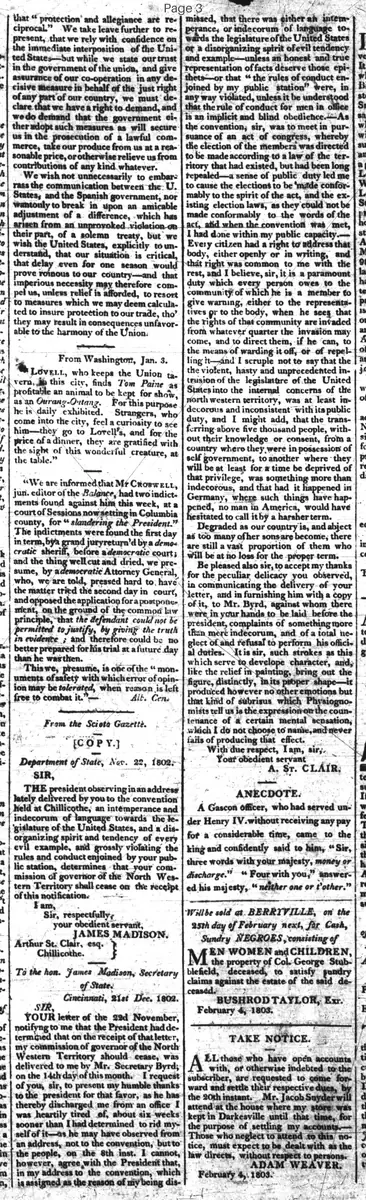
[COPY.]
Department of State, Nov. 22, 1802.
SIR,
THE president observing in an address lately delivered by you to the convention held at Chillicothe, an intemperance and indecorum of language towards the legislature of the United States, and a disorganizing spirit and tendency of every evil example, and grossly violating the rules and conduct enjoined by your public station, determines that your commission of governor of the North Western Territory shall cease on the receipt of this notification.
I am, Sir, respectfully,
your obedient servant.
JAMES MADISON.
Arthur St. Clair, esq.
Chillicothe.
To the hon. James Madison, Secretary of State.
Cincinnati, 21st Dec. 1802.
SIR,
YOUR letter of the 22d November, notifying to me that the President had determined that on the receipt of that letter, my commission of governor of the North Western Territory should cease, was delivered to me by Mr. Secretary Byrd; on the 14th day of this month. I request of you, sir, to present my humble thanks to the president for that favor, as he has thereby discharged me from an office I was heartily tired of, about six weeks sooner than I had determined to rid myself of it as he may have observed from an address, not to the convention, but to the people, on the 8th inst. I cannot, however, agree with the President that, in my address to the convention, which is assigned as the reason of my being dismissed, that there was either an intemperance, or indecorum of language towards the legislature of the United States or a disorganizing spirit of evil tendency and example—unless an honest and true representation of facts deserve those epithets—or that "the rules of conduct enjoined by my public station" were, in any way violated, unless it be understood that the rule of conduct for men in office is an implicit and blind obedience. As the convention, sir, was to meet in pursuance of an act of congress, whereby the election of the members was directed to be made according to a law of the territory that had existed, but had been long repealed—a sense of public duty led me to cause the elections to be made conformably to the spirit of the act, and the existing election laws, as they could not be made conformably to the words of the act, and when the convention was met, I had done within my public capacity. Every citizen had a right to address that body, either openly or in writing, and that right was common to me with the rest, and I believe, sir, it is a paramount duty which every person owes to the community of which he is a member to give warning, either to the representatives or to the body, when he sees, that the rights of that community are invaded from whatever quarter the invasion may come, and to direct them, if he can, to the means of warding it off, or of repelling it—and I scruple not to say that the violent, hasty and unprecedented intrusion of the legislature of the United States into the internal concerns of the north western territory, was at least indecorous and inconsistent with its public duty, and I might add, that the transferring above five thousand people, without their knowledge or consent, from a country where they were in possession of self government, to another where they will be at least for a time be deprived of that privilege, was something more than indecorous, and that had it happened in Germany, where such things have happened, no man in America, would have hesitated to call it by a harsher term. Degraded as our country is, and abject as too many of her sons are become; there are still a vast proportion of them who will be at no loss for the proper term. Be pleased also sir, to accept my thanks for the peculiar delicacy you observed, in communicating the delivery of your letter, and in furnishing him with a copy of it, to Mr. Byrd, against whom there were in your hands to be laid before the president, complaints of something more than mere indecorum, and, of a total neglect of and refusal to perform his official duties. It is sir, such strokes as this which serve to develope character, and, like the relief in painting, bring out the figure, distinctly, in its proper shape—it produced however no other emotions but that kind of subrisus which Physiognomists tell us is the expression on the countenance of a certain mental sensation, which I do not choose to name, and never fails of producing that effect.
With due respect, I am, sir,
Your obedient servant
A. ST. CLAIR.
What sub-type of article is it?
What keywords are associated?
What entities or persons were involved?
Where did it happen?
Domestic News Details
Primary Location
North Western Territory
Event Date
Nov. 22, 1802 To Dec. 21, 1802
Key Persons
Outcome
arthur st. clair's commission as governor ceases upon receipt of notification; he expresses thanks and defends his address.
Event Details
James Madison informs Arthur St. Clair of his dismissal as governor due to an intemperate address to the convention at Chillicothe. St. Clair responds, defending his actions regarding the convention elections and address, criticizing federal intrusion, and thanking for early relief from office.