Thank you for visiting SNEWPapers!
Sign up free
Kentucky Gazette
Lexington, Fayette County, Kentucky
What is this article about?
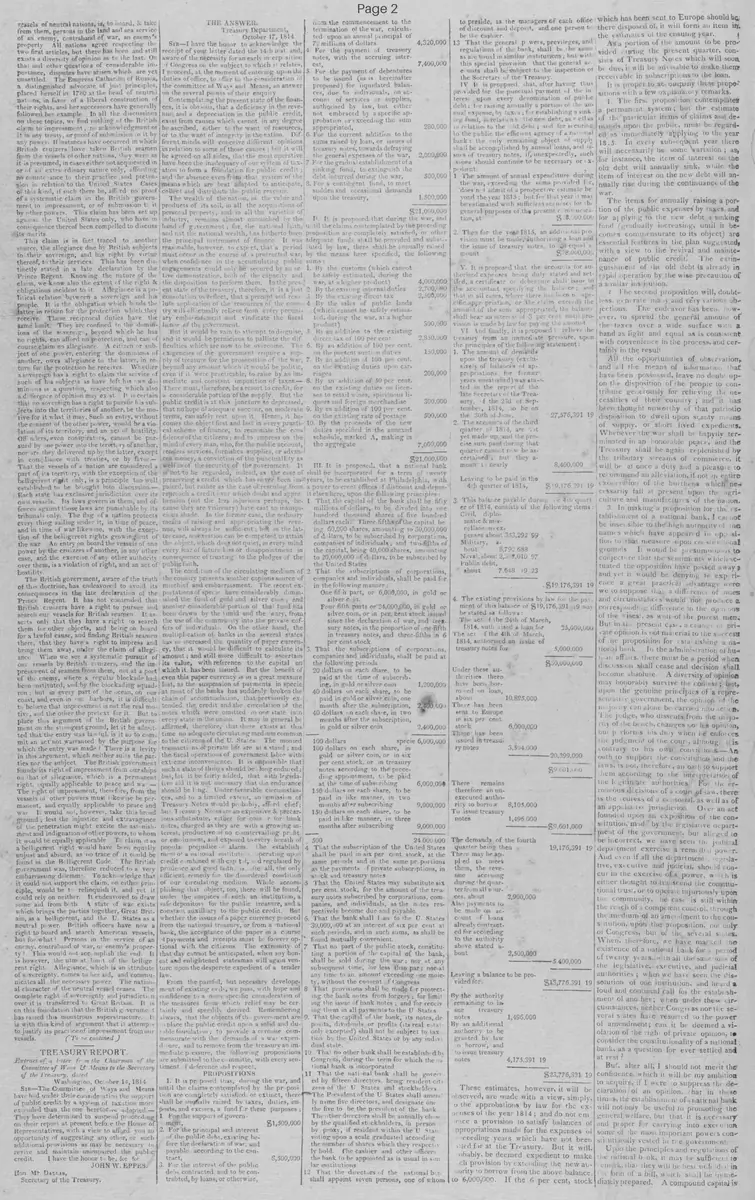
In October 1814, during the War of 1812, Chairman John W. Eppes of the House Committee of Ways and Means wrote to Treasury Secretary A. J. Dallas seeking input on taxation to support public credit. Dallas responded with detailed proposals for revenue raising via taxes, duties, and excises totaling $21 million annually; incorporation of a national bank with $50 million capital; loans and treasury notes for war expenses; and relief measures for immediate treasury pressures.
Merged-components note: Continuation of Treasury Department report on public finances and credit across pages; image overlaps spatially with text in reading order sequence.
Clippings
1 of 2
OCR Quality
Full Text
Extract of a letter from the Chairman of the Committee of Ways & Means to the Secretary of the Treasury, dated Washington, October 14, 1814.
SIR—The Committee of Ways and Means have had under their consideration the support of public credit by a system of taxation more extended than the one heretofore employed. They have determined to suspend proceeding on their report at present before the House of Representatives, with a view to afford you an opportunity of suggesting any other, or such additional provisions as may be necessary to revive and maintain unimpaired the public credit.
I have the honor to be, &c. &c.
JOHN W. EPPES.
Hon. Mr. Dallas, Secretary of the Treasury.
THE ANSWER.
Treasury Department, October 17, 1814.
Sir—I have the honor to acknowledge the receipt of your letter dated the 14th inst. and, aware of the necessity for an early disposition of Congress on the subject to which it relates, I proceed, at the moment of entering upon the duties of office, to offer to the consideration of the committee of Ways and Means, an answer on the several points of their enquiry.
Contemplating the present state of the finances, it is obvious, that a deficiency in the revenue, and a depreciation in the public credit, exist from causes which cannot in any degree be ascribed, either to the want of resources, or to the want of integrity in the nation. Different minds will conceive different opinions in relation to some of those causes; but it will be agreed on all sides, that the most operative have been the inadequacy of our system of taxation to form a foundation for public credit and the absence even from that system of the means which are best adapted to anticipate, collect and distribute the public revenue.
The wealth of the nation, in the value and products of its soil, in all the acquisitions of personal property, and in all the varieties of industry, remains almost untouched by the hand of government: for, the national faith, and not the national wealth, has hitherto been the principal instrument of finance. It was reasonable, however, to expect, that a period must occur in the course of a protracted war; when confidence in the accumulating public engagements could only be secured by an active demonstration, both of the capacity and the disposition to perform them. In the present state of the treasury, therefore, it is a just consolation to reflect, that a prompt and resolute application of the resources of the country will effectually relieve from every pecuniary embarrassment and vindicate the fiscal honor of the government.
But it would be vain to attempt to disguise, and it would be pernicious to palliate the difficulties which are now to be overcome. The exigencies of the government require a supply of treasure for the prosecution of the war, beyond any amount which it would be politic, even if it were practicable, to raise by an immediate and constant imposition of taxes. There must, therefore, be a resort to credit, for a considerable portion of the supply. But the public credit is at this juncture so depressed, that no hope of adequate succour, on moderate terms, can safely rest upon it. Hence, it becomes the object first and last in every practical scheme of finance, to reanimate the confidence of the citizens; and to impress on the mind of every man, who, for the public account, renders services, furnishes supplies, or advances money, a conviction of the punctuality as well as of the security of the government. It is not to be regarded, indeed, as the case of preserving a credit which has never been impaired, but rather as the case of rescuing from reproach a credit over which doubt and apprehension (not the least injurious perhaps, because they are visionary) have cast an inauspicious shade. In the former case, the ordinary means of raising and appropriating the revenue, will always be sufficient; but in the latter case, no exertion can be competent to attain the object, which does not quiet, in every mind, every fear of future loss or disappointment in consequence of trusting to the pledges of the public faith.
The condition of the circulating medium of the country presents another copious source of mischief and embarrassment. The recent exportations of specie have considerably diminished the fund of gold and silver coin; and another considerable portion of that fund has been drawn by the timid and the wary, from the use of the community into the private coffers of individuals. On the other hand, the multiplication of banks in the several states has so increased the quantity of paper currency, that it would be difficult to calculate its amount; and still more difficult to ascertain its value, with reference to the capital on which it has been issued. But the benefit of even this paper currency is in a great measure lost, as the suspension of payments in specie at most of the banks has suddenly broken the chain of accommodation, that previously extended the credit and the circulation of the notes which were current in one state into every state in the union. It may in general be affirmed, therefore, that there exists at this time no adequate circulating medium common to the citizens of the U. States. The monied transactions of private life are at a stand: and the fiscal operations of government labor with extreme inconvenience. It is impossible that such a state of things should be long endured; but, let it be fairly added, that with legislative aid it is not necessary that the endurance should be long. Under favorable circumstances, and to a limited extent, an emission of Treasury Notes would probably afford relief; but Treasury Notes are an expensive & precarious substitute, either for coin or bank notes, charged as they are with a growing interest, productive of no countervailing profit or emolument, and exposed to every breath of popular prejudice or alarm. The establishment of a national institution, operating upon credit combined with capital, and regulated by prudence and good faith, is after all, the only efficient remedy for the disordered condition of our circulating medium. While accomplishing that object, too, there will be found, under the auspices of such an institution, a safe depository for the public treasure, and a constant auxiliary to the public credit. But whether the issues of a paper currency proceed from the national treasury, or from a national bank, the acceptance of the paper in a course of payments and receipts must be forever optional with the citizens. The extremity of that day cannot be anticipated, when any honest and enlightened statesman will again venture upon the desperate expedient of a tender law.
From the painful, but necessary development of existing evil, we pass, with hope and confidence to a more specific consideration of the measures from which relief may be certainly and speedily derived. Remembering always, that the objects of the government are to place the public credit upon a solid and durable foundation; to provide a revenue commensurate with the demands of a war expenditure, and to remove from the treasury an immediate pressure, the following propositions are submitted to the committee, with every sentiment of deference and respect.
PROPOSITIONS
1. It is proposed that, during the war, and until the claims contemplated by the proposition are completely satisfied or extinct, there shall be annually raised by taxes, duties, imposts, and excises, a fund for these purposes;
1. For the support of government, $1,500,000
2. For the principal and interest of the public debt, existing before the declaration of war, and payable according to the contract, $8,500,000
3. For the interest of the public debt contracted and to be contracted, by loans, or otherwise, from the commencement to the termination of the war, calculated upon an annual principal of 7 millions of dollars, $4,320,000
4. For the payment of treasury notes, with the accruing interest, $7,400,000
5. For the payment of debentures to be issued (as is hereinafter proposed) for liquidated balances, due to individuals, on account of services or supplies, authorized by law, but either not embraced by a specific appropriation or exceeding the sum appropriated, $280,000
6. For the current addition to the sums raised by loan, or issues of treasury notes, towards defraying the general expenses of the war, $2,000,000
7. For the gradual establishment of a sinking fund, to extinguish the debt incurred during the war, $500,000
8. For a contingent fund, to meet sudden and occasional demands upon the treasury, $1,500,000
$21,000,000
II. It is proposed that during the war, and until the claims contemplated by the preceding proposition are completely satisfied, or other adequate funds shall be provided and substituted by law, there shall be annually raised by the means here specified, the following sums:
1. By the existing customs (which cannot be safely estimated, during the war, at a higher product) $4,000,000
2. By the existing internal duties $2,700,000
3. By the existing direct tax $2,309,000
4. By the sales of public lands (which cannot be safely estimated, during the war, at a higher product) $500,000
5. By an addition to the existing direct tax of 100 per cent: $2,850,000
6. By an addition of 100 per cent. on the present auction duties $150,000
on the existing duties upon carriages $200,000
on the existing duties on licenses to retail wines, spirituous liquors and foreign merchandise $300,000
9. By an addition of 100 per cent. on the existing rate of postage $500,000
duties specified in the annexed schedule, marked A, making in the aggregate $7,000,000
$21,000,000
III. It is proposed, that a national bank shall be incorporated for a term of twenty years, to be established at Philadelphia, with a power to erect offices of discount and deposit elsewhere, upon the following principles:
1. That the capital of the bank shall be fifty millions of dollars, to be divided into one hundred thousand shares of five hundred dollars each. Three-fifths of the capital being 60,000 shares, amounting to 30,000,000 of dollars, to be subscribed by corporations, companies or individuals; and two-fifths of the capital, being 40,000 shares, amounting to 20,000,000 of dollars, to be subscribed by the United States.
2. That the subscriptions of corporations, companies and individuals, shall be paid for in the following manner:
One fifth part, or 6,000,000, in gold or silver coin.
Four fifth parts or 24,000,000, in gold or silver coin, or in 6 per cent stock issued since the declaration of war, and treasury notes, in the proportion of one-fifth in treasury notes, and three-fifths in 6 per cent stock.
3. That the subscriptions of corporations, companies and individuals, shall be paid at the following periods:
20 dollars on each share, to be paid at the time of subscribing, in gold or silver coin $1,200,000
40 dollars on each share, to be paid in gold or silver coin, one month after the subscription,
40 dollars on each share, in two months after the subscription, in gold or silver coin $2,400,000
100 dollars specie $6,000,000
100 dollars on each share, in gold or silver coin, or in six per cent stock, or in treasury notes according to the preceding appointment, to be paid at the time of subscribing $6,000,000
150 dollars on each share, to be paid in like manner, in two months after subscribing $9,000,000
150 dollars on each share, to be paid in like manner, in three months after subscribing
500
as the payments of private subscriptions, in stock and treasury notes
5. That the United States may substitute six per cent stock, for the amount of the treasury notes subscribed by corporations, companies, and individuals, as the notes respectively become due and payable.
6. That the bank shall loan to the U. States 30,000,000 at an interest of six per cent at such periods, and in such sums, as shall be found mutually convenient.
7. That no part of the public stock, constituting a portion of the capital of the bank, shall be sold during the war; nor at any subsequent time, for less than par; nor at any time to an amount exceeding one moiety, without the consent of Congress.
8. That provisions shall be made for protecting the bank notes from forgery; for limiting the issue of bank notes; and for receiving them in all payments to the U. States.
9. That the capital of the bank, its notes, deposits, dividends or profits (its real estate only excepted) shall not be subject to taxation by the United States or by any individual state.
10. That no other bank shall be established by Congress, during the term for which the national bank is incorporated.
11. That the national bank shall be governed by fifteen directors being resident citizens of the U. States and stockholders. The President of the U. States shall annually name five directors, and designate one of the five to be the president of the bank. The other directors shall be annually chosen by the qualified stockholders, in person or by proxy, if resident within the U. States, voting upon a scale graduated according to the number of shares which they respectively hold. The cashier and other officers of the bank to be appointed as is usual in similar institutions.
12. That the directors of the national bank shall appoint seven persons, one of whom to preside, as the managers of each office of discount and deposit, and one person to be the cashier.
13. That the general powers, privileges, and regulations of the bank, shall be the same as are usual in similar institutions; but with this special provision that the general accounts shall be subject to the inspection of the Secretary of the Treasury.
IV. It is proposed that, after having thus provided for the punctual payment of the interest upon every denomination of public debt; for raising annually a portion of the annual expense, by taxes; for establishing a sinking fund, in relation to the new debt, as well as in relation to the old debt; and for securing to the public the efficient agency of a national bank; the only remaining object of supply shall be accomplished by annual loans, and issues of treasury notes, if, unexpectedly, such issues should continue to be necessary or expedient.
1. The amount of annual expenditure during the war, exceeding the sums provided for, does not admit of a prospective estimate beyond the year 1815; but for that year it may be estimated with sufficient accuracy for the general purposes of the present communication, at $8,000,000.
2. Therefore for the year 1815, an additional provision must be made, authorizing a loan and the issue of treasury notes, to the amount $8,000,000.
V. It is proposed that the accounts for authorized expenses being duly stated and settled, a certificate or debenture shall issue to the accountant specifying the balance; and that in all cases, where there has been no specific appropriation, or the claim exceeds the amount of the sum appropriated, the balance shall bear an interest of 3 per cent until provision is made by law for paying the amount.
VI. And finally, it is proposed to relieve the treasury from an immediate pressure, upon the principles of the following statement:
1. The amount of demands upon the treasury (exclusively of balances of appropriations for former years unexhausted) was stated in the report of the late Secretary of the Treasury, of the 23d of September, 1814, to be on the 6th of June, 1814, $27,576,391.19.
The accounts of the third quarter of 1814, are not yet made up, and the precise sum paid during that quarter cannot now be ascertained; but they amount, nearly $8,400,000.
Leaving to be paid in the 4th quarter of 1814, $19,176,391.19.
3. This balance payable during the 4th quarter of 1814, consists of the following items:
Civil, diplomatic & miscellaneous expenses about $353,292.99
Military, about $8,792,633
Naval, about $2,340,010.97
Public debt, about $7,690,454.23
$19,176,391.19
4. The existing provisions by law for the payment of this balance of $19,176,391.19 may be stated as follows:
The act of the 24th of March, 1814, authorized a loan, for $25,000,000.
The act of the 4th of March, 1814, authorized an issue of treasury notes for $5,000,000.
$30,000,000.
Under these authorities there have been borrowed on loan, about $10,895,000.
There has been sent to Europe in six per cent. stock $6,000,000.
There has been issued in treasury notes $3,504,000.
$20,399,000.
$9,601,000.
There remains therefore an unexecuted authority to borrow $8,105,000.
To issue treasury notes $1,496,000.
$9,601,000.
19,176,391.19
To meet them, the revenue accruing during the quarter from all sources, about $2,900,000.
Also payments to be made on account of loans already contracted for according to the authority above stated about $2,500,000.
$5,400,000.
$13,776,391.19.
By the authority remaining to issue treasury notes $1,496,000.
By an additional authority to be granted by law to borrow, and to issue treasury notes $4,175,391.19.
$5,671,391.19.
$19,447,782.38.
These estimates, however, it will be observed, are made with a view, simply to the appropriations by law for the expenses of the year 1814; and do not embrace a provision to satisfy balances of appropriations made for the expenses of preceding years which have not been called for at the Treasury. But it will, probably, be deemed expedient to make such provision by extending the new authority to borrow from the above balance to $6,000,000. If the 6 per cent. stock which has been sent to Europe should be there disposed of, it will form an item in the estimates of the ensuing year.
1. As a portion of the amount to be provided during the present quarter, consists of Treasury Notes which will soon be due, it will be advisable to make them receivable in subscriptions to the loan.
It is proper to accompany these propositions with a few explanatory remarks.
1. The first proposition contemplates a permanent system; but the estimate of the particular items of claims and demands upon the public, must be regarded as immediately applying to the year 1815. In every subsequent year there will necessarily be some variation; as for instance, the item of interest on the old debt will annually sink, while the item of interest on the new debt will annually rise during the continuance of the war.
The items for annually raising a portion of the public expenses by taxes, and for applying to the new debt a sinking fund (gradually increasing, until it becomes commensurate to its object) are essential features in the plan suggested with a view to the revival and maintenance of public credit. The extinguishment of the old debt is already in rapid operation by the wise precaution of a similar institution.
2. The second proposition will, doubtless, generate many and very various objections. The endeavor has been however, to spread the general amount of the taxes over a wide surface with a hand as light and equal as is consistent with convenience in the process, and certainly in the result. All the opportunities of observation, and all the means of information that have been possessed, leave no doubt upon the disposition of the people to contribute generously for relieving the necessities of their country; and it has been thought unworthy of that patriotic disposition to dwell upon scanty means of supply, or short lived expedients. Whenever the war shall be happily terminated in an honorable peace, and the Treasury shall be again replenished by the tributary streams of commerce, it will be at once a duty and a pleasure to recommend an alleviation, if not an entire exoneration of the burthens which necessarily fall at present upon the agriculture and manufactures of the nation.
3. In making a proposition for the establishment of a national bank, I cannot be insensible to the high authority of the names which have appeared in opposition to that measure upon constitutional grounds. I would be presumptuous to conjecture that the sentiments which actuated the opposition have passed away and yet it would be denying to experience a great practical advantage were we to suppose that a difference of times and circumstances would not produce a corresponding difference in the opinions of the wisest, as well of the purest men. But in the present case, a change of private opinion is not material to the success of the proposition for establishing a national bank. In the administration of human affairs, there must be a period when discussion shall cease and decision shall become absolute. A diversity of opinion may honorably survive the contest; but, upon the genuine principles of a representative government, the opinion of the majority can alone be carried into action. The judge, who dissents from the majority of the bench, changes not his opinion but performs his duty when he enforces the judgment of the court, although it is contrary to his own convictions. An oath to support the constitution and the laws, is not, therefore, an oath to support them according to the interpretation of the legitimate authorities. For the erroneous decisions of a court of law, there is the redress of a constitutional, as well as of an appellate jurisdiction. Over an act founded upon an exposition of the constitution, made by the legislative department of the government, but alleged to be incorrect, we have seen the judicial department exercise a remedial power. And even if all the departments legislative, executive and judicial, should concur in the exercise of a power, which is either thought to transcend the constitutional trust, or to operate injuriously upon the community, the case is still within the reach of a competent control, through the medium of an amendment to the constitution, upon the proposition, not only of Congress, but of the several states.
When, therefore, we have marked the existence of a national bank for a period of twenty years, with all the sanctions of the legislative, executive, and judicial authorities; when we have seen the dissolution of one institution, and heard a loud and continual call for the establishment of another; when under these circumstances, neither Congress nor the several states have resorted to the power of amendment; can it be deemed a violation of the right of private opinion, to consider the constitutionality of a national bank, as a question for ever settled and at rest?
But, after all, I should not merit the confidence, which it will be my ambition to acquire, if I were to suppress the declaration of an opinion, that in these times, the establishment of a national bank will not only be useful in promoting the general welfare, but that it is necessary and proper for carrying into execution some of the most important powers constitutionally vested in the government.
Upon the principles and regulations of the national bank, it may be sufficient to remark, that they will be best unfolded in the form of a bill, which shall be immediately prepared. A compound capital is
suggested, with a design equally to accommodate the subscribers, and to aid the general measures, for the revival of public credit; but the proportions of specie and stock may be varied, if the scarcity of coin should render it expedient: yet not in so great a degree, as to prevent an early commencement of the money operations of the institution.
4. The estimates of receipts, from established sources of revenue, and from the proposed new duties: and the estimates of expenditures, on all the objects contemplated in the present communication; have been made upon a call so sudden, and upon materials so scattered, that it is not expected to claim a perfect reliance on their accuracy. They are, however, believed to be sufficiently accurate to illustrate and support the general plan, for the revival of the public credit, the establishment of a permanent system of revenue, and the removal of the immediate pressure on the Treasury.
Upon the whole, sir, I have freely and openly assumed the responsibility of the station in which I have the honour to be placed. But conscious of the imperfections of the judgment that dictates the answer to the important inquiries of the Committee of Ways and Means, I derive the highest satisfaction from reflecting, that the honor and safety of the nation, for war, or for peace, depend on the wisdom, patriotism, and fortitude of Congress, during times which imperiously demand a display of those qualities in the exercise of the legislative authority.
I have the honor to be,
Very respectfully, Sir,
Your most obedient servant,
A. J. DALLAS.
J. W. Eppes, Chairman of the Committee of Ways & Means.
(A)
Schedule of new taxes referred to in the letter of the Secretary of the Treasury to the chairman of the committee of Ways and Means. in which the taxes proposed in the report of the committee to the House of Representatives on the 10th inst. are principally adopted :
1. On spirits distilled from domestic or foreign materials 25 cents per gallon, computed on 24,000,000 gallons, provided the present tax on the capacity of the stills should be continued. If it is thought best to lay the tax entirely on the liquor, then the tax on the capacity of the stills to be taken off, and 30 cents per gallon to be laid on the liquor For the present estimate, it is taken at 25 cents per gallon,
$6,000,000
2. On porter, ale and strong beer,
2 cents per gallon, computed on 6,000,000 gallons,
120,000
3. On manufactured tobacco, and snuff. averaged at 5 cents per pound, and computed on ten million pounds,
500,000
4. On leather of various kinds, averaged at 3 cents per pound,
and computed on twenty million pounds,
600,000
5. On pig iron at $1 50 per ton,
computed at 300,000 tons,
450,000
6. On paper, at various rates. averaging 7 per cent. on the value of the article. computed on the annual manufacture of the value of 2,500,000 dollars,
175,000
7. On playing cards at 25 cents per pack, computed on 400,000 packs,
100,000
8. On counsellors and attorneys at law, process in suits at law and equity, proceedings in admiralty,
arbitrations and references, and other legal proceedings in the courts of the U States,
300,000
9. On conveyances, mortgages and other contracts relating to real estate,
250,000
$8,495,000
The sum to be raised by new taxes according to the estimates of the Secretary's letter, is 7,000,000
Leaving a surplus for the ex-
What sub-type of article is it?
What keywords are associated?
What entities or persons were involved?
Where did it happen?
Domestic News Details
Primary Location
Washington
Event Date
October 14, 1814 And October 17, 1814
Key Persons
Event Details
Correspondence between Eppes and Dallas on suspending a taxation report to incorporate Dallas's suggestions for reviving public credit through extended taxation, establishment of a national bank, loans, treasury notes, and specific revenue estimates for war funding.