Thank you for visiting SNEWPapers!
Sign up free
Gazette Of The United States & Evening Advertiser
Philadelphia, Philadelphia County, Pennsylvania
What is this article about?
An agricultural essay advocating for 'forward wheat,' an early-ripening variety resistant to rust, which preserves soil fertility, reduces labor, and yields superior crops compared to later-maturing wheats, based on experiments in Virginia.
Merged-components note: These components form a continuous narrative on a new species of wheat, split due to page parsing; text flows sequentially across reading orders 24-26.
Clipping
OCR Quality
Full Text
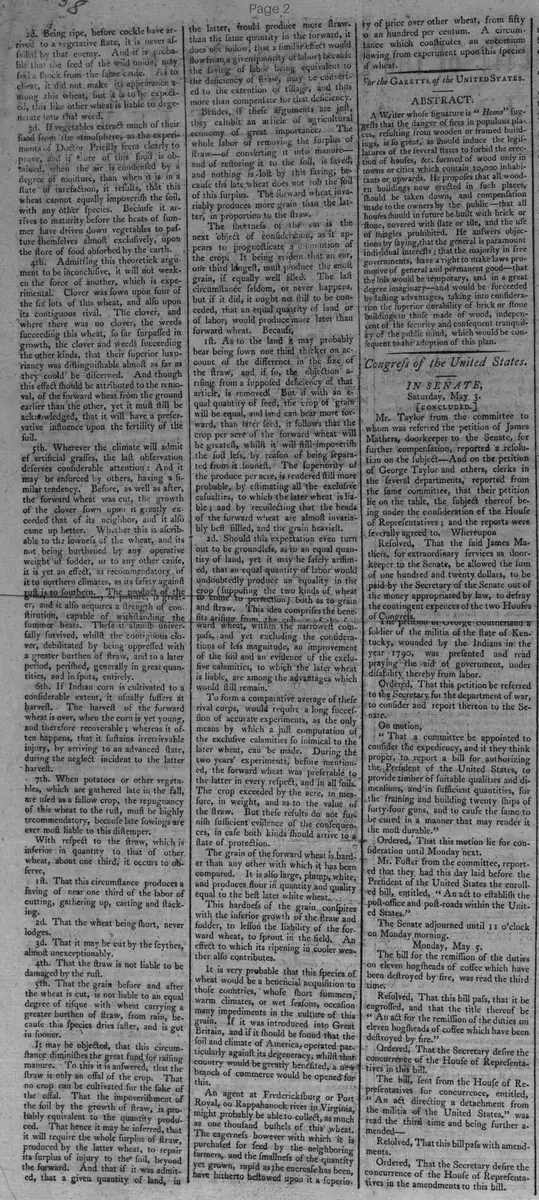
3d. If vegetables extract much of their food from the atmosphere, as the experiments of Doctor Priestley seem clearly to prove, and if more of this food is obtained, when the air is condensed by a degree of moisture, than when it is in a state of rarefaction, it results, that this wheat cannot equally impoverish the soil, with any other species. Because it arrives to maturity before the heats of summer have driven down vegetables to pasture themselves almost exclusively, upon the store of food absorbed by the earth.
4th: Admitting this theoretical argument to be inconclusive, it will not weaken the force of another, which is experimental: Clover was sown upon four of the six lots of this wheat, and also upon its contiguous rival. The clover, and where there was no clover, the weeds succeeding this wheat, so far surpassed in growth, the clover and weeds succeeding the other kinds, that their superior luxuriancy was distinguishable almost as far as they could be discerned. And though this effect should be attributed to the removal, of the forward wheat from the ground earlier than the other, yet it must still be acknowledged, that it will have a preservative influence upon the fertility of the soil.
5th. Wherever the climate will admit of artificial grasses, the last observation deserves considerable attention: And it may be enforced by others, having a similar tendency. Before, as well as after, the forward wheat was cut, the growth of the clover sown upon it greatly exceeded that of its neighbor, and it also came up better. Whether this is ascribable to the sowness of the wheat, and its not being burdened by any operative weight of fodder, or to any other cause, it is yet an effect, as recommendatory of it to northern climates, as its safety against rust is to southern. The product of the pasture, is greater, and it also acquires a strength of constitution, capable of withstanding the summer heats. These it almost universally survived, whilst the contiguous clover, debilitated by being oppressed with a greater burthen of straw, and to a later period, perished, generally in great quantities, and in spots, entirely.
6th. If Indian corn is cultivated to a considerable extent, it usually suffers at harvest. The harvest of the forward wheat is over, when the corn is yet young, and therefore recoverable; whereas it often happens, that it sustains irretrievable injury, by arriving to an advanced state, during the neglect incident to the latter harvest.
7th. When potatoes or other vegetables, which are gathered late in the fall, are used as a fallow crop, the repugnancy of this wheat to the rust, must be highly recommendatory, because late sowings are ever most liable to this distemper.
With respect to the straw, which is inferior in quantity to that of other wheat, about one third, it occurs to observe,
1st. That this circumstance produces a saving of near one third of the labor of cutting, gathering up, carting and stacking.
2d. That the wheat being short, never lodges.
3d. That it may be cut by the scythes, almost unexceptionably.
4th. That the straw is not liable to be damaged by the rust.
5th. That the grain before and after the wheat is cut, is not liable to an equal degree of risque with wheat carrying a greater burthen of straw, from rain, because this species dries faster, and is got in sooner.
It may be objected, that this circumstance diminishes the great fund for raising manure. To this it is answered, that the straw is only an offal of the crop. That no crop can be cultivated for the sake of the offal. That the impoverishment of the soil by the growth of straw, is probably equivalent to the quantity produced. That hence it may be inferred, that it will require the whole surplus of straw, produced by the latter wheat, to repair its surplus of injury to the soil, beyond the forward. And that if it was admitted, that a given quantity of land, in
the latter, would produce more straw than this same quantity in the forward, it does not follow, that a similar effect would flow from, a given quantity of labor; because the saving of labor: being equivalent to the deficiency of straw, may be converted to the extension of tillage, and thus more than compensate for that deficiency. Besides, if these arguments are just, they exhibit an article of agricultural economy of great importance. The whole labor of removing the surplus of straw-of converting it into manure and of restoring it to the soil, is saved, and nothing is lost by this saving; because the late wheat does not rob the soil of this surplus. The forward wheat invariably produces more grain than the latter, in proportion to the straw.
The shortness of the ear is the next object of consideration, as it appears to prognosticate a diminution of the crop. It being evident that an ear, one third longer, must produce the most grain, if equally well filled: The last circumstance seldom, or never happens, but if it did, it ought not still to be conceded, that an equal quantity of land or of labor, would produce more later than forward wheat. Because.
1st. As to the land it may probably bear being sown one third thicker on account of the difference in the size of the straw, and, if so, the objection arising from a supposed deficiency of that article, is removed! But if with an equal quantity of seed; the crop of grain will be equal, and land can bear more forward, than later seed, it follows that the crop per acre of the forward wheat will be greatest, whilst it will still impoverish the soil less, by reason of being separated from it sooner. The superiority of the produce per acre, is rendered still more probable, by estimating all the exclusive casualties, to which the later wheat is liable; and by recollecting that the heads of the forward wheat are almost invariably best filled, and the grain heaviest.
2d. Should this expectation even turn out to be groundless, as to an equal quantity of land, yet it may be safely affirmed, that an equal quantity of labor would undoubtedly produce an equality in the crop (supposing the two kinds of wheat to come to perfection) both as to grain and straw. This idea comprises the benefits arising from the culture of forward wheat, within the narrowest compass, and yet excluding the considerations of less magnitude, an improvement of the soil and an evidence of the exclusive calamities, to which the later wheat is liable, are among the advantages which would still remain.
To form a comparative average of these rival crops, would require a long succession of accurate experiments, as the only means by which a just computation of the exclusive calamities so inimical to the later wheat, can be made. During the two years' experiments, before mentioned, the forward wheat was preferable to the latter in every respect, and in all soils. The crop exceeded by the acre, in measure, in weight, and as to the value of the straw. But these results do not furnish sufficient evidence of the consequences, in case both kinds should arrive to a state of perfection.
The grain of the forward wheat is harder than any other with which it has been compared. It is also large, plump, white; and produces flour in quantity and quality equal to the best later white wheat.
This hardness of the grain conspires with the inferior growth of the straw and fodder, to lessen the liability of the forward wheat, to sprout in the field. An effect to which its ripening in cooler weather also contributes.
It is very probable that this species of wheat would be a beneficial acquisition to those countries, whose short summers; warm climates, or wet seasons, occasion many impediments in the culture of this grain. If it was introduced into Great Britain, and if it should be found that the soil and climate of America, operated particularly against its degeneracy; whilst that country would be greatly benefited; a new branch of commerce would be opened for this.
An agent at Fredericksburg or Port Royal, on Rappahannock river in Virginia, might probably be able to collect, as much as one thousand bushels of this wheat. The eagerness however with which it is purchased for seed by the neighboring farmers, and the smallness of the quantity yet grown, rapid as the increase has been, have hitherto bestowed upon it a superior.
ity of price over other wheat, from fifty to an hundred per centum. A circumstance which constitutes, an encomium flowing from experiment upon this species of wheat.
What sub-type of article is it?
What keywords are associated?
What entities or persons were involved?
Where did it happen?
Story Details
Key Persons
Location
Fredericksburg Or Port Royal, On Rappahannock River In Virginia
Story Details
The text presents arguments and experimental evidence for the advantages of forward wheat, including early ripening, resistance to rust and weeds, less soil depletion, better subsequent crops like clover, labor savings from shorter straw, and overall superior yield and quality compared to later wheat varieties.