Thank you for visiting SNEWPapers!
Sign up free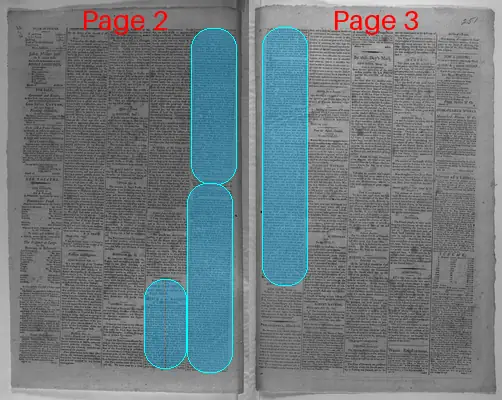
Gazette Of The United States And Daily Evening Advertiser
Philadelphia, Philadelphia County, Pennsylvania
What is this article about?
In a House of Lords speech on December 30, the Marquis of Lansdowne criticizes British war efforts against France, highlighting military failures in the West Indies, Corsica, and Europe, French successes in 1794, and calls for peace negotiations.
Merged-components note: Continuation of the Marquis of Lansdowne's speech in the House of Lords across pages.
Clippings
1 of 2
OCR Quality
Full Text
House of Lords Dec. 30.
On the Address in answer to the
King's Speech.
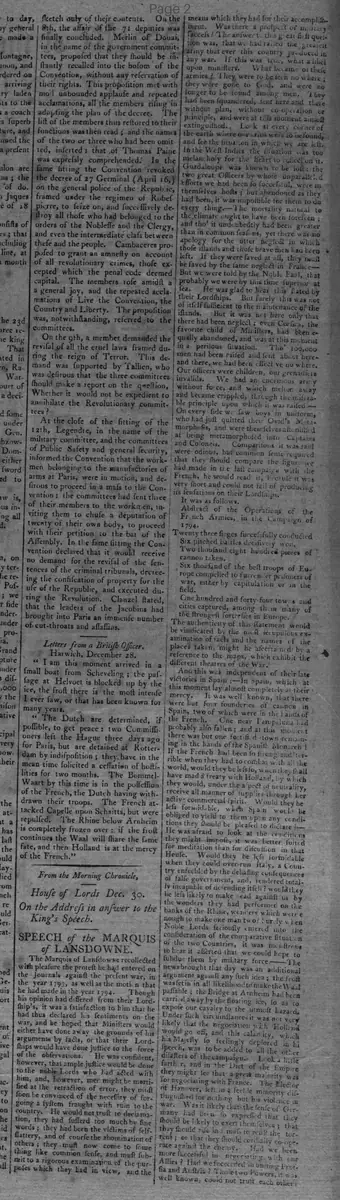
SPEECH of the MARQUIS
of LANSDOWNE.
The Marquis of Lansdowne recollected
with pleasure the protest he had entered on
the Journals against the present war, in
the year 1793, as well as the motion that
he had made in the year 1794. Though
his opinion had differed from their Lord-
ships, it was a satisfaction to him that he
had thus declared his sentiments on the
war, and he hoped that Ministers would
either have done away the grounds of his
arguments by facts, or that their Lord-
ships would have done justice to the force
of the observations. He was confident,
however, that ample justice would be done
to the noble Lords who had acted with
him, and, however, men might be mor-
tified at the retraction of error, they must
soon be convinced of the necessity of for-
going a system fraught with ruin to the
country. He would not trust to declama-
tion, they had suffered too much by fine
words; they had been the victims of self.
flattery, and of course the abomination of
others ; they must now come to some-
thing like common sense, and must sub-
mit to a rigorous examination of the pur-
poses which they had in view, and the
means which they had for their accom-
plishment. Was there a prospect of military
success? The answer to this great first ques-
tion was, that we had raised the greatest
army that ever this country produced in
any war. If this was true, what a libel
upon ministers. What became of these
armies ? They were to be seen no where;
they were gone to God, and were no
longer to be found among men. They
had been squandered, sent here and there
without plan, without co-operation or
principle, and were at this moment almost
extinguished. Look at every corner of
the earth where our arms were to be found,
and see the situation in which we are left.
In the West Indies the situation was too
melancholy for the heart to reflect on it.
Guadaloupe was known to be lost: the
two great Officers by whose unparalleled
efforts we had been so successful, were in
themselves hosts ; but abandoned as they
had been, it was impossible for them to do
every thing.—The mortality natural to
the climate ought to have been foreseen ;
and tho' it undoubtedly had been greater
than in common seasons, yet there was no
apology for the utter neglect in which
those islands and those brave men had been
left. If they were saved at all, they must
be saved by the same neglect in France---
But we were told by the Noble Earl, that
probably we were by this time superior at
sea. He was glad to hear this stated by
their Lordships. But surely this was not
of itself sufficient to the maintenance of the
islands. But it was not here only that
there had been neglect; even Corsica, the
favorite child of Ministers, had been e-
qually abandoned, and was at this moment
in a perilous situation. Tho 100,000
men had been raised and sent about here-
and there, we had been successful no where.
Our officers were children, our grenadiers
invalids. We had an enormous army
without force, and which melted away
and became crippled, through the miserable principle upon which it was raised.--
On every side we saw boys in uniform,
who had just quitted their Ovid's Me-
tamorphoses, and were themselves astonished
at being metamorphosed into Captains
and Colonels. Comparisons it was said
were odious, but common sense required
that they should compare the figure we
had made in the last campaign with the
French, he would read it, because it was
very short and could not fail of producing
its sensations on their Lordships.
It was as follows.
Abstract of the Operations of the
French Armies,, in the Campaign of
1794.
Twenty three sieges successfully conducted
Six pitched battles decisively won.
Two thousand eight hundred pieces of
cannon taken.
Six thousand of the best troops of Eu-
rope compelled to surrender prisoners of
war, either by capitulation or in the
field.
One hundred and forty-four towns and
cities captured, among them many of
the strongest fortresses in Europe.
The authenticity of this statement would
be vindicated by the most scrupulous ex-
amination of facts and the names of the
places taken, might be ascertained by a
reference to the maps, which exhibit the
different theatres of the War.'
And this was independent of their late
victories in Spain ;—In Spain, which at
this moment lay almost completely at their
mercy. It was well known, that there
were but four founderies of cannon in
Spain, two of which were in the hands of
the French. One near Pampeluna had
probably also fallen; and at this moment
there was but one fortified town remain-
ing in the hands of the Spanish Monarch !
If the French had been so strong and ter-
rible when they had to combat with all the
world, would they be less so, when they shall
have made a treaty with Holland, by which
they would, under the aspect of neutrality,
receive all manner of supplies through her
active commercial spirit. Would they be
less formidable, when Spain would be
obliged to yield to them upon any condi-
tions they should be pleased to dictate -
He was afraid to look at the conditions
they might impose, it was better suited
for meditation than for discussion in that
House. Would they be less formidable
when they could over-run Italy, a Coun-
try enfeebled by the debasing consequences
of false government, and, rendered total-
ly incapable of defending itself? would they
be less likely to make head against us by
the wonders they had performed on the
banks of the Rhine, wonders which were e-
nough to make one man two? surely when
Noble Lords seriously entered into the
consideration of the comparative situation
of the two Countries, it was monstrous
to hear it asserted that we could hope to
subdue them by military force.—The
news brought that day was an additional
argument against any such idea; the frost
was setting in all likelihood to make the Waal
passable ; the Bridge at Arnheim had been
carried away by the floating ice, so as to
expose our cavalry to the utmost hazard.
Under such circumstances it was not very
likely that the negociation with Holland
would go off, and this calamity, which
his Majesty so feelingly deplored in his
speech, was to be added to all the other
disasters of the campaign. Look a little
farther, and in the Diet of the Empire
they might see that a great majority was
for negotiating with France. The Elector
of Hanover, left in a feeble minority dis-
tinguished for nothing but his violence in
war. Was it likely that the sense of (Ger-
many had been so expressed that they
should be likely to exert themselves; that
they should rise in a mass to resist the tor-
rent; or that they should cordially co-ope-
rate against the enemy. Had we been
more successful in negotiating with our
Allies ? Had we succeeded in uniting Prus-
sia and Austria ? Those two Powers, It was
well known, could not trust each other
Prussia had in truth never been the enemy of France, and he could not be of. Those two Powers, mutually and necessarily rivals, looked only to their private interests; and who could blame them? They regarded their own country with becoming feelings, they were not their own enemies, they had not a parliament to stand between them and the people, and therefore their ministers were more careful of the advice which they gave to their masters, as the consequences must fall on their own heads.
With these sentiments, it was not to be wondered however, that they had been brought to commence the unnatural league they never had been serious friends in the contest and indeed it would not be difficult to prove, that Prussia, as he had no support but from France against the power of his rival, had never seriously been the enemy of France, the dismemberment of which would have been so fatal to himself. The third light in which this political question was to be considered, was the resources. To be sure it was pleasant to hear of 24 millions being raised in the morning. He did not mean to cry down credit, it was in its nature to do wonders while it lasted. A merchant of 30,000 pounds capital, could have more credit than a nobleman of an hereditary fortune to the same annual account. He might circulate his paper for 50 or 100,000 pounds, but it was not unusual that on some fine morning he should break. He would not enter into the discussion of the wild theories about the nature of the credit by which they strove to delude themselves; they had originated in France under its old system, and yet France had not been saved. The truth was, we might go on in the same blind path without perceiving, until we fell into the abyss to which it led. And what were the objections to treating with the French for peace? The first was too contemptible for a serious answer, with whom could we treat in France? It was a question unworthy even of a German Diet. We certainly could find persons to treat with if we had a disposition to seek them. France, with all its changes of parties, and in the midst of its most violent commotions, has not failed its engagements since the revolution, with any one foreign state. The next reason against treating was—What! should we give up our invaluable conquests? As to those invaluable conquests, one part of them, those in the West-Indies, were likely not to stand in our way—Martinique was but too probably already in the hands of the French. As to Corsica, if it had not been for this idle enterprise we might have protected our commerce, guarded our coasts, given confidence to industry, and instead of the abominable attempt to starve the French by intersepting their corn, we might have done what was, consistent with legitimate war, intercepted their naval stores, we might have saved the effusion of much human blood; but then undoubtedly, we should not have been able to have added half a dozen sinecures to the influence of the crown to be parcelled out among the men who were alarmed for the existence of the constitution. He ridiculed the idea of our debasing ourselves by the offer of peace; nothing could be more extravagant. If they were disposed to treat, they might come together without submissions on either part. He had no doubt but France would treat with the present ministers, though perhaps other men who might negotiate on better terms. He approved of their American treaty, and wished to God they would retract their error with France, as wisely as they had done with our American brethren. The noble Lord concluded by giving his hearty approbation of the amendment.
What sub-type of article is it?
What keywords are associated?
What entities or persons were involved?
Where did it happen?
Foreign News Details
Primary Location
France
Event Date
Dec. 30
Key Persons
Outcome
british armies squandered and nearly extinguished; guadaloupe lost; high mortality in west indies; corsica in peril; french successes: 23 sieges, 6 battles, 2800 cannon taken, 6000 troops surrendered, 144 towns captured; spanish foundries and towns lost to french; potential french treaty with holland; majority in german diet for negotiating with france; failed alliances with prussia and austria.
Event Details
Marquis of Lansdowne's speech criticizes British war efforts, noting lack of military success, neglect in West Indies and Corsica, French victories in 1794 campaign including sieges, battles, captures in Europe and Spain, potential French gains in Holland, Italy, Rhine; calls for rigorous examination, peace negotiations, and retraction of war policy.