Thank you for visiting SNEWPapers!
Sign up free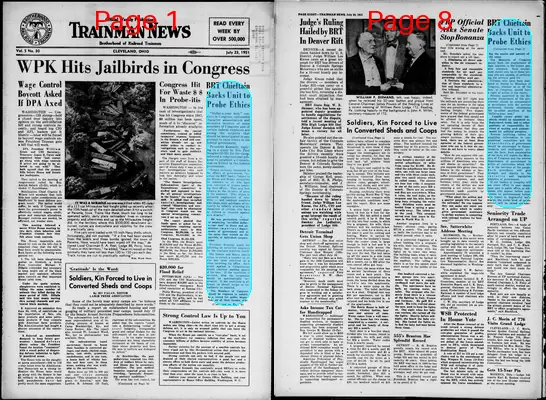
Trainman News
Indianapolis, Marion County, Indiana
What is this article about?
BRT President Kennedy endorses Sen. Paul Douglas's proposal for a congressional Commission on Ethics in the federal government. He criticizes convicts serving in Congress, excessive incomes, nepotism, character assassination, and dollar-a-year men, urging reforms like suspension of convicted members, income disclosure, limits on relative employment, and fair compensation for officials.
Merged-components note: Continuation of editorial on ethics probe across pages.
Clippings
1 of 2
OCR Quality
Full Text
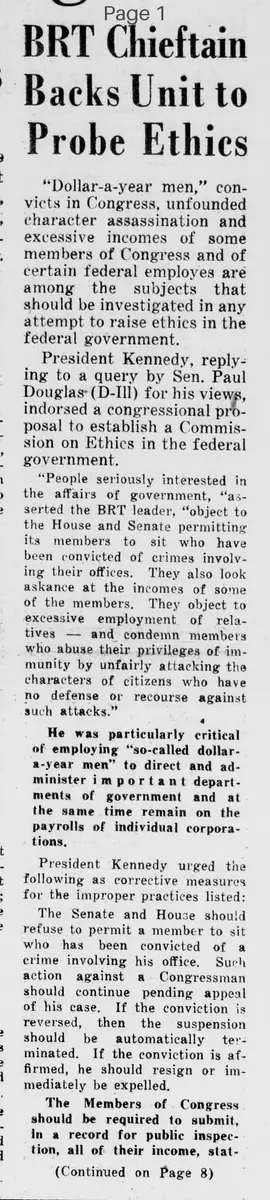
"Dollar-a-year men," convicts in Congress, unfounded character assassination and excessive incomes of some members of Congress and of certain federal employes are among the subjects that should be investigated in any attempt to raise ethics in the federal government.
President Kennedy, replying to a query by Sen. Paul Douglas (D-Ill) for his views, endorsed a congressional proposal to establish a Commission on Ethics in the federal government.
"People seriously interested in the affairs of government," asserted the BRT leader. "object to the House and Senate permitting its members to sit who have been convicted of crimes involving their offices. They also look askance at the incomes of some of the members. They object to excessive employment of relatives -- and condemn members who abuse their privileges of immunity by unfairly attacking the characters of citizens who have no defense or recourse against such attacks."
He was particularly critical of employing "so-called dollar-a-year men to direct and administer important departments of government and at the same time remain on the payrolls of individual corporations.
President Kennedy urged the following as corrective measures for the improper practices listed:
The Senate and House should refuse to permit a member to sit who has been convicted of a crime involving his office. Such action against a Congressman should continue pending appeal of his case. If the conviction is reversed, then the suspension should be automatically terminated. If the conviction is affirmed, he should resign or immediately be expelled.
The Members of Congress should be required to submit, in a record for public inspection, all of their income, stating the source and amount of the same.
The Members of Congress should limit the employment of their relatives to the lowest possible minimum. Such employment should only be of those persons who are capable of performing the services paid for.
Citizens who have been slandered or libeled by Members of Congress, whether on or off the floor of Congress, should have a right of action in the courts.
Persons appointed in the Executive Department of the government should be compensated in accordance with the services performed, thereby eliminating the so-called sacrifices of the "dollar-a-year men."
Capable career public employees should be appointed as department heads and to other positions of responsibility instead of making such appointments for political purposes.
Persons testifying before or supplying information to congressional committees and the departments of government should be encouraged to dispassionately and intelligently present the facts. Such presentation of the facts will enable the Members of Congress and the several departments of government to arrive at conclusions which will be in the interests of the people.
Such procedures will give strength and dignity to the executive and legislative branches of government.
If our leaders of integrity will use every effort to cast shame upon men in public office, or witnesses who appear before committees or governmental bodies, who resort to disgraceful techniques, the moral level of public service will be raised considerably.
What sub-type of article is it?
What keywords are associated?
What entities or persons were involved?
Editorial Details
Primary Topic
Support For Commission On Ethics In Federal Government
Stance / Tone
Strongly Supportive Of Ethics Reforms And Critical Of Congressional Misconduct
Key Figures
Key Arguments