Thank you for visiting SNEWPapers!
Sign up free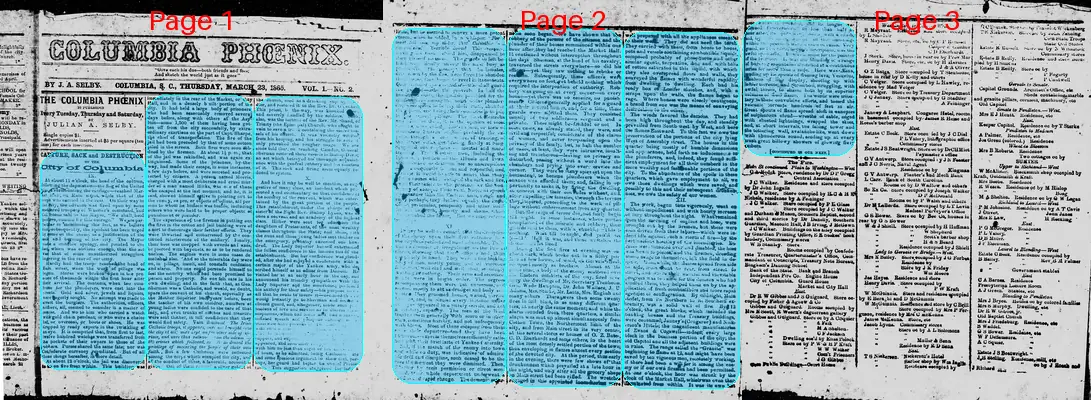
Columbia Phoenix
Columbia, Richland County, South Carolina
What is this article about?
Union troops under Gen. Sherman capture Columbia, SC, in 1865; they immediately begin pillaging stores and homes, assault citizens, and set multiple fires that destroy much of the city despite firemen's efforts.
Merged-components note: This is a continuous narrative article about the capture, sack, and destruction of Columbia, spanning pages 1-3 with sequential reading orders and direct text continuation.
Clippings
1 of 3
OCR Quality
Full Text
OF THE
City
of Columbia
IX.
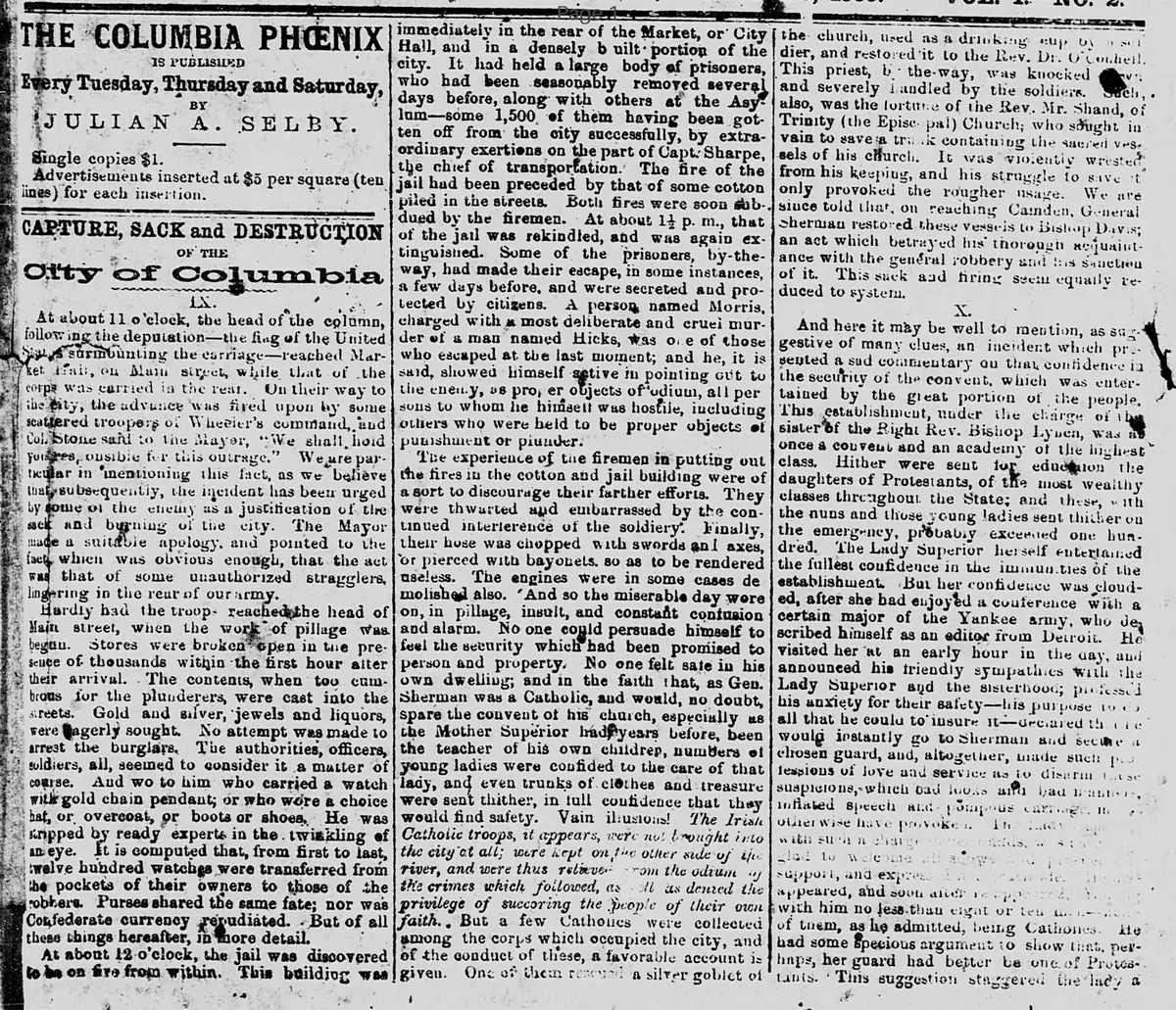
At about 11 o'clock, the head of the column, following the deputation--the flag of the United States surmounting the carriage--reached Market Hall, on Main street, while that of the corps was carried in the rear. On their way to the city, the advance was fired upon by some scattered troopers of Wheeler's command, and Col. Stone said to the Mayor, "we shall hold you responsible for this outrage. We are particular in mentioning this fact, as we believe that subsequently, the incident has been urged by some of the enemy as a justification of their sack and burning of the city. The Mayor made a suitable apology, and pointed to the fact which was obvious enough, that the act was that of some unauthorized stragglers lingering in the rear of our army.
Hardly had the troops reached the head of Main street, when the work of pillage was begun. Stores were broken open in the presence of thousands within the first hour after their arrival. The contents, when too cumbersome for the plunderers, were cast into the streets. Gold and silver, jewels and liquors, were eagerly sought. No attempt was made to arrest the burglars. The authorities, officers, soldiers, all, seemed to consider it a matter of course. And woe to him who carried a watch with gold chain pendant; or who wore a choice hat, or overcoat, or boots or shoes. He was stripped by ready experts in the twinkling of an eye. It is computed that, from first to last, twelve hundred watches were transferred from the pockets of their owners to those of the robbers. Purses shared the same fate; nor was Confederate currency repudiated. But of all these things hereafter, in more detail.
At about 12 o'clock, the jail was discovered to be on fire from within. This building was immediately in the rear of the Market, or City Hall, and in a densely built portion of the city. It had held a large body of prisoners, who had been seasonably removed several days before, along with others at the Asylum --some 1,500 of them having been gotten off from the city successfully, by extraordinary exertions on the part of Capt. Sharpe, the chief of transportation. The fire of the jail had been preceded by that of some cotton piled in the streets. Both fires were soon subdued by the firemen. At about 1 p. m., that of the jail was rekindled, and was again extinguished. Some of the prisoners, by-the-way, had made their escape, in some instances, a few days before. and were secreted and protected by citizens. A person named Morris, charged with a most deliberate and cruel murder of a man named Hicks, was one of those who escaped at the last moment; and he, it is said, showed himself active in pointing out to the enemy, as proper objects of odium, all persons to whom he himself was hostile, including others who were held to be proper objects of punishment or plunder.
The experience of the firemen in putting out the fires in the cotton and jail building were of a sort to discourage their farther efforts. They were thwarted and embarrassed by the continued interference of the soldiery. Finally, their hose was chopped with swords and axes, or pierced with bayonets, so as to be rendered useless. The engines were in some cases demolished also. And so the miserable day wore on, in pillage, insult, and constant confusion and alarm. No one could persuade himself to feel the security which had been promised to person and property. No one felt safe in his own dwelling; and in the faith that, as Gen. Sherman was a Catholic, and would, no doubt, spare the convent of his church, especially as the Mother Superior had years before, been the teacher of his own children, numbers of young ladies were confided to the care of that lady, and even trunks of clothes and treasure were sent thither, in full confidence that they would find safety. Vain illusions! The Irish Catholic troops, it appears, were not brought into the city at all; were kept on the other side of the river, and were thus relieved from the odium of the crimes which followed, as it is denied the privilege of succoring the people of their own faith. But a few Catholics were collected among the corps which occupied the city, and of the conduct of these, a favorable account is given. One of them rescued a silver goblet of the church, used as a drinking cup by a soldier, and restored it to the Rev. Dr. O'Connell. This priest, by the way, was knocked down and severely handled by the soldiers. Such, also, was the fortune of the Rev. Mr. Shand, of Trinity (the Episcopal) Church; who sought in vain to save a trunk containing the sacred vessels of his church. It was violently wrested from his keeping, and his struggle to save it only provoked the rougher usage. We are since told that, on reaching Camden, General Sherman restored these vessels to Bishop Davis; an act which betrayed his thorough acquaintance with the general robbery and sanction of it. This sack and firing seem equally reduced to system.
x.
And here it may be well to mention, as suggestive of many clues, an incident which presented a sad commentary on that confidence in the security of the convent, which was entertained by the great portion of the people. This establishment, under the charge of the sister of the Right Rev. Bishop Lynch, was at once a convent and an academy of the highest class. Hither were sent for education the daughters of Protestants, of the most wealthy classes throughout the State; and these, with the nuns and those young ladies sent thither on the emergency, probably exceeded one hundred. The Lady Superior herself entertained the fullest confidence in the immunities of the establishment. But her confidence was clouded, after she had enjoyed a conference with a certain major of the Yankee army, who described himself as an editor from Detroit. He visited her at an early hour in the day, and announced his friendly sympathies with the Lady Superior and the sisterhood; professed his anxiety for their safety--his purpose to do all that he could to insure it--declared that he would instantly go to Sherman and secure a chosen guard, and, altogether, made such professions of love and service as to disarm all suspicions, which had just a little shaded her animated speech and propitious carriage, might otherwise have provoked. In this state with such a cheat glad to welcome the aid support, and express appeared, and soon after 1 p. with him no less than eight or ten troops of them, as he admitted, being Catholics. He had some specious argument to show that, perhaps, her guard had better be one of Protestants. This suggestion staggered the lady a little, but he seemed to convey a more potent reason, when he added, in a whisper: "For I must tell you, my sister, that Columbia is doomed city! Terrible doom! This creature, never did before him, disappeared to the right and left. The guards so left behind were finally also the next busy as pick and rain. The mourners thus so in mates, drawn on by the rag. Greet three I to abandon the city to a. Their hungar to revel in its contents. Quis custodiet ipsos custodes--we shall guard the guards as well. In half the number burst ences, the guild proceeded for the city along the most oxide plunder. They are yare to to destroy their nets, abandon the ass, and to bring their comrades in to join in the sacker's pillage. The act met rous and of them. It is the opinion of most one to the civil isester men, or men of mansion eastern orrin--probably the ex-juris through art so see of training, of the inner city struggling finally at Sing-Sing other places in mental and moral their ig. The Western men, including the Isaiah portions of the Illinois and Iowa, se in horror so deep nor so unscrupulous & infrequent to him and respectful: and, perhaps, it would be safe to assume that many of the houses will escaped the sack and fire. Be theirs are to the present or the ton. The gy of some u the be men. Under of speech opinion manner than the Pantic. Like, rough, and fug perhaps, that touched equally the impo-dence, pretension, pomposity and utter ignif-ter act to reach honesty and shame, which outraged the leader. But we must replace P. S.
XI.
It may be well to remark that the discipline of the army upon their irp entrance into the city was perfect and most admirable. There was so disorder or irregularity in the line or march, showing that the city had them completely in hand. They were a fine looking body of men, mostly young and of vigorous ftation, well clad and well shod, seeming ly acting in nothing. Their arms and accoutre-ments were in bright order. The negroes accompanying them were not numerous, and seemed mostly to act as drudges and body ser-vants. They groomed horses, waited, carried Ua- gas, and, in almost every instance under appeared in a purely servile, and not s ultary, capacity. The men of the West treated them generally with scorn or in siler-cnce, sometimes harshly, and not unfrequently with blows. Most of those escaping from them re thir departure and they have been r er rol.--express themselves sufficiently satis- De with their brief taste of Yankee fraternity. i.l, if the march of the enemy into town and while on duty, was indicative of admira- ble drill and discipline such ceased to be the care the moment they were dismissed. Then, y, with their by tacit permission or direct com- mand, their whole deportment underwent a sudden change. The demon
mania soon began. We have shown that the robbery of the persons of the citizens and the plunder of their houses commenced within one hour after they had reached the Market Hall. It continued without interruption throughout the day. Sherman, at the head of his cavalry, traversed the streets everywhere--so did his officers--yet they saw nothing to rebuke or rest in. Subsequently, these officers were everywhere on foot, yet beheld nothing which required the interposition of authority. Rob-bery was going on at every corner--in every house--yet there was no censure, no punish-ment. Citizens generally applied for a guard at their houses, and, for a time, these guards were allotted them. They consisted usually of two soldiers, a sergeant and a private. There might be faithful ones in some cases, as already stated, they were and civil and respectful; considerate of the claims of women, and never trespassing upon the privacy of the family: but, in half the number of cases, at least, they were intrusive, insult- ing and treacherous, leaving no privacy un- disturbed, passing without a word into the chambers and prying into every orifice and corner. They were so many spies set upon the homestead, to become plunderers when the chance was afforded them; and, failing in op- portunity to make it, by firing the dwelling, in concert with their comrades without and, after expelling the inmates. Through the terrors they inspired, proceeding to the work of pil- lage without embarrassment from any quarter. But the reign of terror did not fairly begin till night. In some instances, where parties complained of the misrule and robbery, their guards said to them, with a chuckle: this is nothing. Wait till to night, and you'll see h--il! Hell it was, and these wretches the d-emons, all let loose innvig the first force at evening was one shou.t dark, which broke out in s fitehr par i: n Gr low houses, of wood, on Gervais street, cu npiel mostly as brothels. Almost at right same time, a body of the enemy scattered over ihr Castern outskirts of the city, fired seve r:iy the dwellings of Mr. Secretary Trenholm. Gen. Wade Hampton, Dr. John Wallace, J. U. Adams, Mrs. Starke, Mr. Latta, Mrs. English and many others. There were then some twenty ires in full blast, in as many different quarters, at nearly the same moment: and while the alarm sounded from these quarters, a similar alarm was sent up almost simultaneously from Cotton Town, the Northeastern limit of the eity, and from Main street in its very centre, at the several stores or houses of O. Z. Bates, C. D. Eberhardt and some others in the heart of the most densely settled portion of the town: thus enveloping in flames almost every section of the devoted city. At this period, thus early in the evening, there were few shows of that drunkenness which prevailed at a late hour in the night, and only after all the grocery shops on Main street had been rifled. The wretches engaged in this appointed work and saving were
well prepared with all the appliances essential to their work. They did not need the torch. They carried with them, from house to house, pots and vessels containing combustible liquids, composed probably of phosphorus and other similar agents, turpentine, &c; and, with balls of cotton saturated in this liquid, with which they also overspread floors and walls, they conveyed the flames with wonderful rapidity from dwelling to dwelling. Each had his ready box or Lucifer matches, and, with a scrape upon the walls, the flames began to rage. Where houses were closely contiguous, a brand from one was the means of conveying destruction to the other t P. The winds favored the demons. They had been high throughout the day, and steadily prevailed from South-west by West and bore the flames Eastward. To this fact we owe the preservation of the portions of the city lying West of Assembly street. The houses in this quarter being mostly of humble dimensions and appearance, held forth no inducements to the plunderers and indeed they found sufficient employment for all their numbers in the more wealthy and fashionable portion of the city. To the abundance of the spoils in these quarters, which gave employment to all, we owe those dwellings which were saved: and possibly to this and their subsequent drunken- ness, we owe the safety of our women.
XII.
The work, began thus vigorously, went on without impediment and with hourly increase of fury throughout the night. What remained troun the morning of engines and hose, were brought out by the firemen, but these were soon driven from their labors --which were indeed idle against such a storm of fire--by the pertinacious hostility of the incendiaries. Engines were tumbled over and disabled, the hose was hewn to pieces, and the firemen, dreading usage to themselves, left the field in despair. Meanwhile, the flames spread from side to side, from front to rear, from street to street, and where their natural and inevitable progress was too slow for the demons who had kindled them, they helped them on by the ap- plication of fresh combustibles and more rapid urgencies of conflagration. By midnight, Main -street, from its Northern to its Southern er- tremity, was a solid wall of fire. By 1 o'clock, the great blocks which included the banking houses and the Treasury buildings, were consumed: Jumper's (Congaree) and Nickerson's Hotels; the magnificent manufactories of Evans & Cogswell --indeed, every large block in the business portion of the city; the old Capitol and all the adjacent buildings were in ruins. The bridge called the "Granite" w&s beginning to flame at 12 and might have been saved by ten vigorous men, resolutely working, if there had been a will for it among the ene- my or if our own firemen had been permitted. At one o'clock, the hour was struck by the clock of the Market Hall, which was even then smoking from within. It was its own last
The power which it assumed was something unheard of, and its tongue was lengthened more and more in this direction half a long after. Its spire ran thus with a crash, and by its big arch all the buildings within thy precincts so a toss of ruins. Very grand, in its terrified description, was the awful spectacles. It was a scene for the painter of the terrible. It was like the bleeding of a range of burning mountains presented as a continuous series for more than a mile. Here was Aetna, ending up its spouts of flaming lava; Vesuvius, tumultuous of the display, shooting up with loftier torrents; and Stromboli, struggling with awful fires, to shame both by its superior volumes by the same. The winds were strong to these convulsive efforts, and tossed the volcanic currents hundreds of feet in air. Great spouts of flame spread aloft in canopies of sulphureous cloud—wreaths of sable, edged with sheeted lightnings, wrapped the skies, and, at short intervals, the falling tower and the tottering wall avalanche-like, went down with thunderous sound, sending up at every crash great billowy showers of glowing fiery embers.
[CONTINUED IN OUR NEXT.]
What sub-type of article is it?
What themes does it cover?
What keywords are associated?
What entities or persons were involved?
Where did it happen?
Story Details
Key Persons
Location
City Of Columbia
Story Details
Union troops under Gen. Sherman enter Columbia, SC, face initial resistance, then systematically pillage homes and stores, assault citizens including clergy, and ignite multiple fires using combustibles, destroying much of the city despite fire suppression attempts; the narrative details the day's events leading to nighttime inferno.