Thank you for visiting SNEWPapers!
Sign up free
Literary
June 6, 1879
The Benton Record
Fort Benton, Chouteau County, Montana
What is this article about?
Eustace St. James, a wealthy orphan, fakes financial ruin after the 1873 crash to test his fiancée Eunice Hildreth's love and his friends' loyalty. Society abandons him; Eunice rejects him in poverty due to pride, leading to her despair when he reveals the ruse too late.
Clipping
OCR Quality
95%
Excellent
Full Text
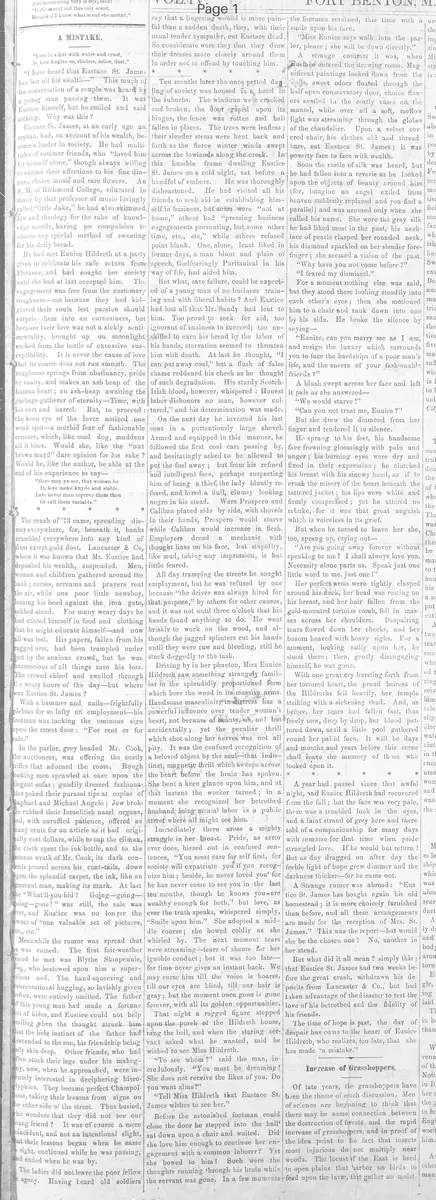
A MISTAKE.
"Love in a hut with water and crust,
Is, love forgive us, cinders, ashes, dust."
"I have heard that Eustace St. James
has lost all his wealth—"
This much of
the conversation of a couple was heard by
a young man passing them. It was
Eustace himself, but he smiled and said
nothing. Why was this?
Eustace St. James, at an early age an
orphan, had, on account of his wealth, be-
come a leader in society. He had multi-
tudes of summer friends, who "loved him
for himself alone," though always willing
to extend their affections to his fine din-
ners, choice music and rare flowers. An
A. M. of Richmond College, educated in
music by that professor of music lovingly
called "little Jake," he had also skimmed
law and theology for the sake of knowl-
edge merely, having no compulsion to
choose any special method of sweating
for his daily bread.
He had met Eunice Hildreth at a party
given to celebrate his safe return from
Florence, and had sought her society
until she had at last accepted him. The
engagement was free from the customary
roughness—not because they had kid-
gloved their souls lest passion should
surprise them into an earnestness, but
because their love was not a sickly senti-
mentality, brought up on moonlight
sucked from the bottle of excessive sus-
ceptibility. It is never the cause of love
that its course does not run smooth. The
roughness springs from obstinacy, pride
or vanity, and makes an ash heap of the
human heart; an ash-heap awaiting the
garbage gatherer of eternity—Time, with
his cart and barrel. But, to proceed:
the keen eye of the lover noticed one
weak spot—a morbid fear of fashionable
censure, which, like mad dog, maddens
all it bites. Would she, like the "nut
brown maid" dare opinion for his sake?
Would he, like the author, be able at the
end of his experience to say—
"Here may ye see, that woman ba
In love meke knyde and stable.
Late never man reprove them then
Or call them variable."
The crash of '73 came, spreading dis-
may everywhere, for, beneath it, banks
crumbled everywhere into any kind of
dust except gold dust. Lancaster & Co.
where it was known that Mr. Eustace had
deposited his wealth, suspended. Men,
woman and children gathered around the
bank; curses, screams and prayers rent
the air, while one poor little newsboy,
leaning his head against the iron gate,
sobbed aloud. For many weary days he
had stinted himself in food and clothing
that he might educate himself—and now
all was lost. His papers, fallen from his
ragged arm, had been trampled under
foot by the anxious crowd, but he was
unconscious of all things save his loss.
The crowd ebbed and swelled through
the weary hours of the day—but where
was Eustace St. James?
With a hammer and nails—frightfully
plebeian for so lofty an employment—his
footman was tacking the ominous sign
upon the street door: "For rent or for
sale."
In the parlor, grey headed Mr. Cook,
the auctioneer, was offering the costly
rifles that adorned the room. Rough
looking men sprawled at ease upon the
elegant sofas; gaudily dressed fashiona-
bles poked their parasol tips at copies of
Raphael and Michael Angelo; Jew brok-
ers rubbed their Israelitish nasal organs,
and, with unruffled patience, offered as
many cents for an article as it had origi-
nally cost dollars, while to cap the climax,
the clerk upset the ink bottle, and to the
intense wrath of Mr. Cook, its dark con-
tents poured across his coat-tails, down
upon the splendid carpet, the ink, like an
ignorant man, making its mark. At last
the "What'll-you-bid? Going—going—
going—gone!" was still, the sale was
over, and Eustace was no longer the
owner of "one valuable set of pictures,
etc., etc."
Meanwhile the rumor was spread that
he was ruined. The first fair-weather
friend he met was Blythe Skinpennie,
Esq., who bestowed upon him a super-
fluous nod. The hand-squeezing and
conversational hugging, so lavishly given
before, were entirely omitted. The father
of this young man had made a fortune
out of hides, and Eustace could not help
smiling when the thought struck him
that the hide instinct of the father had
descended to the son, his friendship being
only skin-deep.
Other friends, who had
often stuck their legs under his mahog-
any, now, when he approached, were in-
tensely interested in deciphering hiero-
glyphics. They became perfect Champol-
lions, taking their lessons from signs on
the other side of the street. Thus busied,
they wonders that they did not see our
young friend? It was of course a mere
coincident, and not an intentional slight,
that their lessons began when he came
sight, continued while he was passing,
and ended when he was by.
The ladies did not leave the poor fellow
in agony. Having heard old soldiers
say that a lingering wound is more pain-
ful than a sudden death, they, with their
usual tender sympathy, cut Eustace dead.
So considerate were they that they drew
their dresses more closely around them
in order not to offend by touching him.
Ten months later the once petted dar-
ling of society was housed in a hotel in
the suburbs. The windows were cracked
and broken, the door gaped upon its
hinges, the fence was rotten and half
fallen in places. The trees were leafless;
their slender stems were bent back and
forth as the fierce winter winds swept
across the lowlands along the creek. In
this humble frame dwelling Eustace
St. James on a cold night, sat before a
handful of embers. He was thoroughly
disheartened. He had visited all his
friends to seek aid in establishing him-
self in business, but some were "not at
home," others had "pressing business
engagements preventing, but some other
time, etc., etc," while others refused
point blank. One, alone, least liked in
former days, a man blunt and plain of
speech, God-fearing Puritanical in his
way of life, had aided him.
But what, save failure, could be expect-
ed of a young man of no business train-
ing and with liberal habits? And Eustace
had lost all that Mr. Sandy had lent to
him. Too proud to seek for aid, too
ignorant of business to succeed; too un-
skilled to earn his bread by the labor of
his hands, starvation seemed to threaten
him with death. At last he thought, "I
can put away coal," but a flush of false
shame reddened his cheek as he thought
of such degradation. His sturdy Scotch-
Irish blood, however, whispered: Honest
labor dishonors no man, however cul-
tured," and his determination was made.
On the next day he invested his last
cent in a portentously large shovel.
Armed and equipped in this manner, he
followed the first coal cart passing by.
and hesitatingly asked to be allowed to
put the fuel away; but from his refined
and intelligent face, perhaps suspecting
him of being a thief, the lady bluntly re-
fused, and hired a dull, clumsy looking
negro in his stead. Were Prospero and
Caliban placed side by side, with shovels
in their hands, Prospero would starve
while Caliban would increase in flesh.
Employers dread a mechanic with
thought lines on his face, but stupidity,
like mud, taking any impression, is but
little feared.
All day tramping the streets he sought
employment, but he was refused by one
because "the driver was always hired for
that purpose," by others for other causes,
and it was not until three o'clock that his
hands found anything to do. He went
briskly to work on the wood, and al-
though the jagged splinters cut his hands
until they were raw and bleeding, still he
stuck doggedly to the task.
Driving by in her phaeton, Miss Eunice
Hildreth saw something strangely famil-
iar in the splendidly proportioned form
which bore the wood in its massive arms.
Handsome masculinity in distress has a
powerful influence over tender woman's
heart, not because of beauty, oh, no! but
accidentally; yet the peculiar thrill
which shot along her nerves was not all
pity. It was the confused recognition of
a beloved object by the soul—that indis-
tinct, magnetic thrill which sweeps across
the heart before the brain has spoken.
She bent a keen glance upon him, and at
that instant the worker turned; in a
moment she recognized her betrothed
husband doing menial labor in a public
street where all might see him.
Immediately there arose a mighty
struggle in her breast. Pride, as error
ever does, hissed out in confused sen-
tences, "You must care for self first, for
society will expatriate you if you recog-
nize him; beside, he never loved you' for
he has never come to see you in the last
ten months, though he knows you are
wealthy enough for both," but love, as
ever the truth speaks, whispered simply,
"Smile upon him." She adopted a mid-
dle course; she bowed coldly as she
whirled by. The next moment tears
were streaming—tears of shame for her
ignoble conduct; but it was too late—
for time never gives an instant back. We
may curse him till the voice is hoarse,
till our eyes are blind, till our hair is
gray; but the moment once gone is gone
forever, with all its golden opportunities.
That night a ragged figure stepped
upon the porch of the Hildreth house,
rang the bell, and when the staring ser-
vant asked what he wanted, said he
wished to see Miss Hildreth.
"To see whom?" said the man, in-
credulously. "You must be dreaming!
She does not receive the likes of you. Do
you want alms?"
"Tell Miss Hildreth that Eustace St.
James wishes to see her."
Before the astonished footman could
close the door he stepped into the hall,
sat down upon a chair and waited. Did
she love him enough to continue her en-
gagement with a common laborer? Yet
she bowed to him! Such were the
thoughts running through his brain while
the servant was gone. In a few moments
the footman returned, this time with a
smile upon his face.
"Miss Eunice says walk into the par-
lor, please; she will be down directly."
A strange contrast it was, when
Eustace entered the drawing room. Mag-
nificent paintings looked down from the
walls, sweet odors floated through the
half open conservatory door, choice flow-
ers nestled in the costly vases on the
mantel, while over all a soft, mellow
light was streaming through the globes
of the chandelier. Upon a velvet cov-
ered chair, his clothes old and thread-
bare, sat Eustace St. James; it was
poverty face to face with wealth.
Soon the rustle of silk was heard, but
he had fallen into a reverie as he looked
upon the objects of beauty around him
(for, imagine an angel exiled from
heaven suddenly replaced and you find a
parallel) and was aroused only when she
called his name. She wore the gray silk
he had liked most in the past, his neck-
lace of pearls clasped her rounded neck,
his diamond sparkled on her slender fore-
finger; she seemed a vision of the past.
"Why have you not come before?"
"I feared my dismissal."
For a moment nothing else was said,
but they stood there looking steadily into
each other's eyes; then she motioned
him to a chair and sank down into one
by his side. He broke the silence by
saying—
"Eunice, can you marry me as I am
and resign the luxury which surrounds
you to face the hardships of a poor man's
life, and the sneers of your fashionable
friends?"
A blush swept across her face and left
it pale as she answered
"We would starve!"
"Can you not trust me, Eunice?"
But she drew the diamond from her
finger and tendered it in silence.
He sprang to his feet, his handsome
face frowning gloomily with pain and
anger; his burning eyes were dry and
fixed in their expression; he clutched
his breast with his sinewy hand, as if to
crush the misery of the heart beneath the
tattered jacket; his lips were white and
firmly compressed; yet he uttered no
rebuke, for it was that great anguish
which is voiceless in its grief.
But when he turned to leave her she,
too, sprang up, crying out—
"Are you going away forever without
speaking to me? I shall always love you.
Necessity alone parts us. Speak just one
little word to me, just one!"
Her perfect arms were tightly clasped
around his neck, her head was resting on
his breast, and her hair fallen from the
gold-mounted tortoise comb, fell in mas-
ses across her shoulders. Despairing
tears flowed down her cheeks, and her
bosom heaved with heavy sighs. For a
moment, looking sadly upon her, he
stood there; then, gently disengaging
himself, he was gone.
With one great cry bursting forth from
her tortured heart, the proud heiress of
the Hildreths fell heavily, her temple
striking with a sickening thud. And, as
before, her tears had fallen fast, thus
freely now, drop by drop, her blood pat-
tered down, until a little pool gathered
round her pallid face. It will be days
and months and years before this scene
shall leave the memory of those who
looked upon it.
A year had passed since that awful
night, and Eunice Hildreth had recovered
from the fall; but the face was very pale
there was a troubled look in the eyes
and a faint strand of grey here and there
told of a companionship for many days
with remorse for that time when pride
strangled love. If he would but return!
But as day dragged on after day the
feeble light of hope grew dimmer and the
darkness thicker—for he came not.
A strange rumor was abroad: "Eustace St. James has bought again his old
homestead; it is more choicely furnished
than before, and all these arrangements
are made for the reception of Mrs. St.
James." This was the report—but would
she be the chosen one? No, another in
her stead.
But what did it all mean? simply this;
that Eustace St. James had two weeks be-
fore the great crash, withdrawn his de-
posits from Lancaster & Co., but had
taken advantage of the disaster to test the
love of his betrothed and the fidelity of
his friends.
The time of hope is past, the day of
despair has come to the heart of Eunice
Hildreth, who realizes, too late, that she
has made "a mistake."
"Love in a hut with water and crust,
Is, love forgive us, cinders, ashes, dust."
"I have heard that Eustace St. James
has lost all his wealth—"
This much of
the conversation of a couple was heard by
a young man passing them. It was
Eustace himself, but he smiled and said
nothing. Why was this?
Eustace St. James, at an early age an
orphan, had, on account of his wealth, be-
come a leader in society. He had multi-
tudes of summer friends, who "loved him
for himself alone," though always willing
to extend their affections to his fine din-
ners, choice music and rare flowers. An
A. M. of Richmond College, educated in
music by that professor of music lovingly
called "little Jake," he had also skimmed
law and theology for the sake of knowl-
edge merely, having no compulsion to
choose any special method of sweating
for his daily bread.
He had met Eunice Hildreth at a party
given to celebrate his safe return from
Florence, and had sought her society
until she had at last accepted him. The
engagement was free from the customary
roughness—not because they had kid-
gloved their souls lest passion should
surprise them into an earnestness, but
because their love was not a sickly senti-
mentality, brought up on moonlight
sucked from the bottle of excessive sus-
ceptibility. It is never the cause of love
that its course does not run smooth. The
roughness springs from obstinacy, pride
or vanity, and makes an ash heap of the
human heart; an ash-heap awaiting the
garbage gatherer of eternity—Time, with
his cart and barrel. But, to proceed:
the keen eye of the lover noticed one
weak spot—a morbid fear of fashionable
censure, which, like mad dog, maddens
all it bites. Would she, like the "nut
brown maid" dare opinion for his sake?
Would he, like the author, be able at the
end of his experience to say—
"Here may ye see, that woman ba
In love meke knyde and stable.
Late never man reprove them then
Or call them variable."
The crash of '73 came, spreading dis-
may everywhere, for, beneath it, banks
crumbled everywhere into any kind of
dust except gold dust. Lancaster & Co.
where it was known that Mr. Eustace had
deposited his wealth, suspended. Men,
woman and children gathered around the
bank; curses, screams and prayers rent
the air, while one poor little newsboy,
leaning his head against the iron gate,
sobbed aloud. For many weary days he
had stinted himself in food and clothing
that he might educate himself—and now
all was lost. His papers, fallen from his
ragged arm, had been trampled under
foot by the anxious crowd, but he was
unconscious of all things save his loss.
The crowd ebbed and swelled through
the weary hours of the day—but where
was Eustace St. James?
With a hammer and nails—frightfully
plebeian for so lofty an employment—his
footman was tacking the ominous sign
upon the street door: "For rent or for
sale."
In the parlor, grey headed Mr. Cook,
the auctioneer, was offering the costly
rifles that adorned the room. Rough
looking men sprawled at ease upon the
elegant sofas; gaudily dressed fashiona-
bles poked their parasol tips at copies of
Raphael and Michael Angelo; Jew brok-
ers rubbed their Israelitish nasal organs,
and, with unruffled patience, offered as
many cents for an article as it had origi-
nally cost dollars, while to cap the climax,
the clerk upset the ink bottle, and to the
intense wrath of Mr. Cook, its dark con-
tents poured across his coat-tails, down
upon the splendid carpet, the ink, like an
ignorant man, making its mark. At last
the "What'll-you-bid? Going—going—
going—gone!" was still, the sale was
over, and Eustace was no longer the
owner of "one valuable set of pictures,
etc., etc."
Meanwhile the rumor was spread that
he was ruined. The first fair-weather
friend he met was Blythe Skinpennie,
Esq., who bestowed upon him a super-
fluous nod. The hand-squeezing and
conversational hugging, so lavishly given
before, were entirely omitted. The father
of this young man had made a fortune
out of hides, and Eustace could not help
smiling when the thought struck him
that the hide instinct of the father had
descended to the son, his friendship being
only skin-deep.
Other friends, who had
often stuck their legs under his mahog-
any, now, when he approached, were in-
tensely interested in deciphering hiero-
glyphics. They became perfect Champol-
lions, taking their lessons from signs on
the other side of the street. Thus busied,
they wonders that they did not see our
young friend? It was of course a mere
coincident, and not an intentional slight,
that their lessons began when he came
sight, continued while he was passing,
and ended when he was by.
The ladies did not leave the poor fellow
in agony. Having heard old soldiers
say that a lingering wound is more pain-
ful than a sudden death, they, with their
usual tender sympathy, cut Eustace dead.
So considerate were they that they drew
their dresses more closely around them
in order not to offend by touching him.
Ten months later the once petted dar-
ling of society was housed in a hotel in
the suburbs. The windows were cracked
and broken, the door gaped upon its
hinges, the fence was rotten and half
fallen in places. The trees were leafless;
their slender stems were bent back and
forth as the fierce winter winds swept
across the lowlands along the creek. In
this humble frame dwelling Eustace
St. James on a cold night, sat before a
handful of embers. He was thoroughly
disheartened. He had visited all his
friends to seek aid in establishing him-
self in business, but some were "not at
home," others had "pressing business
engagements preventing, but some other
time, etc., etc," while others refused
point blank. One, alone, least liked in
former days, a man blunt and plain of
speech, God-fearing Puritanical in his
way of life, had aided him.
But what, save failure, could be expect-
ed of a young man of no business train-
ing and with liberal habits? And Eustace
had lost all that Mr. Sandy had lent to
him. Too proud to seek for aid, too
ignorant of business to succeed; too un-
skilled to earn his bread by the labor of
his hands, starvation seemed to threaten
him with death. At last he thought, "I
can put away coal," but a flush of false
shame reddened his cheek as he thought
of such degradation. His sturdy Scotch-
Irish blood, however, whispered: Honest
labor dishonors no man, however cul-
tured," and his determination was made.
On the next day he invested his last
cent in a portentously large shovel.
Armed and equipped in this manner, he
followed the first coal cart passing by.
and hesitatingly asked to be allowed to
put the fuel away; but from his refined
and intelligent face, perhaps suspecting
him of being a thief, the lady bluntly re-
fused, and hired a dull, clumsy looking
negro in his stead. Were Prospero and
Caliban placed side by side, with shovels
in their hands, Prospero would starve
while Caliban would increase in flesh.
Employers dread a mechanic with
thought lines on his face, but stupidity,
like mud, taking any impression, is but
little feared.
All day tramping the streets he sought
employment, but he was refused by one
because "the driver was always hired for
that purpose," by others for other causes,
and it was not until three o'clock that his
hands found anything to do. He went
briskly to work on the wood, and al-
though the jagged splinters cut his hands
until they were raw and bleeding, still he
stuck doggedly to the task.
Driving by in her phaeton, Miss Eunice
Hildreth saw something strangely famil-
iar in the splendidly proportioned form
which bore the wood in its massive arms.
Handsome masculinity in distress has a
powerful influence over tender woman's
heart, not because of beauty, oh, no! but
accidentally; yet the peculiar thrill
which shot along her nerves was not all
pity. It was the confused recognition of
a beloved object by the soul—that indis-
tinct, magnetic thrill which sweeps across
the heart before the brain has spoken.
She bent a keen glance upon him, and at
that instant the worker turned; in a
moment she recognized her betrothed
husband doing menial labor in a public
street where all might see him.
Immediately there arose a mighty
struggle in her breast. Pride, as error
ever does, hissed out in confused sen-
tences, "You must care for self first, for
society will expatriate you if you recog-
nize him; beside, he never loved you' for
he has never come to see you in the last
ten months, though he knows you are
wealthy enough for both," but love, as
ever the truth speaks, whispered simply,
"Smile upon him." She adopted a mid-
dle course; she bowed coldly as she
whirled by. The next moment tears
were streaming—tears of shame for her
ignoble conduct; but it was too late—
for time never gives an instant back. We
may curse him till the voice is hoarse,
till our eyes are blind, till our hair is
gray; but the moment once gone is gone
forever, with all its golden opportunities.
That night a ragged figure stepped
upon the porch of the Hildreth house,
rang the bell, and when the staring ser-
vant asked what he wanted, said he
wished to see Miss Hildreth.
"To see whom?" said the man, in-
credulously. "You must be dreaming!
She does not receive the likes of you. Do
you want alms?"
"Tell Miss Hildreth that Eustace St.
James wishes to see her."
Before the astonished footman could
close the door he stepped into the hall,
sat down upon a chair and waited. Did
she love him enough to continue her en-
gagement with a common laborer? Yet
she bowed to him! Such were the
thoughts running through his brain while
the servant was gone. In a few moments
the footman returned, this time with a
smile upon his face.
"Miss Eunice says walk into the par-
lor, please; she will be down directly."
A strange contrast it was, when
Eustace entered the drawing room. Mag-
nificent paintings looked down from the
walls, sweet odors floated through the
half open conservatory door, choice flow-
ers nestled in the costly vases on the
mantel, while over all a soft, mellow
light was streaming through the globes
of the chandelier. Upon a velvet cov-
ered chair, his clothes old and thread-
bare, sat Eustace St. James; it was
poverty face to face with wealth.
Soon the rustle of silk was heard, but
he had fallen into a reverie as he looked
upon the objects of beauty around him
(for, imagine an angel exiled from
heaven suddenly replaced and you find a
parallel) and was aroused only when she
called his name. She wore the gray silk
he had liked most in the past, his neck-
lace of pearls clasped her rounded neck,
his diamond sparkled on her slender fore-
finger; she seemed a vision of the past.
"Why have you not come before?"
"I feared my dismissal."
For a moment nothing else was said,
but they stood there looking steadily into
each other's eyes; then she motioned
him to a chair and sank down into one
by his side. He broke the silence by
saying—
"Eunice, can you marry me as I am
and resign the luxury which surrounds
you to face the hardships of a poor man's
life, and the sneers of your fashionable
friends?"
A blush swept across her face and left
it pale as she answered
"We would starve!"
"Can you not trust me, Eunice?"
But she drew the diamond from her
finger and tendered it in silence.
He sprang to his feet, his handsome
face frowning gloomily with pain and
anger; his burning eyes were dry and
fixed in their expression; he clutched
his breast with his sinewy hand, as if to
crush the misery of the heart beneath the
tattered jacket; his lips were white and
firmly compressed; yet he uttered no
rebuke, for it was that great anguish
which is voiceless in its grief.
But when he turned to leave her she,
too, sprang up, crying out—
"Are you going away forever without
speaking to me? I shall always love you.
Necessity alone parts us. Speak just one
little word to me, just one!"
Her perfect arms were tightly clasped
around his neck, her head was resting on
his breast, and her hair fallen from the
gold-mounted tortoise comb, fell in mas-
ses across her shoulders. Despairing
tears flowed down her cheeks, and her
bosom heaved with heavy sighs. For a
moment, looking sadly upon her, he
stood there; then, gently disengaging
himself, he was gone.
With one great cry bursting forth from
her tortured heart, the proud heiress of
the Hildreths fell heavily, her temple
striking with a sickening thud. And, as
before, her tears had fallen fast, thus
freely now, drop by drop, her blood pat-
tered down, until a little pool gathered
round her pallid face. It will be days
and months and years before this scene
shall leave the memory of those who
looked upon it.
A year had passed since that awful
night, and Eunice Hildreth had recovered
from the fall; but the face was very pale
there was a troubled look in the eyes
and a faint strand of grey here and there
told of a companionship for many days
with remorse for that time when pride
strangled love. If he would but return!
But as day dragged on after day the
feeble light of hope grew dimmer and the
darkness thicker—for he came not.
A strange rumor was abroad: "Eustace St. James has bought again his old
homestead; it is more choicely furnished
than before, and all these arrangements
are made for the reception of Mrs. St.
James." This was the report—but would
she be the chosen one? No, another in
her stead.
But what did it all mean? simply this;
that Eustace St. James had two weeks be-
fore the great crash, withdrawn his de-
posits from Lancaster & Co., but had
taken advantage of the disaster to test the
love of his betrothed and the fidelity of
his friends.
The time of hope is past, the day of
despair has come to the heart of Eunice
Hildreth, who realizes, too late, that she
has made "a mistake."
What sub-type of article is it?
Prose Fiction
What themes does it cover?
Love Romance
Social Manners
Moral Virtue
What keywords are associated?
Love Test
Social Prejudice
Financial Ruin
False Poverty
Romantic Betrayal
Literary Details
Title
A Mistake.
Key Lines
"Love In A Hut With Water And Crust, Is, Love Forgive Us, Cinders, Ashes, Dust."
"We Would Starve!"
The Time Of Hope Is Past, The Day Of Despair Has Come To The Heart Of Eunice Hildreth, Who Realizes, Too Late, That She Has Made "A Mistake."